
Lieferung heute & morgen

Qualitätsgarantie

Willkommens-Angebote freischalten: KOSTENLOSE Lieferung | Bis zu 80 % RABATT | Kostenlose 30-Tage-JoyPlus-Testphase
App herunterladen
Solar garden lights don’t need a permanent electricity supply and can usually be placed outdoors without any tools. However, not every model will provide the right lighting for your needs. The key factors are location, IP rating, light colour, battery capacity and the light’s intended purpose: a small decorative light for a flowerbed has different requirements from a solar light for a frequently used path.
The term “weatherproof” doesn’t tell you much on its own. The IP rating indicates how well a product is protected against solid objects and water. IP44, for example, means protection against solid objects larger than 1 mm and splashing water. A light with this rating is suitable for a sheltered outdoor area, but shouldn’t be left standing in puddles or submerged. For exposed locations, a higher rating such as IP65 may be more suitable.
The stated lighting time is generally based on suitable charging conditions. Shade from walls, trees or balconies reduces the energy collected by the solar panel. Short winter days and cloudy weather also affect how long the light stays on. If you’re buying solar stake lights, check that the panel will receive several hours of direct daylight.
Many LED solar lights are designed to create a subtle atmosphere. Warm white solar lights at around 2700 K give a soft glow and are well suited to flowerbeds, patios and seating areas. For evenly lighting a path, spacing, light height and luminous flux are more important. RGB solar lights add a splash of colour, but won’t necessarily replace functional outdoor lighting.
For lawns, flowerbeds and paths, the light must at least be rated by the manufacturer as suitable for outdoor use. As well as checking the IP rating, look at the construction. Plastic housings are lightweight and easy to position, while stainless steel surfaces offer a different look. Products with a stainless steel finish may still have a plastic base material, so read the product description carefully.
Solar lights with a battery store the energy collected during the day. Figures such as 4 to 6 hours’ charging time and 8 to 12 hours’ lighting time depend on sunlight, panel orientation and battery condition. Also check the battery type, such as Ni-MH or lithium-ion, and whether it can be replaced. If you’ll use the light mainly at certain times of year, a model with an easily accessible battery may be more practical in the long term.
The models below suit a range of requirements, from a simple solar garden light to smart outdoor lighting with RGB+CCT functionality.
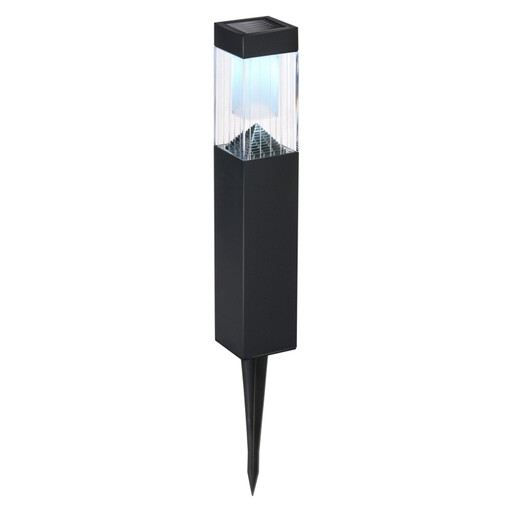
Why this product suits these needs: Its classic ground-stake design is intended for simple markers along garden paths, driveways or lawns. The light is cordless and, according to the product description, switches on automatically when it gets dark.
The design skips unnecessary app and colour options, keeping things simple with two LEDs and a built-in battery.
Cordless installation with a ground stake, a black housing and automatic lighting according to the product details.
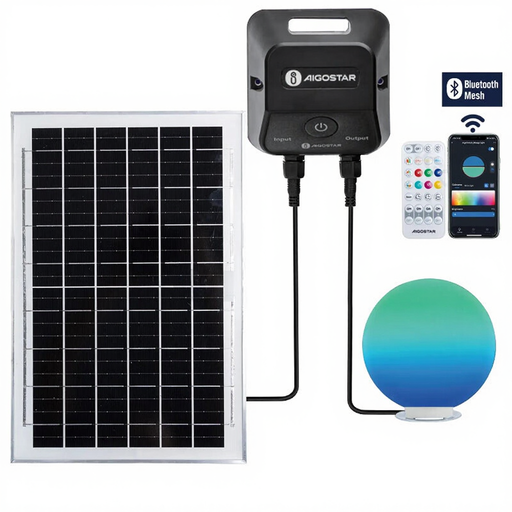
Why this product suits these needs: This floor lamp is designed for larger patios, outdoor living areas or more structured garden lighting. According to the product details, it offers RGB and white light between 2700 K and 6500 K, as well as Bluetooth Mesh control.
The IP65 rating is clearly stated. The technical details also specify the battery, charging time, luminous flux and operating temperature.
Lithium battery with a stated capacity of 8000 mAh, RGB+CCT lighting, a 120° beam angle and Bluetooth Mesh control for multiple lights.
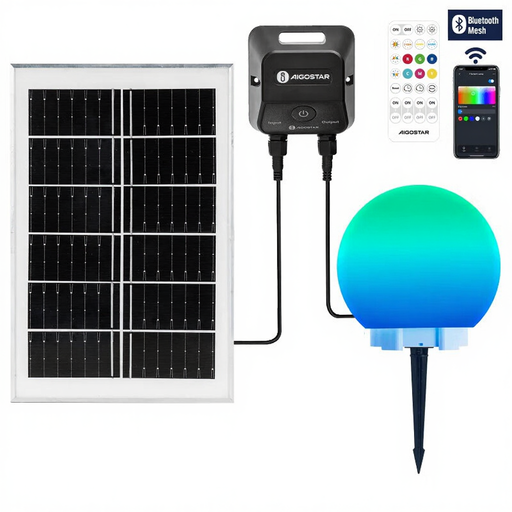
Why this product suits these needs: This smart solar garden light is designed for anyone who wants to group, dim or schedule several light sources using the AigoSmart app. RGB+CCT provides coloured, warm white and cool white light.
The control options are clearly specified. The product description also lists IP54 and IP44 ratings, so the light shouldn’t be used where water can collect around it.
Bluetooth Mesh for multiple devices, RGB+CCT from 2700–6500 K and app control with scheduling and grouping, according to the product details.
We’ve put together a complete, regularly updated list of products that meet these strict selection criteria and the safety regulations in force in the EU.
Position the solar panel where it will get as much sunlight as possible, and angle it upwards. Solar ground lights should be installed where they won’t be left standing in water. For solar path lights, even spacing is best to avoid isolated pools of light.
Clean the panel regularly with a soft, damp cloth. Don’t use abrasive cleaning products. If there’s a frost or you won’t be using the light for an extended period, follow the manufacturer’s guidance on storage and battery care. Don’t continue using lights with damaged housings or cables.
It depends on the panel, battery, sunlight and temperature. Some of the models mentioned are rated for 8 to 12 hours of light. These figures assume suitable charging conditions and may be lower in winter or after extended periods of cloudy weather.
Models with an IP44 rating are protected against splashing water, but aren’t designed to be submerged. A light with a higher rating, such as IP65, may be more suitable for a very exposed location. Check the specific IP rating before you buy.
No. Solar lights charge their built-in battery through the solar panel and don’t need to be connected to the mains for normal use. However, the amount of energy they collect depends on their location, the time of year, panel orientation and shade.