
Lieferung heute & morgen

Qualitätsgarantie

Willkommens-Angebote freischalten: KOSTENLOSE Lieferung | Bis zu 80 % RABATT | Kostenlose 30-Tage-JoyPlus-Testphase
App herunterladen
Solar garden lights are a practical way to illuminate outdoor spaces without fixed wiring. A solar panel charges the battery during the day, and the light switches on automatically at dusk, depending on the model. There are options to suit gardeners, homeowners and tenants alike: solar lights for the garden with ground spikes, solar ground lights, solar path lights, or decorative lights for patios and flower beds.
To avoid being disappointed soon after buying, it’s worth looking beyond the basics. Design and light colour matter, but so do the IP rating, battery, location and materials.
The term weather-resistant solar lights is widely used by retailers. The stated IP rating gives you more useful information. Models with IP44 are protected against solid objects above a certain size and splashing water from different directions. However, they are not designed to be immersed in water, left in standing water or placed in a garden pond.
If the lights will be in an exposed location, check that they’re suitable for the conditions there. Placing them beneath dense foliage can also reduce how much charge the solar panel receives.
Claims such as “8–12 hours” depend on several factors:
A solar light that works reliably in summer may run for less time in autumn or after several cloudy days. Treat the manufacturer’s figure as a guide, rather than a guarantee.
Decorative LED solar garden lights can help you find your way and create atmosphere, but they won’t necessarily provide bright security or task lighting. Small, low-power lights are generally suitable for paths, flower beds and lawns. For a driveway or front door, a more powerful model with a wider light output may be a better choice.
IP44 may be sufficient for sheltered outdoor areas. Even so, don’t place the light in a dip where rainwater can collect. If you’re installing it in the ground, make sure the spike is secure and won’t be damaged by loose soil or frequent repositioning.
Warm white solar lights at around 2700 Kelvin give off a soft, yellowish glow. They work well on patios, in seating areas and among flower beds. Cooler white light, such as 6500 Kelvin, has a more functional feel and can make paths stand out more clearly.
RGB solar lights switch between different colours and are best suited to decorative accents. For consistent guidance along a path, a steady light colour is often easier to follow.
Check the battery type and stated capacity. The models featured here include Ni-MH batteries. A charging time of around 4–6 hours may provide a stated operating time of 8–12 hours in suitable conditions. Automatic dusk-to-dawn switching means less effort for you: the light comes on when it gets dark and switches off again in daylight.
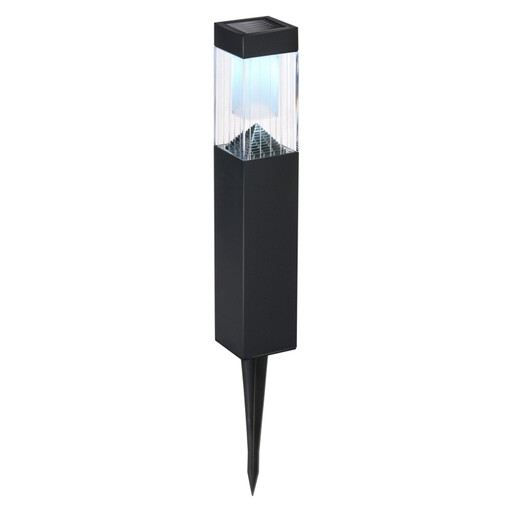
Why it suits this profile: This black solar stake light can be pushed into soft ground without any cables, making it a simple way to add your first lighting accents along garden paths, across lawns or on the driveway.
The specifications list two LEDs, an integrated solar power supply and an AAA battery. This makes the basic operating details clearer than a vague claim about brightness alone.
Compact dimensions of 6.5 × 34 cm, two LEDs and a weight of 402 g. It’s designed for straightforward installation in the ground.
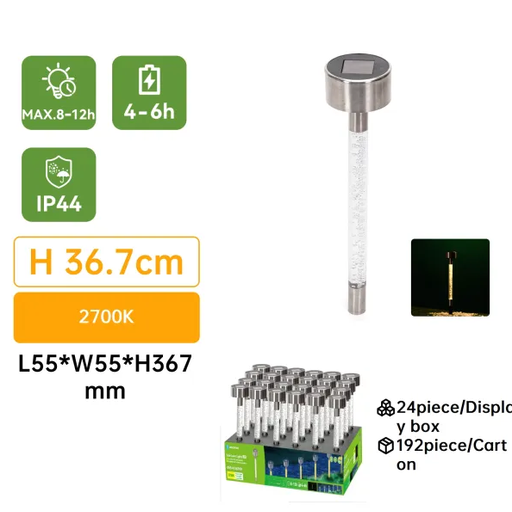
Why it suits this profile: The warm white light at 2700 Kelvin is a good fit for patios, flower beds and seating areas where you want subtle, decorative garden lighting.
The IP44 rating is clearly stated. It offers protection against splashing water, but doesn’t make the light suitable for locations that stay wet or are at risk of flooding.
2700 Kelvin, a 40 mAh Ni-MH battery, a stated charging time of 4–6 hours and an operating time of 8–12 hours in suitable conditions.
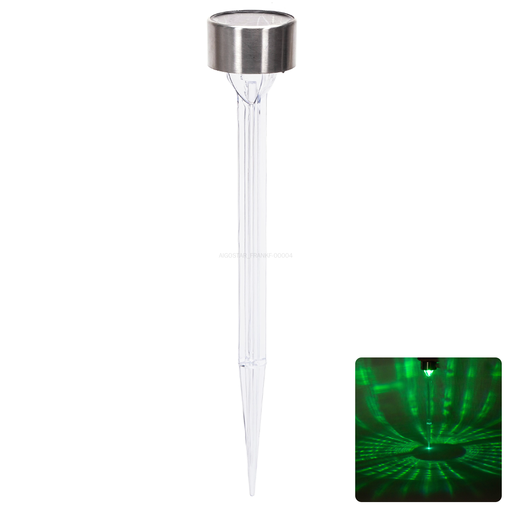
Why it suits this profile: The RGB function is ideal for garden parties, colourful accents along paths or changing up the decoration on lawns and in flower beds.
The RGB light type, 4–6-hour charging time and IP44 rating are all clearly stated. This helps you distinguish a decorative model from a functional path light.
RGB lighting, a 200 mAh Ni-MH battery, a stated operating time of 8–12 hours and a height of 32 cm.
We’ve put together a complete, regularly updated list of products that meet these strict selection criteria and fully comply with the safety regulations in force in the EU.
Push solar lights with ground spikes into firm soil that isn’t rock-hard. In very hard ground, the spike may be damaged as you insert it. For the best charging performance, the solar panel should get as many hours of direct sunlight as possible. Avoid placing it beneath dense trees, behind walls or directly under roof overhangs.
Clean the solar panel regularly with a soft, slightly damp cloth. Don’t use abrasive cleaners. Before winter or a long period out of use, it may be worth storing the light according to the manufacturer’s instructions. At the end of their useful life, batteries and electronic components should be taken to the appropriate collection points.
It depends on the solar panel, battery and model. The technical specifications for the lights mentioned here generally state a charging time of 4–6 hours in suitable conditions. Direct sunlight is better than bright shade. Cloudy weather or shorter daylight hours can reduce the operating time.
IP44 is suitable for many sheltered outdoor areas and indicates protection against splashing water. Even so, the lights shouldn’t be submerged or left in standing rainwater for long periods. Also check the temperature range stated for the product.
No. Solar lights charge their built-in battery using the solar panel and don’t normally need to be connected to the mains. This means there are no ongoing electricity costs from mains use. However, the battery is a consumable part and may lose capacity over time.