
Lieferung heute & morgen

Qualitätsgarantie

Willkommens-Angebote freischalten: KOSTENLOSE Lieferung | Bis zu 80 % RABATT | Kostenlose 30-Tage-JoyPlus-Testphase
App herunterladen
Solar garden lights are a practical choice for paths, flower beds, patios and lawns because they do not require a power connection or complicated electrical installation. However, solar lights for the garden vary considerably in terms of light colour, battery capacity, materials and protection rating. If you buy based on design alone, you may later find yourself dealing with short lighting times, weak light or unstable ground spikes.
Claims such as “8–12 hours” generally assume that the solar panel receives several hours of direct sunlight. In shade, heavy cloud or winter, the amount of stored energy may be lower. A dirty panel will also reduce charging performance.
You should therefore consider the combination of charging time, stated lighting time and location conditions. A solar light should not be placed beneath a densely leafed tree or against a house wall that remains in shade.
The IP44 protection rating indicates protection against solid foreign objects measuring 1 millimetre or more, as well as splashing water from different directions. It is suitable for many decorative outdoor areas, but does not mean that a light is fully waterproof or designed to be submerged in water.
When choosing weatherproof solar lights, always check the specific IP rating. Avoid locations where water regularly collects and follow the manufacturer's instructions.
Warm white solar lights with around 2700 Kelvin create a yellowish, decorative lighting effect. Cool white light at around 6500 Kelvin, on the other hand, appears noticeably clearer and more bluish. RGB solar lights change colour and are primarily suitable for decorative accents rather than providing uniform path lighting.
The size of the set should also match how you plan to use it. A six-piece solar light set can create a visually even layout across flower beds or along a longer path. For a small balcony or a single planter, individual solar garden lights are often sufficient.
The protection rating is a key consideration for outdoor use. IP44 may be suitable for sheltered garden areas, paths and flower beds. However, the light should not be immersed in water or operated continuously in standing moisture.
When it comes to materials, distinguish between genuine stainless steel, plastic and a stainless-steel finish. Plastic is often lighter and may be perfectly adequate for ground-spike lights. A stainless-steel surface or stainless-steel look mainly affects the appearance. What matters most is how robustly the housing, ground spike and connecting elements are made.
Solar lights with ground spikes need firm ground. Do not force the spike into hard or frozen soil, as this could damage it. In loose soil, a wider base or additional fastening may be useful.
Many of the models listed here specify a charging time of around 4–6 hours and a lighting time of 8–12 hours under suitable conditions. These figures should be understood as product specifications and may vary depending on the weather, season, orientation and cleanliness of the panel.
You should also check the battery type. The products mentioned use integrated Ni-MH batteries with different capacities. A battery is a consumable component. Do not open or modify the light yourself if the manufacturer prohibits this. When disposing of the product, the light and battery must be handled in accordance with local requirements.
For a calm, welcoming look on patios, around entrances or in flower beds, choose warm white solar garden lights. Cool white can highlight contours and the layout of paths more clearly. RGB solar lights are suitable for adding colourful accents to lawns, seating areas or decorative planting.
Brightness should not be considered in isolation. For orientation lighting, the position, spacing and number of lights are just as important as the technical light output. Decorative solar ground lights do not automatically replace functional outdoor lighting with a high level of illumination.
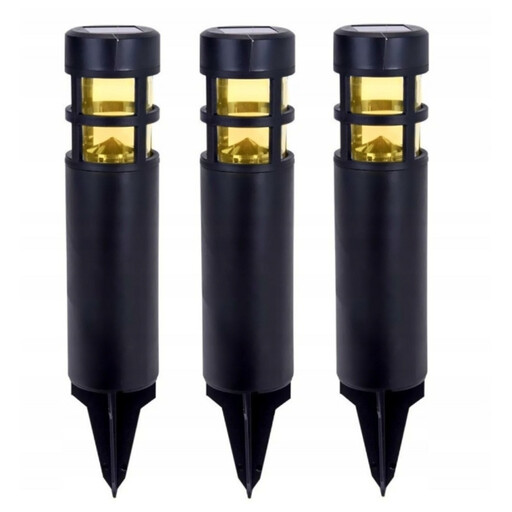
Why this product suits this profile: The three-piece set offers a simple way to mark out small paths, flower beds or a balcony without fixed wiring.
The set size prevents individual lights from being spaced too far apart across a larger area. Automatic activation at dusk also reduces the need for manual operation.
3 lights, solar operation and automatic activation in darkness; designed for simple decorative applications.

Why this product suits this profile: The clear 6500-Kelvin light and stainless-steel design head complement straight paths and modern outdoor spaces.
The product specifications state a charging time of 4–6 hours, 8–12 hours of illumination under suitable conditions and IP44 protection. This makes the key comparison points clear.
Polycrystalline solar panel, NiMH battery, stainless-steel design and a stated temperature range of -10 °C to 50 °C.
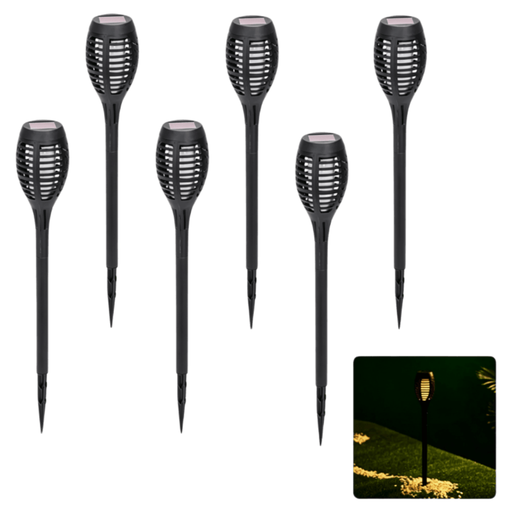
Why this product suits this profile: The six-piece set with 2700-Kelvin warm white light is suitable for larger flower beds, paths, lawn edges and patio areas, adding a decorative flame effect.
The specifications explicitly state IP44, a charging time of 4–6 hours and a lighting time of 8–12 hours under suitable conditions. This helps set realistic expectations for outdoor use.
6 pieces per set, 2700 Kelvin, NiMH battery, LED light source and automatic activation after nightfall.
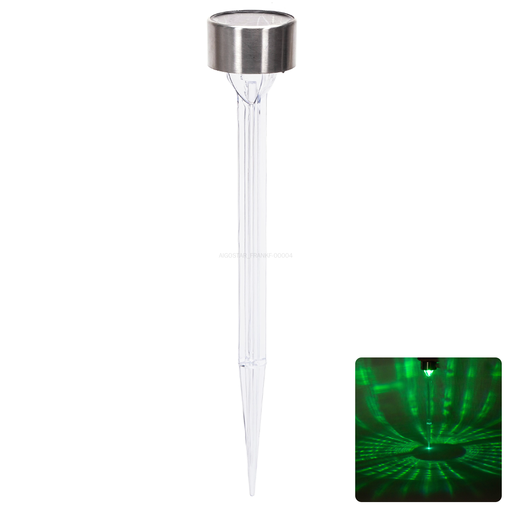
Why this product suits this profile: The RGB function is designed for adding colourful accents to paths, lawns and seating areas when variable lighting is more important than neutral orientation lighting.
The RGB function is clearly positioned as a decorative feature. With IP44 protection, the light is designed to withstand splashing water, but not to be submerged.
RGB light, ground-spike installation, NiMH battery, plus a stated charging time of 4–6 hours and lighting time of 8–12 hours under suitable conditions.
We have put together a complete, regularly updated list of products that fully meet these strict selection criteria and the safety regulations applicable in the EU.
The lighting time depends on sunlight, charging time, battery, temperature and cleanliness. Several of the models mentioned specify 8–12 hours under suitable conditions. In winter or on heavily overcast days, the actual lighting time may be shorter.
This depends on the protection rating. Models with IP44 are protected against splashing water, but should not be submerged or used in permanently wet surroundings. When installing them, avoid flood-prone areas and dips in the ground.
Not during normal operation. The solar panel charges the integrated battery during the day. Ongoing costs mainly arise from possible replacement batteries and from maintaining or eventually replacing the light.