
Lieferung heute & morgen

Qualitätsgarantie

Willkommens-Angebote freischalten: KOSTENLOSE Lieferung | Bis zu 80 % RABATT | Kostenlose 30-Tage-JoyPlus-Testphase
App herunterladen
Solar garden lights don’t need a fixed mains connection and can usually be set up outdoors without complicated installation. However, models vary considerably in colour temperature, IP rating, battery capacity and intended use. If you focus only on design or the stated lighting time, you could end up with a light that barely charges in a shady spot or isn’t adequately protected from rain.
This guide explains what individuals, gardeners and homeowners in Germany should look for when choosing solar lights for the garden. It covers not only decorative lighting, but also clear technical specifications and choosing the right light for the job.
Figures such as “8–12 hours” generally assume suitable charging conditions. In winter, under overcast skies or in a shady spot, the amount of stored energy will be lower. A dirty solar panel can also reduce charging performance.
So check these three details:
Many decorative solar lights are rated as IP44 solar lights. The first digit indicates protection against solid objects, while the second indicates protection against splashing water from different directions. IP44 is therefore suitable for many sheltered outdoor areas, but not for submersion in water.
A higher IP rating may be a better choice in areas where water can collect, in heavy rain or for recessed installation. Solar ground lights with an IP67 rating should still be installed according to the manufacturer’s instructions.
RGB solar lights switch between different colours and are best suited to decorative accents. For paths, entrances and seating areas, warm white light at around 2700 K to 3000 K is often considered more subtle. Cool white light at around 6500 K looks more neutral and can make outlines stand out more clearly.
Choose a colour temperature that suits the location. An RGB light isn’t automatically a good choice for guiding the way, while warm white solar lights are primarily designed to create a softer atmosphere.
Before buying, check that the IP rating is suitable for the location. Solar garden lights with ground spikes are practical for lawns, flower beds and paths, provided the ground is soft enough. A ground spike may be damaged if pushed into hard or stony ground. In this case, a freestanding light or a suitable ground-mounted option may be a better choice.
For recessed installation, also consider the dimensions, drainage and cable routing. A light with an IP67 rating may be designed for more demanding outdoor locations, but always follow the specific installation instructions.
Integrated NiMH batteries are common in many decorative solar-powered outdoor lights. The key considerations are battery capacity, charging time and expected lighting time. Aigostar models with NiMH batteries are listed with charging times of around 4–6 hours and lighting times of 8–12 hours, depending on the model. These figures depend on sunlight, orientation, temperature and battery age.
A higher-capacity battery may provide more reserve when charging conditions are suitable. However, it can’t make up for a lack of sunshine. Make sure the solar panel won’t be in permanent shade from trees, walls or buildings.
Wattage alone doesn’t tell you how bright a light will appear. Where the information is available, also check the luminous flux, colour temperature and intended use. Decorative garden spike lights are often designed to create accents and add to the look of your garden, rather than to illuminate a long path evenly.
For subtle path lighting, several lights placed at regular intervals may work better than a single light with a bright spot. When planning the installation, make sure potential trip hazards are still addressed with adequate ambient lighting and a safe path layout.
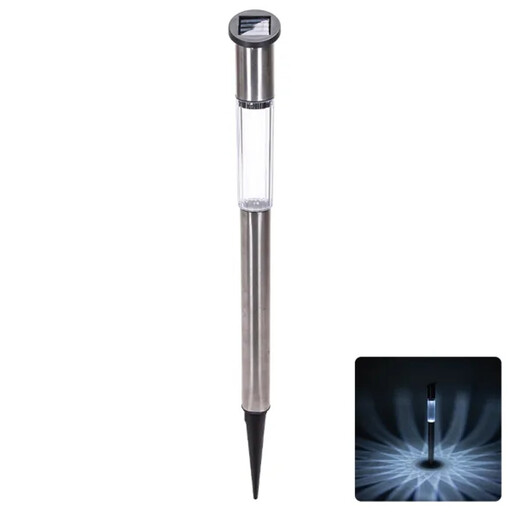
Why this product suits this profile: This light can be placed in soft soil or a lawn without a fixed mains connection, and is designed for simple solar path lighting.
The stated charging time of 4–6 hours and lighting time of 8–12 hours make the expected operating conditions clearer. The IP44 rating also indicates its limits when exposed to heavy water.
Polycrystalline silicon panel, NiMH battery, 6500 K light colour and ground spike installation; product details state an IP44 rating and an operating temperature range of -10 °C to 50 °C.
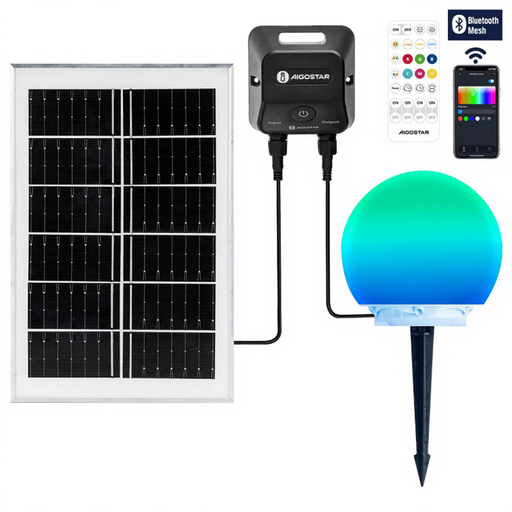
Why this product suits this profile: The separate solar panel, adjustable light colour from 2700 K to 6500 K and Bluetooth Mesh control make this a good fit for larger terraces, patios or coordinated groups of lights.
The IP67 rating is more useful when choosing a light for a demanding installation location than a vague claim that it is weatherproof. The separate panel also makes it easier to position towards the sun.
4000-mAh lithium battery, 5-W monocrystalline solar panel, RGB and adjustable white light, plus Bluetooth Mesh connectivity, according to the product description.
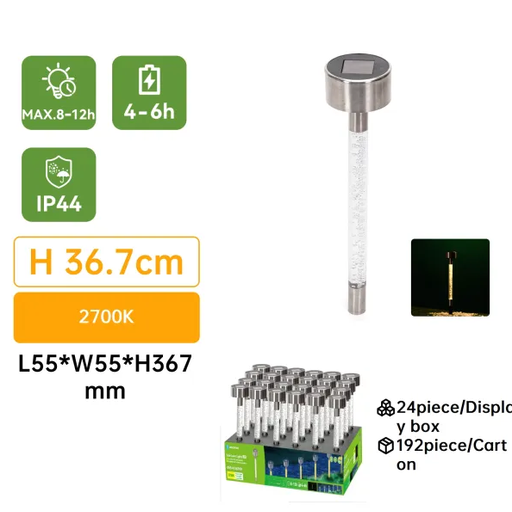
Why this product suits this profile: Its decorative design is well suited to repeated accent lighting in flower beds, lawns and along paths, especially when several matching solar garden spike lights are used together.
The warm white colour temperature of 2700 K is clearly stated. This makes it easier to judge the lighting effect before you buy, rather than relying on product images alone.
NiMH battery, 4–6 hours’ charging time, stated lighting time of 8–12 hours, IP44 rating, ground spike design and compact dimensions of 55 × 55 × 367 mm.
We’ve put together a complete, regularly updated list of products that meet these strict selection criteria and fully comply with the safety regulations in force in the EU.
It depends on the battery, charge level, sunlight, temperature and battery age. Several of the models listed here are stated to provide 8–12 hours under suitable conditions. Actual lighting time may be shorter in winter or in shady locations.
Many products are rated for a specific temperature range, for example -10 °C to 50 °C. However, frost, shorter days and limited sunlight can reduce charging performance. Check the manufacturer’s specifications and, if necessary, store delicate lights in a dry place when they won’t be used for an extended period.
Charging doesn’t require an external mains connection. So, unlike mains-powered lights, they don’t add to your household electricity bill. However, you may need to allow for the cost of replacement batteries or a replacement light, as well as disposal at the end of its useful life.