
Lieferung heute & morgen

Qualitätsgarantie

Willkommens-Angebote freischalten: KOSTENLOSE Lieferung | Bis zu 80 % RABATT | Kostenlose 30-Tage-JoyPlus-Testphase
App herunterladen
Solar garden lights are a practical way to illuminate outdoor areas without a fixed power supply. They are ideal for garden paths, borders, lawns, driveways and patios. However, not every seemingly affordable model will deliver the right result. The key factors are location, ingress protection rating, light colour, battery capacity and the actual build quality.
Claims such as "up to 8–12 hours" or "up to 24 hours" refer to suitable charging conditions. In shade, during short winter days, in cloudy weather or with a dirty solar panel, the lighting duration may be shorter. So check whether your planned location receives several hours of direct daylight.
With solar lights, the usable light output does not depend solely on the wattage. What matters are lumens, beam angle, solar panel, battery and light distribution. Some decorative solar ground spike lights operate at very low power and are intended primarily for accent lighting. For evenly visible path lighting, you need a model with the right light intensity and sufficient spacing between the lights.
The ingress protection rating shows how well a product is protected against dust and water. IP44, for example, protects against splashing water but is not designed for submersion. IP65 offers higher protection against dust and water jets, while IP67 allows temporary immersion under specified conditions. Even with a higher protection rating, solar garden lights should not be installed in permanently flooded areas.
Pay attention to the battery type and the stated capacity. NiMH batteries are common; smart solar lights sometimes use lithium batteries. A larger capacity can enable longer run times, but the actual performance still depends on daily solar charging and the chosen brightness.
With solar ground spike lights, the panel should face upwards and not be shaded by trees, walls or buildings. Models with a separate panel offer more flexibility in tricky locations, because the light and panel can be positioned independently of each other.
Solar path lights with a ground spike can be inserted into soft soil or lawn. For hard, compacted earth, a ground light or a different installation method may be more suitable. Solar ground lights should sit securely or be properly recessed, and must not create a trip hazard.
Also check the temperature range, housing material and protection rating. Plastic housings are lightweight, while stainless steel elements offer a different look. However, a stainless steel appearance can also be made of plastic, as stated with some decorative models. So you should read the product description carefully.
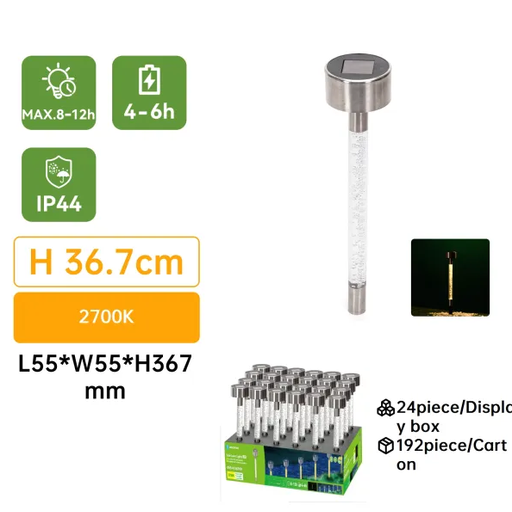
Why this product fits the profile: This compact solar ground spike light is designed for decorative accents in borders, lawns and paths, and requires no mains connection.
The specifications state 2700 K, a charging time of around 4–6 hours and 8–12 hours of lighting under suitable conditions. This makes it easier to assess suitability realistically.
Warm white light at 2700 K, integrated NiMH battery with 40 mAh and IP44 protection rating.
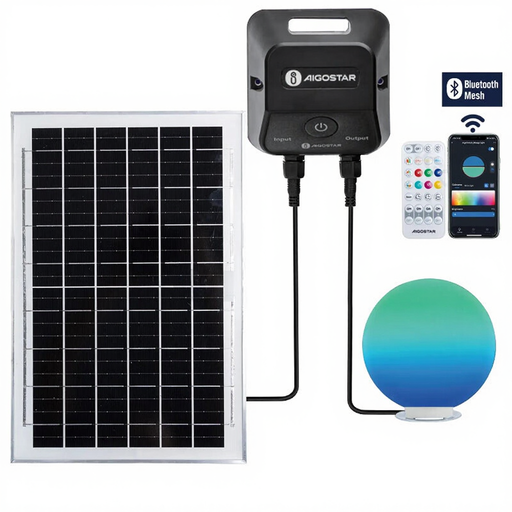
Why this product fits the profile: For larger patios, garden areas or users who want to control multiple lights centrally, this model offers additional adjustment options.
The technical specifications state IP65, a separate solar surface with cable, 350 lumens and a stated maximum operating time of up to 24 hours. This makes location and brightness planning easier.
RGB+CCT with 2700–6500 K, Bluetooth Mesh control and lithium battery with 8000 mAh.
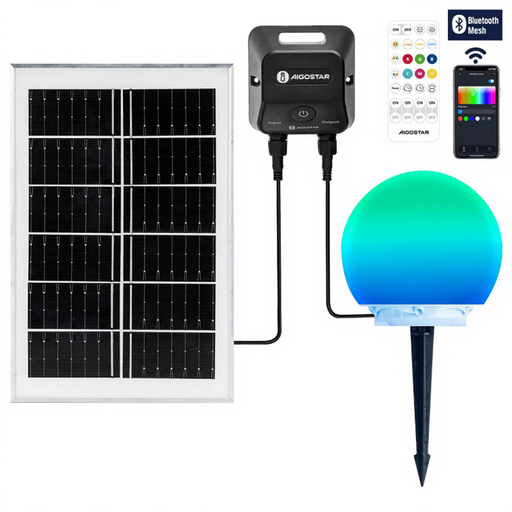
Why this product fits the profile: The recessed design is aimed at users who want to light paths, patios or specific garden features in a targeted and controllable way.
The separate panel positioning can be helpful in partially shaded areas. However, the IP67 rating should not be taken as permission for permanent submersion.
Bluetooth Mesh, RGB+CCT, 4000 mAh lithium battery and a stated maximum lighting duration of up to 24 hours.
For consistent performance, let the lights charge fully before first use. With solar ground spike lights, gently push the spike into soft soil. Avoid stones and excessively hard ground, as the spike can be damaged.
Wipe the solar panel regularly with a soft, damp cloth. Dust, pollen and bird droppings reduce the available charging surface. In frost, flooding or during extended periods of non-use, follow the manufacturer's instructions. Batteries and electronic components should be disposed of in the designated collection systems after replacement or at the end of their service life.
If you are looking for a simple garden lighting solution without a mains connection, you can start with individual solar path lights. For larger areas, we recommend sketching a plan first: mark out paths, seating areas and decorative zones, then choose the light colour, installation type and spacing.
We have compiled a complete, regularly updated list of products that fully meet these strict selection criteria and the safety regulations in force in the EU.
The lighting duration depends on sunlight, charging time, battery capacity, temperature and brightness setting. Product claims such as 8–12 hours generally apply under suitable conditions. In winter or on heavily overcast days, the run time may be shorter.
This can only be assessed based on the specific protection rating and the stated temperature range. IP44 models are protected against splashing water but should not stand in water. In frost, snow and prolonged damp conditions, the manufacturer's instructions are decisive.
During normal operation, they do not require a mains connection. The solar panel charges the integrated battery during the day. This means no ongoing electricity costs from the household supply; however, maintenance, battery replacement and any spare parts remain possible follow-up costs.