
Lieferung heute & morgen

Qualitätsgarantie

Willkommens-Angebote freischalten: KOSTENLOSE Lieferung | Bis zu 80 % RABATT | Kostenlose 30-Tage-JoyPlus-Testphase
App herunterladen
Solar lights for outdoor gardens create illumination without a permanently installed power cable. However, not every decorative light is suitable for every location. Many models look similar in product images, while differences in protection rating, battery capacity, charging conditions and design only become apparent in everyday use.
Three common purchasing misconceptions are particularly likely to cost you money:
So, if you are looking for solar garden torches, solar ground lights or decorative LED solar lights, you should consider more than just the design.
The IP rating consists of two digits. The first describes protection against solid foreign objects, while the second describes protection against water.
IP65 solar lights are therefore generally suitable for more exposed outdoor areas than models with IP44. Nevertheless, lights should not be left standing in puddles for extended periods. With solar ground lights, it is also important that the ground spike is firmly positioned and that the housing is not damaged by inserting it incorrectly.
Charging performance depends on the available sunlight. A location beneath trees, against a north-facing wall or behind a tall hedge can significantly reduce the operating time. Therefore, check the following:
For example, the Aigostar model specifies a charging time of approximately 4 to 6 hours and a lighting duration of 8 to 12 hours under suitable charging conditions. These figures are not a guarantee for every location, but provide technical guidance.
For paths and entrance areas, even, subtle illumination may be useful. Solar garden torches with a flame effect, on the other hand, place greater emphasis on appearance. An automatic solar light switches on by itself when it gets dark and off again in daylight. This reduces the need for manual operation, but does not replace checking the switch before first use.
With an RGB solar light, it should be clear whether the colour changes automatically or whether you can select a fixed colour. Height, beam direction and the number of lights are also relevant for flower beds, lawns and patios. Several lights allow for a more even arrangement, but they also require more suitable locations with sufficient sunlight.
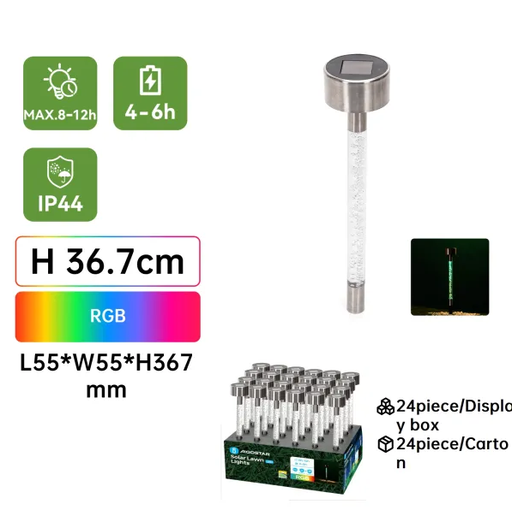
Why this product suits this profile: This compact RGB ground light is ideal for shoppers who want to add decorative accents to flower beds, lawns or paths without installing a power cable.
The specific IP44 protection rating, charging time and lighting duration are stated. This makes it easier to assess the likely suitability of the location than a general advertising claim such as “for outdoor use”.
RGB light source, 36.7 cm height, integrated Ni-MH battery and automatic operation without a direct mains connection.
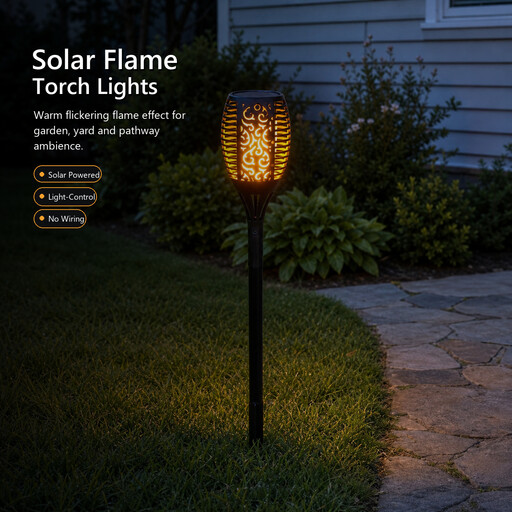
Why this product suits this profile: Two solar lights with a flame effect are well suited to patios, seating areas and paths where a decorative torch-style look is desired.
The IP65 rating is more specific than a general claim that the product is waterproof. In addition, 96 LEDs per torch and automatic switching on and off are specified.
Two-piece set, flame effect, 96 LEDs per light and a specified IP65 protection rating.
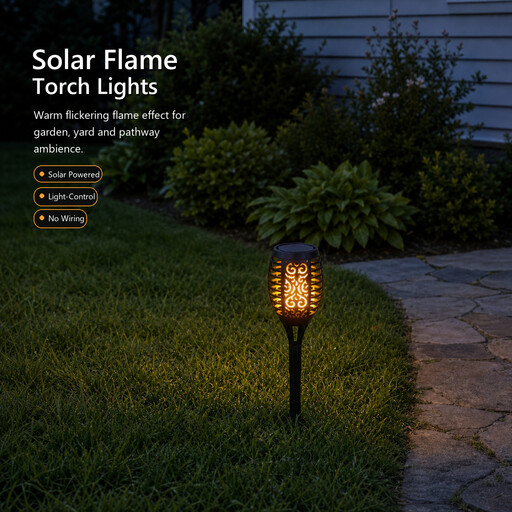
Why this product suits this profile: This four-piece set is designed for larger properties, longer paths or several flower beds where a coordinated arrangement of solar garden torches is wanted.
The selection is based not only on the flame effect, but also on the specified IP65 protection rating, the height of 51 cm and the automatic operation.
Four lights in the set, 12 LEDs per torch, 51 cm height and automatic switching on and off.
We have put together a complete, regularly updated list of products that fully meet these strict selection criteria and the safety regulations applicable in the EU.
Before installation, choose the location based on the actual amount of sunlight it receives. For even solar garden lighting, position the lights so that walls, shrubs or buildings do not cast shadows over them. The following steps can also help:
Solar lights operate without mains electricity. As a result, ongoing energy costs do not arise in the same way as they do with permanently connected outdoor lights. However, the purchase price, battery wear and any replacement parts should still be taken into account.
This depends on the panel, battery and available sunlight. As a specific guide, the Aigostar model states a charging time of around 4 to 6 hours under suitable conditions. On cloudy days, in the shade or when the panel is dirty, the available energy may be lower.
IP44 is suitable for many sheltered outdoor areas, such as patios, balconies and some flower beds. The light is protected against splashing water, but is not designed to be immersed in water. For exposed locations subject to more severe weather, a light with IP65 may be better suited to your requirements.
During operation, solar lights draw their energy from the integrated battery, which is charged by the solar panel during the day. The lighting itself does not consume mains electricity directly. However, the actual lighting duration depends on the charging conditions, battery and temperature.