
Lieferung heute & morgen

Qualitätsgarantie

Willkommens-Angebote freischalten: KOSTENLOSE Lieferung | Bis zu 80 % RABATT | Kostenlose 30-Tage-JoyPlus-Testphase
App herunterladen
Solar lights for the garden can be installed without a permanent power connection and are suitable for paths, lawns, flowerbeds and seating areas. However, not every decorative model provides the right kind of illumination. The key factors are location, IP rating, light colour, battery capacity and the light’s actual purpose.
This buying guide from the Joybuy Product Recommendation Officer helps you identify common marketing pitfalls and choose solar garden lights using clear, practical criteria.
Claims such as “8–12 hours” generally refer to suitable charging conditions. In shade, cloudy weather or winter, the battery may absorb less energy. A solar light should therefore receive several hours of direct sunlight wherever possible. Trees, house walls and other walls can significantly reduce charging performance.
IP44 protects against solid foreign objects measuring 1 millimetre or more, as well as splashing water. This makes the light suitable for many outdoor areas, but it should not be left standing in water or sprayed directly with a garden hose. For more exposed locations, an outdoor light with IP65 may be the better choice. This rating provides protection against dust and water jets from various directions.
RGB solar lights or warm white solar lights create atmosphere, but they do not automatically illuminate a path sufficiently. Effective garden path lighting also depends on the number of lights, the spacing between them, the installation height and the distribution of light. Lighting should be planned particularly evenly around steps and uneven paths.
Colour temperature is measured in Kelvin:
A model with 6500 K may give a garden path a more practical appearance, while 2700 K creates a softer, more understated lighting effect. The colour rendering index, CRI or Ra, describes how naturally colours appear under the light. A value of Ra≥70 is specified for the models listed here.
Before buying, check whether the light is suitable for the intended outdoor area. Alongside the IP rating, the materials and build quality are also important. Plastic models are often lightweight and easy to reposition. A stainless steel look can complement modern gardens aesthetically, but it does not automatically mean that every component is made from stainless steel.
According to the product details, the Aigostar models listed are designed for an operating range of -10 °C to 50 °C. In winter, you should also consider frozen ground, standing water and road salt nearby.
Solar ground lights and solar lights with ground spikes need a stable, sunny location. The ground spike should be pushed into soft soil or grass. On hard or stony ground, the spike may be damaged; pre-drilling with a suitable tool is the safer approach.
You should also check:
The panel should be cleaned regularly with a soft, damp cloth. Abrasive cleaners can damage the surface and reduce charging performance.
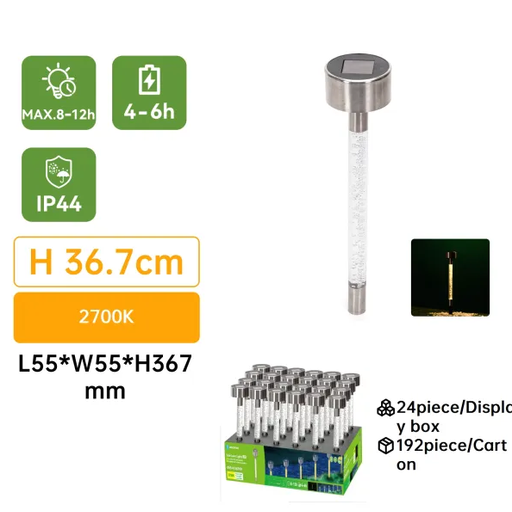
Why this product suits the profile: At 36.7 cm tall, this light is lightweight, installs in soft soil without cables and is suitable for flowerbeds, lawn edges and small paths.
The product details explicitly state a charging time of 4–6 hours and a lighting duration of 8–12 hours under suitable conditions. IP44 makes its usage limits clear.
Warm white light at 2700 K, an integrated Ni-MH battery and automatic switching on and off according to the product description.
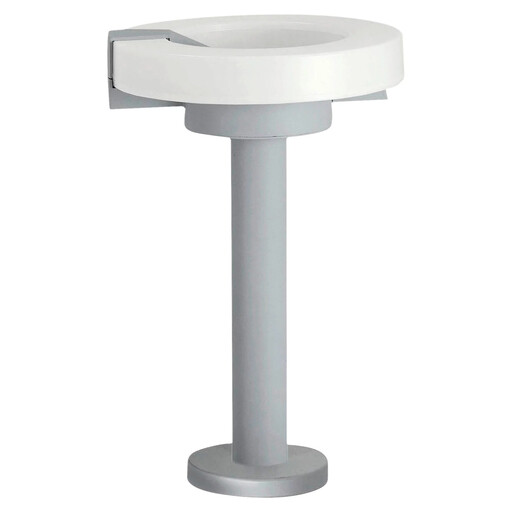
Why this product suits the profile: This permanently installable outdoor garden light is aimed at users looking for robust, long-term lighting for paths, driveways or lawns.
With its stated IP65 rating, this model is designed for dust-protected outdoor areas and water jets. However, it is not a solar light but a mains-powered light.
The specifications include 3000 K, 470 lumens, an integrated non-dimmable LED module and an E27 fitting for up to 40 W.
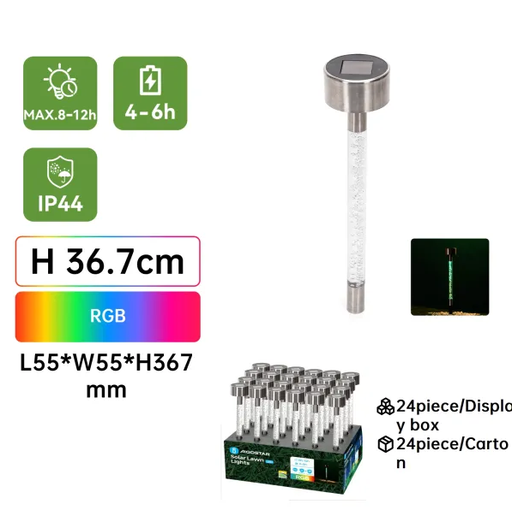
Why this product suits the profile: RGB lighting is suitable for decorative garden areas, seasonal displays and users who deliberately want colourful accents instead of neutral path lighting.
The IP44 rating and stated temperature range of -10 °C to 50 °C indicate the intended outdoor use. Nevertheless, the light should not be left standing in water.
RGB lighting, a 200-mAh Ni-MH battery, a polycrystalline silicon solar panel and a stated lighting duration of 8–12 hours under suitable charging conditions.

Why this product suits the profile: The cool 6500 K light colour may appeal to users who want contours along paths or property boundaries to be more clearly visible.
The product details specify IP44, a Ni-MH battery and a charging time of 4–6 hours. This allows you to check the protection rating and power supply before buying.
6500 K, Ra≥70, a polycrystalline silicon solar panel and 8–12 hours of lighting under suitable conditions according to the product details.
We have put together a complete, regularly updated list of products that fully meet these strict selection criteria and the safety regulations applicable in the EU.
Their lifespan depends on the battery, solar panel, weather conditions, charging cycles and care. According to the product details, the Aigostar models listed have an LED lifespan of up to 15,000 hours. This refers to the light source and does not necessarily indicate the lifespan of the entire product. The battery may lose performance sooner.
Choose a location with as much direct sunlight as possible. The panel should not be permanently shaded by trees, buildings or parasols. For paths, positioning the lights along the edge is recommended so that they do not become a trip hazard. On very hard ground, do not push the ground spike in with excessive force.
During operation, solar garden lights draw their energy from the battery charged during the day. A mains connection is not required. However, the actual lighting duration depends on sunlight, the panel, the battery, temperature and shade. For consistently predictable lighting on heavily used driveways, a wired LED garden lighting system with a suitable protection rating may be the more practical solution.