
Lieferung heute & morgen

Qualitätsgarantie

Willkommens-Angebote freischalten: KOSTENLOSE Lieferung | Bis zu 80 % RABATT | Kostenlose 30-Tage-JoyPlus-Testphase
App herunterladen
Solar lights for the garden do not require a fixed power connection and can usually be installed without tools. Even so, not every light is suitable for every outdoor space. Purchases often disappoint because product images suggest high brightness, protection ratings are unclear or the actual lighting conditions in the garden have not been taken into account.
Specifications such as “8 to 12 hours” generally refer to suitable charging conditions. In autumn and winter in the UK, shorter days, cloudy weather, low temperatures and shade can significantly reduce the available energy. A solar garden light should therefore receive as many direct hours of sunlight as possible. A solar panel beneath a tree or on a house wall that is permanently in the shade will only charge to a limited extent.
A solar light rated IP44 is protected against solid foreign objects measuring 1 millimetre or more and against water splashed from various directions. It is suitable, for example, for sheltered paths, borders or patio areas, but should not be left standing in water or submerged.
Solar lights rated IP65 offer greater protection against dust and water jets. Solar lights rated IP67 are additionally designed to withstand temporary immersion under the conditions specified in the relevant standard. The manufacturer’s specific installation and care instructions remain decisive.
Depending on the model, RGB solar lights create colourful accents, but they are not automatically suitable for safely lighting steps or driveways. For orientation along paths, even light distribution, sufficient mounting height and sensible spacing are more important than a wide choice of colours. Warm white light at around 2700 Kelvin has a subtle, decorative effect, while cool white light at 6500 Kelvin appears significantly clearer and offers stronger contrast.
You should also check the colour rendering index Ra. A value of Ra≥70 is a meaningful technical specification for decorative lights, but on its own it says nothing about the actual brightness.
The key factors are the battery type, capacity, charging time and the conditions under which the operating time was measured. NiMH batteries are used in many compact solar spike lights. More powerful smart solar lights often use lithium or lithium iron phosphate batteries.
A stated charging time of 4 to 6 hours and a lighting duration of 8 to 12 hours should be understood as manufacturer specifications measured under suitable conditions. Before buying, check whether the battery can be replaced and which replacement battery is intended. Replacing a permanently installed battery later may be more complicated.
Before first use, remove any protective film from the panel and charge it according to the manufacturer’s instructions. Regular cleaning with a soft, damp cloth prevents dust and pollen from affecting charging performance.
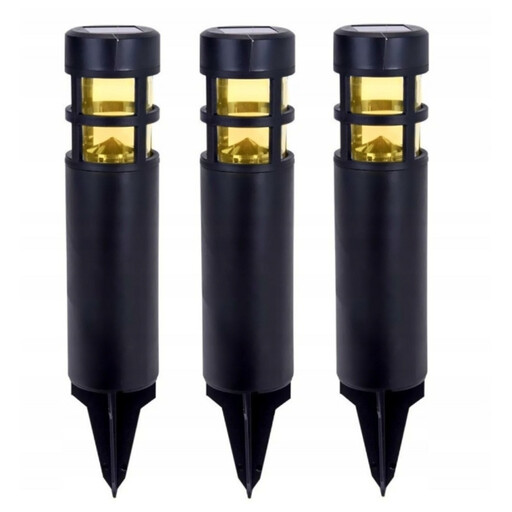
Why this product suits this profile: This set of three is ideal for shoppers who want to distribute several small points of light along a path, around a border or across a lawn. It can be installed without a fixed power connection.
The product description specifically states that the lights switch on automatically at dusk. This means you do not have to activate each light individually every evening.
Three lights in one set; designed for paths, gardens and borders; automatic dusk lighting.
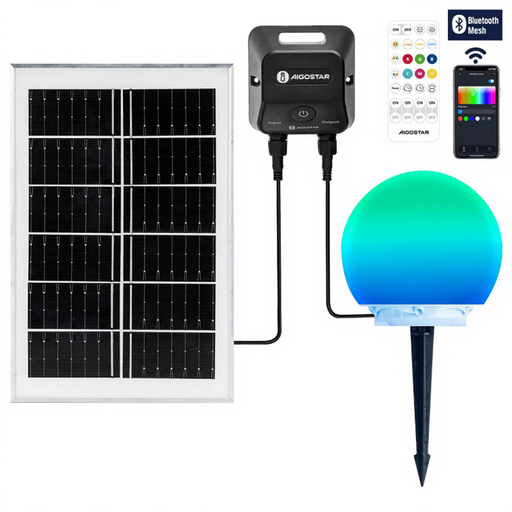
Why this product suits this profile: This recessed light is aimed at users who want to control the light colour, colour changes and multiple lights via Bluetooth Mesh. Its stated IP67 rating is relevant for more exposed installation locations.
The specifications explicitly mention RGBCCT, Bluetooth Mesh and an IP67 classification. This allows shoppers to compare the features and protection rating before buying.
20 W rating; RGB and white light from 2700 to 6500 Kelvin; 4000 mAh lithium battery; Bluetooth Mesh control.
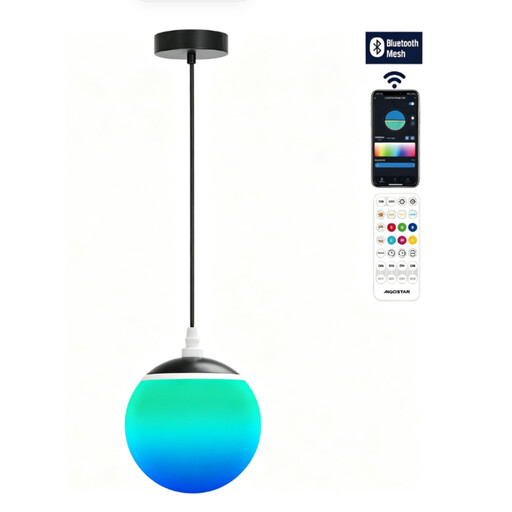
Why this product suits this profile: This pendant light is a practical choice for gazebos, patios and covered seating areas when the solar panel needs to be hung in the sun while the light remains in the shade.
The separate panel reduces dependence on the light’s installation location. Even so, the IP65 rating should not be confused with suitability for underwater use.
RGBCCT lighting; 200 lm according to the product specification; separate 6 W solar panel; Bluetooth Mesh and AigoSmart app.
We have put together a complete, regularly updated list of products that fully meet these strict selection criteria and the safety regulations applicable in the EU.
Do not place solar lights directly beneath trees, roof overhangs or tall shrubs. With solar path lights, even spacing is recommended to prevent alternating bright and dark sections. Spikes should only be pushed into loose but stable soil. Hard ground can damage the spike or housing.
For ground lights, pay attention to the installation depth and drainage. Water must not collect permanently around the housing, even when a higher IP protection rating is specified. Choose motion or dusk automation according to the intended use: the dusk function is suitable for regular orientation lighting, while a motion sensor controls lighting duration and energy consumption according to the situation.
Their lifespan depends on the LED, housing, battery, weather conditions and care. The Aigostar models mentioned are specified with an LED lifespan of up to 15,000 and 30,000 hours respectively. These figures refer to the light source and not automatically to the complete light. The battery may lose capacity sooner.
Many models are approved for a specific temperature range, for example from -10 to 50 °C. However, performance often drops in winter because of shorter days, lower levels of sunlight and snow or dirt on the panel. Clean the panel regularly and store the light according to the manufacturer’s instructions if it is not intended for use in freezing conditions.
When operating, solar lights do not use electricity from the mains. However, costs may arise from the initial purchase, replacing batteries or damaged components. Choosing a suitable protection rating and installation location, as well as caring for the battery correctly, can help preserve the service life of your outdoor lighting.