
Lieferung heute & morgen

Qualitätsgarantie

Willkommens-Angebote freischalten: KOSTENLOSE Lieferung | Bis zu 80 % RABATT | Kostenlose 30-Tage-JoyPlus-Testphase
App herunterladen
Solar garden lights do not require a fixed power connection and, depending on their design, can be placed flexibly outdoors. However, not every model will suit every garden. Many poor purchases happen because buyers focus mainly on colours, illumination time or advertising claims, while overlooking important technical details.
Claims such as “up to 12 hours” refer to suitable charging conditions. In shady locations, during short winter days, when solar panels are dirty or after several rainy days, the actual operating time may be shorter. Small solar lights with compact panels and batteries are particularly dependent on a sunny location.
You should therefore check:
RGB solar lights can add colourful accents, but they are not automatically suitable for lighting a path or patio. For a calm atmosphere, 2700K warm white solar lights are a sensible choice. Their colour temperature creates a comparatively warm effect, making them suitable for seating areas, flower beds or decorative arrangements.
If you want to combine functional lighting with colour changes, you should also check the luminous flux in lumens. The choice of colours alone says little about brightness.
The protection rating is shown using the abbreviation IP followed by two digits. An IP44 solar light is protected against solid foreign objects measuring 1 mm or more, as well as splashing water from various directions. It is suitable, for example, for sheltered patios, lawns and flower beds.
An IP65 solar light offers greater protection against dust and water jets. However, this does not mean it can be submerged or left permanently in water. Even with IP65, the solar panel, cable connections and installation position must comply with the manufacturer’s instructions.
Pay attention to the dimensions, weight and surface. A lightweight plastic stake may be less stable in loose soil than in compacted earth. For hanging lights, the suspension system and cable length should suit the installation location.
2700K describes warm white light with a more yellow-toned appearance. Neutral or cool white light up to 6500K looks more functional and may be better suited to paths or work areas. RGB+CCT combines coloured light with adjustable white light.
With smart solar lights controlled via an app, you should check whether a hub is required. A Bluetooth Mesh solar light can group and synchronise several compatible lights. This is useful for larger gardens or festive decorations, but requires a compatible smartphone, an app and, where necessary, a stable Bluetooth connection.
Solar lights store the energy collected during the day in a battery. Product specifications may list Ni-MH or lithium batteries, for example. Capacity should be considered alongside charging time, luminous flux and illumination time.
For more consistent performance:
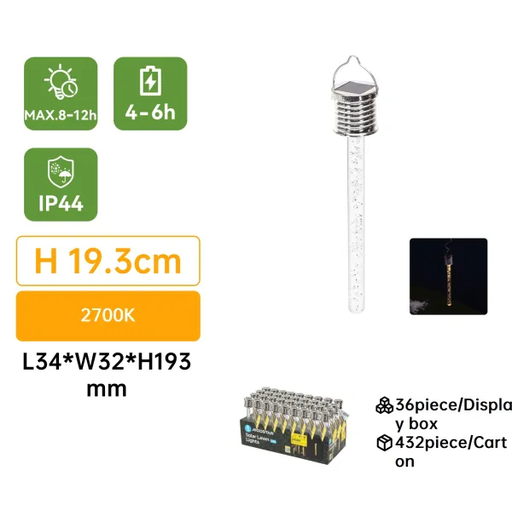
Why this product suits the profile: This compact solar hanging light is designed for decorative areas and does not require a fixed power connection. Its 2700K warm white light suits balconies, patios and smaller garden areas.
The specifications state the charging time and operating time clearly: around 4–6 hours of charging and 8–12 hours of battery operation under suitable conditions. The IP44 rating also helps set realistic expectations regarding weather protection.
2700K, 40mAh Ni-MH battery, stated operating time of 8–12 hours and a weight of 40g.
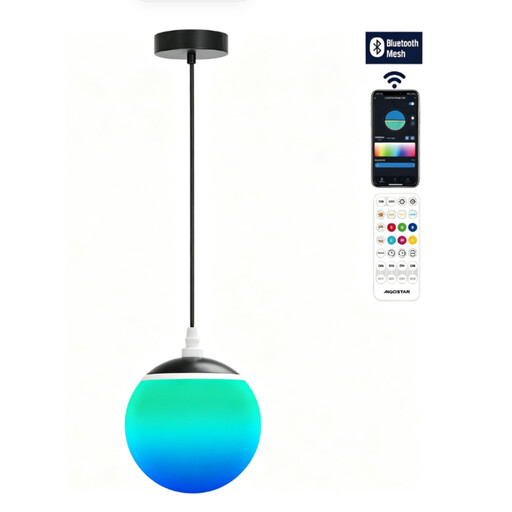
Why this product suits the profile: The separate panel can be installed in direct sunlight while the globe light hangs beneath a gazebo or on a patio. Bluetooth Mesh and RGBCCT offer additional control options.
The IP65 rating is accompanied by a note stating that the product is not designed for submersion. The separate solar panel reduces the risk of installing the light in an unsuitable shady location.
20W, 200lm, RGB+CCT from 2700K to 6500K, Bluetooth Mesh 5.0, LiFePO4 battery and a stated maximum battery life of 24 hours.
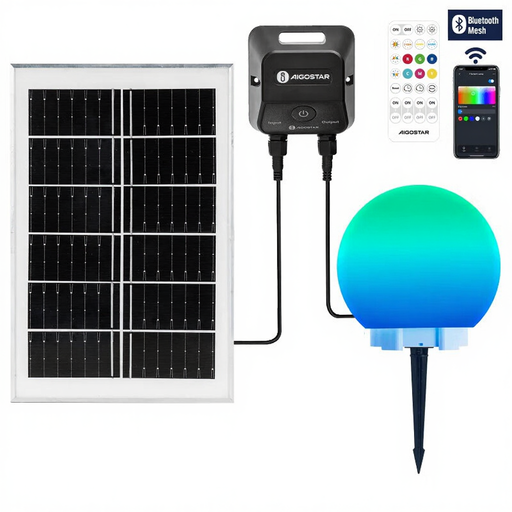
Why this product suits the profile: For larger areas or recurring decorations, the app offers group control, schedules and adjustable brightness. According to the product specifications, installation as a solar stake light is intended for a sunny location.
The product specifications indicate IP54 or IP44. This means the light should not be classed as a submersible model. Buyers can therefore choose an installation location that protects it from prolonged exposure to water.
RGB+CCT from 2700K to 6500K, Bluetooth Mesh control, AigoSmart app and group-control functionality.
We have put together a complete, regularly updated list of products that fully meet these strict selection criteria and the safety regulations applicable in the EU.
The solar panel should receive as many hours of direct sunlight as possible. Avoid shade from house walls, trees and parasols. A firm surface is also important for solar stake lights. Solar ground lights should be installed so that water can drain away and they do not create a trip hazard.
Their lifespan depends on the LED, battery, housing, weather conditions and care. Product specifications may state up to 15,000 hours for certain decorative lights and up to 30,000 hours for a smart solar hanging light, for example. These figures describe the stated lifespan of the light source and do not automatically represent the service life of the entire product. The battery may lose capacity sooner and is not replaceable in every model.
While operating, solar garden lights draw their energy from the previously charged battery. The charging power is generated by the solar panel. However, when considering ongoing costs, you should also factor in the battery, possible replacement parts and maintenance. Smart models may also require energy for a smartphone or optional hub.