
Lieferung heute & morgen

Qualitätsgarantie

Willkommens-Angebote freischalten: KOSTENLOSE Lieferung | Bis zu 80 % RABATT | Kostenlose 30-Tage-JoyPlus-Testphase
App herunterladen
Solar garden torches illuminate paths, lawns, patios and house entrances without power cables. However, for decorative garden lighting to work reliably outdoors, you should look beyond the appearance of the flame effect. Key considerations include IP rating, charging conditions, illumination time and build quality.
The term “waterproof” is widely used in retail. The IP rating provides more meaningful information. The first digit describes protection against solid foreign objects, while the second indicates protection against water.
For freestanding garden lighting, the IP rating should match the intended location. Conditions beneath a roof overhang differ from those on a completely exposed lawn.
Garden torches with a flame effect are primarily decorative light sources. Flickering light can visually mark paths, but it does not necessarily replace bright safety or task lighting. Details such as the number of LEDs or colour temperature can help you assess a product, but they do not tell you everything about perceived brightness.
If you are looking for a warm atmosphere, choose warm white light. A specification such as 2700 K indicates a warm tone. For illuminating dark steps or a larger courtyard area, additional solar path lights or other functional lighting are a sensible choice.
Solar lights do not charge independently of local conditions. Shade from house walls, trees or balconies reduces the available solar energy. Illumination time may also be shorter in winter or during extended periods of rain than it is in suitable lighting conditions.
Before buying, check whether the solar panels will receive as much direct daylight as possible during the day. For sets with several lights, it is also important to ensure that each torch has a suitable position.
The IP rating is a key comparison point for solar torches for outdoor use. For permanently exposed locations, IP65 can offer greater protection against dust and water jets than IP44. IP44 may be sufficient for patios, balconies or partially sheltered paths, provided that the manufacturer’s instructions are followed.
The IP rating applies to the housing under the specified test conditions. Plug connections, the battery compartment and damage caused by incorrect installation can affect the actual level of protection.
A realistic assessment requires several details:
For example, the Aigostar model is specified with a charging time of approximately 4 to 6 hours and an illumination time of 8 to 12 hours. According to the product description, these figures apply under suitable conditions and should not be understood as a guaranteed duration in every type of weather.
A 51 cm-high torch creates a different lighting effect from a low-level ground spotlight. For paths and flower beds, the light should not be positioned so close to the edge that it can easily be knocked over when mowing the lawn or walking past.
Sets with ground stakes that can be firmly inserted into the soil are particularly practical. Do not force them into very hard or frozen ground, as this could damage the housing and connecting components.
The following outdoor solar lights vary in set size, number of LEDs, IP rating and technical specifications. Each product is matched to typical use cases.
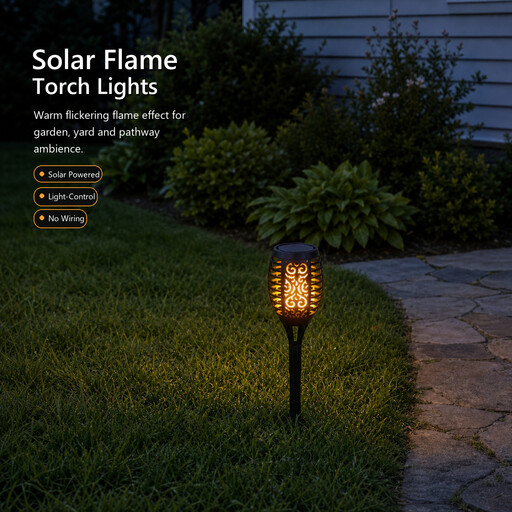
Why this product suits the profile: The 4-piece set is ideal if you want to create a consistent flame effect at several points along a path or flower bed. The stated height of 51 cm makes the lights easy to see when positioned around the garden.
The product specifications state that the lights switch on and off automatically and have an IP65 rating. This removes the need to switch them on manually every day, while the IP rating gives you more specific information than simply calling them “waterproof”.
4 pieces, 12 LEDs according to the product name, 51 cm height, flame effect, automatic on/off function and IP65 rating.
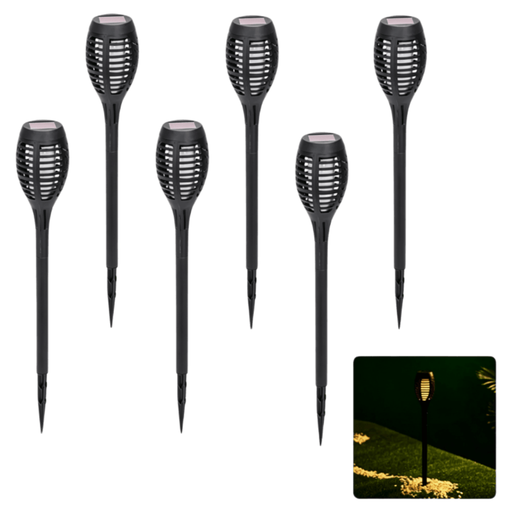
Why this product suits the profile: The 6-piece set offers a defined light colour of 2700 K and is suitable for paths, flower beds, patios and lawns. Its technical specifications make it easier to choose the right decorative warm white garden lighting.
The product description explicitly states the IP44 rating and limits use to conditions within this protection category. This allows you to choose the location more carefully instead of relying solely on the term “weatherproof”.
6-piece set, 2700 K warm white light, stated charging time of 4–6 hours and illumination time of 8–12 hours under suitable conditions.
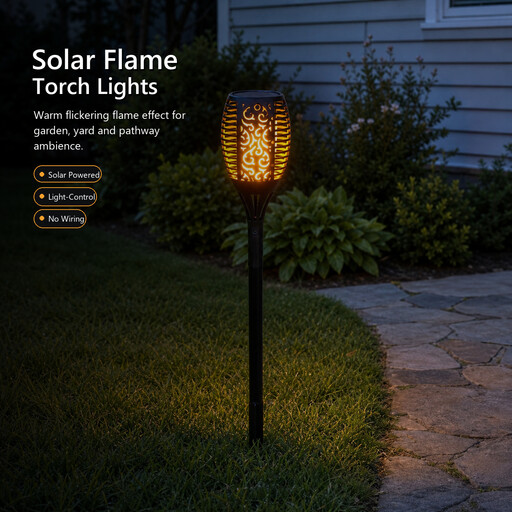
Why this product suits the profile: The 2-piece set is suitable for entrances, smaller patios or two carefully positioned accents. The product name specifies 96 LEDs, a dancing flame effect, IP65 protection and automatic on/off functionality.
The automatic control reduces the need for unnecessary manual switching. The IP65 rating provides a specific technical reference for outdoor positioning; the illumination time should also be checked before buying.
2 pieces, 96 LEDs according to the product name, dancing flame effect, IP65 rating and automatic on/off function.
For the most consistent performance possible, follow these steps:
For paths where better visibility is needed, solar garden torches can be combined with solar path lights. This preserves the decorative flame effect while adding extra points of light along the walking area.
We have put together a complete, regularly updated list of products that fully meet these strict selection criteria and the safety regulations applicable in the EU.
This depends on battery capacity, charge level, sunlight, temperature and lighting mode. The Aigostar set is specified as providing 8 to 12 hours under suitable conditions. Illumination time may be shorter in winter or on heavily overcast days.
Models with a stated IP rating are designed for specific outdoor conditions. IP44 protects against splashing water, while IP65 offers a higher level of protection against water jets. Permanent immersion, standing water and conditions outside the manufacturer’s specifications should be avoided.
Solar lights charge their integrated battery via the solar panel and do not require a mains connection during normal operation. This means there are no ongoing electricity costs from mains usage. However, costs may arise from replacing the battery, purchasing spare parts or buying a replacement light in the future.