
Lieferung heute & morgen

Qualitätsgarantie

Willkommens-Angebote freischalten: KOSTENLOSE Lieferung | Bis zu 80 % RABATT | Kostenlose 30-Tage-JoyPlus-Testphase
App herunterladen
Solar garden lights seem straightforward at first glance: position them, let them soak up the sun and enjoy automatic light in the evening. In practice, however, a few details can lead to disappointment. Weak sunlight, a misunderstood protection rating or an unstable construction can significantly limit how they can be used.
This buying guide from the Joybuy Product Recommendation Officer helps you choose solar garden torches for outdoor use based on clear, practical criteria. The focus is on lighting duration, protection rating, positioning, lighting effect and what’s included.
The term waterproof garden torches is often used in general terms. However, the specific IP protection rating is what really matters. A light with IP44 is protected against solid foreign objects measuring 1 mm or more, as well as splashing water from various directions. Even so, it should not be placed in a permanently wet hollow or sprayed directly with a garden hose.
IP65 offers greater protection against dust and water jets. These lights are not designed to be submerged either. In practice, this means that the protection rating, installation location and maintenance all need to work together.
Solar torches with a flame effect use moving LED illumination. This creates a decorative effect, but it does not necessarily replace functional pathway lighting. If you want to illuminate a dark entrance safely, you should also consider the position, beam angle and number of LEDs.
For flower beds, lawns and patios, however, atmosphere is often the main priority. Warm white garden lighting at around 2700 K creates a less clinical effect than cool white light.
Figures such as “up to 8–12 hours” assume suitable charging conditions. In shaded locations, during shorter days or under overcast skies, the amount of stored energy may be lower. A dirty solar panel can also reduce charging performance.
Solar lights with a dusk sensor typically switch on automatically as the light level falls. This saves you from having to operate them manually, but it does not mean that the light can run for the same length of time every night.
Before buying, you should decide where the light will be used:
In freezing temperatures, you should also check the manufacturer’s stated temperature range. For example, the Aigostar model is specified as having an operating range of -10 °C to 50 °C.
An integrated solar panel charges the battery during the day. Check whether the chosen location receives several hours of direct daylight. Trees, house walls and tall hedges can significantly restrict charging performance.
Important details include:
According to the product description, the Grundig model operates with one AAA battery and two LEDs. The Aigostar lights use an integrated Ni-MH battery with a capacity of 200 mAh and state a charging time of approximately 4–6 hours, along with a lighting duration of 8–12 hours under suitable conditions.
For a single accent light, a compact solar garden light is often sufficient. For paths or longer flower beds, a solar light set is more practical, as several points of light can be distributed evenly.
Look out for:
A ground spike should sit straight and sufficiently deep in the soil. In very hard or frozen ground, it may be sensible to make a pilot hole first, so that the spike is not damaged.
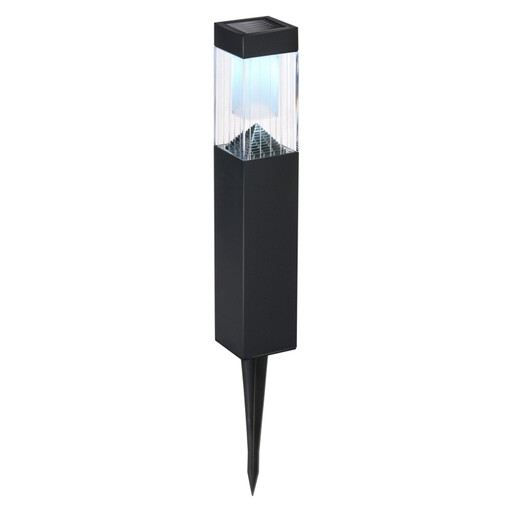
Why this product suits this profile: This compact model is suitable for individual paths, small flower beds or balconies. It can be installed without cables using a ground spike.
The description specifically states the dimensions of 6.5 × 34 cm, two LEDs and one AAA battery, rather than making only general claims about brightness.
Two LEDs, black housing, integrated solar panel and simple installation without a power cable.
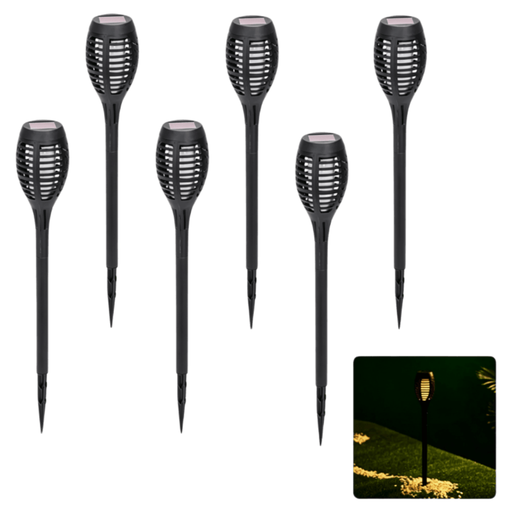
Why this product suits this profile: The 6-pack creates a consistent look along paths, patios and lawns. The stated colour temperature of 2700 K produces warm white light.
The IP44 rating is clearly stated. This makes it easier to plan use in sheltered locations, rather than interpreting “waterproof” as a blanket claim.
Six lights, 2700 K, Ni-MH battery with a capacity of 200 mAh and a stated lighting duration of 8–12 hours under suitable conditions.
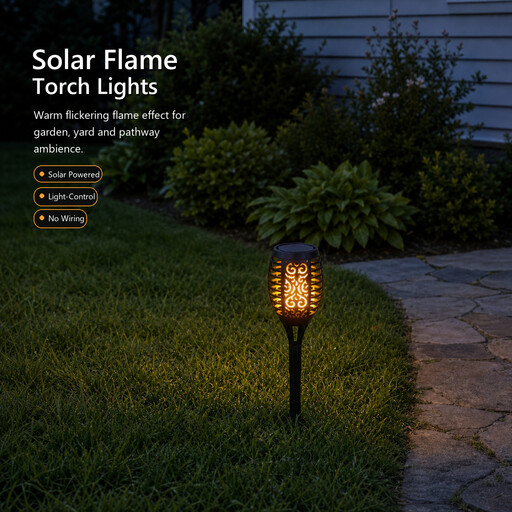
Why this product suits this profile: Four 51 cm-tall solar torches are suitable for longer paths, driveways or larger garden areas where several points of light are needed.
The product details state the quantity, height, number of LEDs and IP65 rating. This allows you to compare the coverage and level of protection required before buying.
4-piece set, 12 LEDs per light, 51 cm height and automatic switching on and off according to the product name.
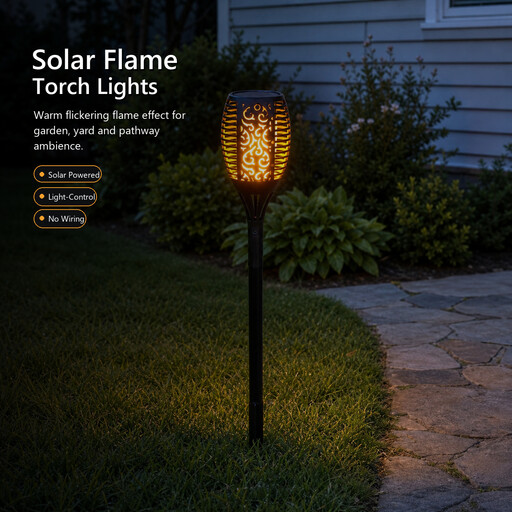
Why this product suits this profile: The two flame-effect torches are ideal for patios, garden parties or seating areas where the visual impact matters more than evenly lighting a path.
The key technical details, including 96 LEDs and IP65, are provided. However, these lights remain decorative outdoor lighting and should not be relied on as the sole source of security lighting.
Two pieces, 96 LEDs in total according to the product name, flame effect and automatic switching on and off.
We have put together a complete, regularly updated list of products that fully meet these strict selection criteria and the safety regulations applicable in the EU.
Choose a location with as much direct sunlight as possible. Before using the light for the first time, charge it according to the product instructions. The ground spike will sit more securely if the soil is not compacted or frozen.
For solar pathway lighting, an even spacing along the path is recommended. On a patio, two torches can instead be positioned as side accents beside seating areas or planters. The solar panel should be cleaned regularly to remove dust, leaves and pollen.
Solar lights should also not be positioned directly next to powerful outdoor lamps. Their light can affect the dusk sensor and delay automatic activation.
The duration depends on battery capacity, charge level, sunlight, temperature and LED output. Product specifications such as 8–12 hours generally apply under suitable charging conditions. In winter or on heavily overcast days, the runtime may be shorter.
This depends on the IP protection rating. IP44 protects against splashing water, while IP65 also provides protection against water jets. Neither rating means that the light can be operated underwater or left standing permanently in a puddle.
No. Solar lights charge their integrated battery or the specified battery during the day via the solar panel. This removes the need to connect them to a socket. Ongoing costs mainly arise when rechargeable batteries or standard batteries need to be replaced after extended use.