
Lieferung heute & morgen

Qualitätsgarantie

Willkommens-Angebote freischalten: KOSTENLOSE Lieferung | Bis zu 80 % RABATT | Kostenlose 30-Tage-JoyPlus-Testphase
App herunterladen
A solar light with a motion sensor promises a simple and cost-effective solution for more light and security around your home and garden. With no mains connection and no complicated wiring, installation seems like a breeze. However, the market is flooded with products whose performance claims often don't hold up in practice. Many buyers quickly find that their new lighting fails in bad weather or provides inadequate illumination for their driveway.
As a Joybuy Product Recommendation Officer, I see it as my duty to provide you with objective criteria to help you make an informed decision. This guide focuses on the technical pitfalls and will help you find a light that still works reliably after the first winter.
Before we dive into the technical details, let's look at the three most common reasons for making a bad purchase:
To avoid these pitfalls, you should focus on verifiable technical specifications. A good outdoor light without a mains connection depends on a few, but crucial, parameters.
The IP (Ingress Protection) rating indicates how well a housing is protected against the ingress of foreign objects (first digit) and water (second digit).
Look for at least IP65 to ensure a long lifespan for your solar garden lamp.
The brightness of a light is measured in lumens (lm), not in the number of LEDs. An outdoor solar spotlight intended to illuminate a driveway requires a higher lumen count than a decorative outdoor solar wall light.
Additionally, the available light modes are crucial for practical use:
The performance of a solar light depends directly on the quality of its battery and solar panel.
Here are some product recommendations tailored to specific use cases that meet the quality criteria mentioned.

Why This Fits Their Persona: Ideal for the large-scale illumination of driveways, garages, and dark property areas where maximum brightness and a wide detection range are paramount for security.
The product description specifies a concrete lumen value (3000 lm according to the manufacturer) instead of just the LED count. Furthermore, the IP65 rating ensures high weather resistance.
Three flexibly adjustable light heads allow for a wide 270° illumination angle. Three selectable modes offer flexibility between maximum security and energy conservation.
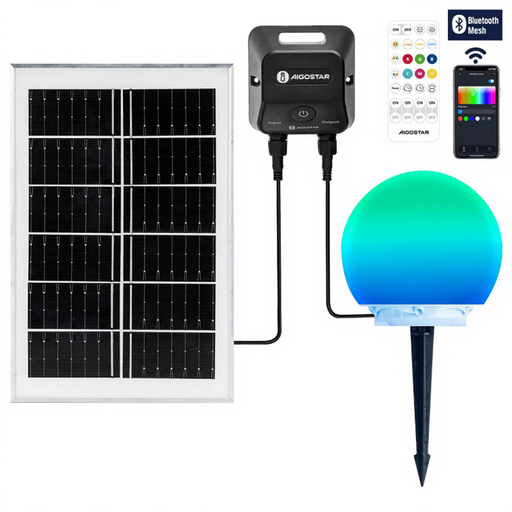
Why This Fits Their Persona: Perfect for users who want to create not just illumination, but ambiance. Ideal for staging paths, flowerbeds, or patios with controllable colours and effects.
The separate solar panel with an extended cable solves the problem of fixed panels, allowing for optimal alignment with the sun regardless of the light's location. The IP65 certification ensures durability.
The Bluetooth-Mesh technology allows for the networking and synchronous control of over 200 lights via an app. The RGBCCT function offers a full colour palette as well as adjustable white light (2700K-6500K).
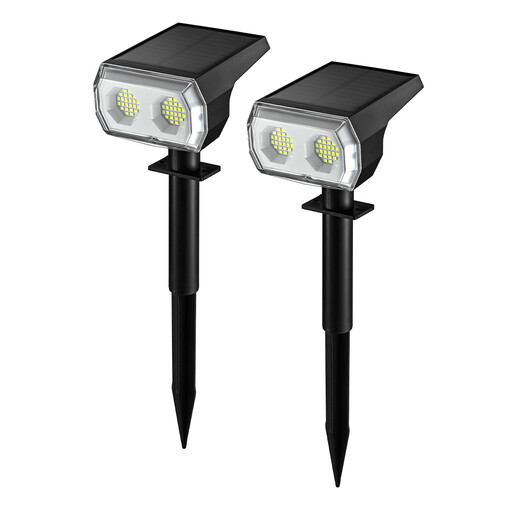
Why This Fits Their Persona: A straightforward and versatile solution for anyone wanting to flexibly illuminate various areas like paths, fences, or plants without much hassle.
This product focuses on the essentials: solid IP65 weather resistance and two simple but useful light modes. It avoids overloaded features, offering reliable core performance instead.
The 2-in-1 installation via ground stake or wall mount offers maximum placement flexibility. Being supplied as a 2-pack represents good value for money for lighting multiple spots.
We have compiled a complete, real-time list of products that fully satisfy these strict selection criteria and UK safety regulations.
Winter reliability heavily depends on the product's quality. A high battery capacity (mAh) and an efficient solar panel (preferably monocrystalline) are crucial. On short, cloudy winter days, charging performance is naturally lower. Models with an energy-saving sensor mode (light only on motion) or a separate, optimally positioned solar panel generally perform more reliably during the darker months.
No, and that's one of their biggest advantages. Since these lights do not require a connection to the 230V mains supply, installation is typically very simple and can be done by any DIY enthusiast. Usually, it only involves fitting a few screws to mount the light and the panel.
The IP rating indicates the degree of protection for an enclosure. The first digit (6 in IP65) stands for protection against solid foreign objects and means "dust-tight." The second digit (5 in IP65) describes protection against water and means "protection against water jets from any angle." A light with an IP65 rating is therefore well-protected against rain, snow, and dirt, making it suitable for unprotected outdoor use.