
Lieferung heute & morgen

Qualitätsgarantie

Willkommens-Angebote freischalten: KOSTENLOSE Lieferung | Bis zu 80 % RABATT | Kostenlose 30-Tage-JoyPlus-Testphase
App herunterladen
Outdoor solar lights are an attractive solution: they save on electricity costs, protect the environment, and can be installed without complex wiring. But the market is overwhelming, and many products don't live up to their advertising promises. As a Joybuy Product Recommendation Officer, I see daily which features truly matter and where the most common pitfalls lie. This guide will help you make an informed decision and avoid disappointment.
Before you invest in new garden lighting, you should be aware of the three most common reasons why many solar lights become useless after a short time or are disappointing from the start.
To avoid these pitfalls, you should focus on objective, technical parameters. These three criteria are crucial for the performance and longevity of your solar garden lights.
The IP (Ingress Protection) rating indicates how well a housing is protected against the ingress of foreign objects and water.
The combination of the battery and panel determines how much energy can be stored and how long the light can operate.
These two values define the actual light output.
Instead of a one-size-fits-all recommendation, we present models tailored to specific user profiles that meet the quality criteria mentioned above.
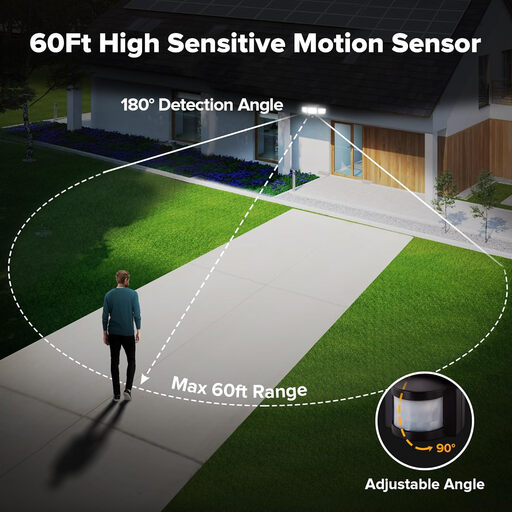
Why This Fits Their Persona: Ideal for securing driveways, garages, or dark corners of the garden. The focus here is clearly on functionality and deterrence through high brightness upon motion detection.
With a luminous flux of 3000 lumens, it bypasses the pitfall of disappointing brightness. The IP65 certification ensures that the light functions reliably even in heavy rain.
Three flexibly adjustable light heads allow for wide 270° coverage. The motion sensor has a long range, and there are three different operating modes to choose from.

Why This Fits Their Persona: Perfect for anyone wanting to create an ambient atmosphere on their balcony, patio, or in the garden. The flexible outdoor solar string light can be creatively draped around railings, plants, or on walls.
The IP65 certification provides reliable protection against the elements. The product description gives a realistic, weather-dependent runtime, thus avoiding the trap of exaggerated promises.
The set includes two string lights, each 8 metres long with 80 LEDs. Eight different lighting modes and a memory function offer design versatility without needing to be reset daily.
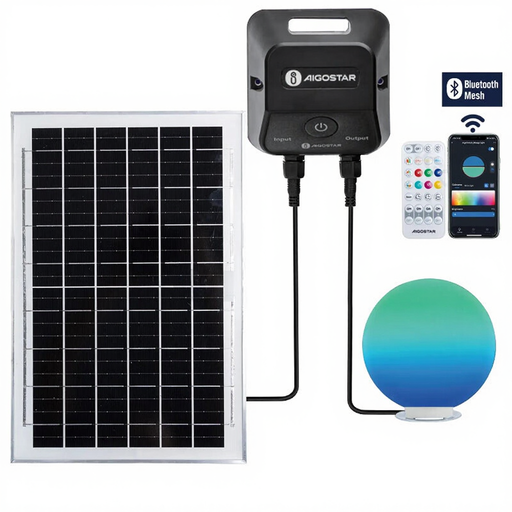
Why This Fits Their Persona: For users who want more than just light. This smart light offers full control over colours and brightness via an app and integrates seamlessly into sophisticated outdoor spaces with its modern design.
This model avoids the trap of unrealistic claims with clear specifications: 350 lumens of brightness, a large 12W monocrystalline solar panel, and an 8000mAh battery ensure reliable performance.
Control via Bluetooth Mesh allows for the networking of over 200 devices. The colour temperature (2700K-6500K) and RGB colours are infinitely adjustable.

Why This Fits Their Persona: A straightforward and effective solution for marking paths, flowerbeds, or lawn edges. The installation is incredibly simple and requires no prior technical knowledge.
This set is designed for a clear purpose: decorative path lighting. It doesn't promise extreme brightness but reliably delivers orientation light, thus avoiding the trap of false expectations.
Installation is tool-free via a ground stake. The 5-piece set allows for a uniform design. You can also choose between warm white light and an RGB colour-changing mode.
We have compiled a complete, up-to-date list of products that fully meet these strict selection criteria and UK safety regulations.
1. Do solar lights work in winter or on cloudy days? Yes, modern solar garden lights also work in diffuse light, but with reduced performance. The solar panel charges the battery even on cloudy days, just slower than in direct sunlight. This results in a shorter runtime per night in winter. For year-round operation, models with high-quality monocrystalline panels and large batteries are preferable.
2. What is the lifespan of outdoor solar lights? The lifespan is determined by two main components: the LED and the battery. The LEDs themselves have a very long life, often over 30,000 hours. The limiting factor is usually the battery, whose capacity can diminish after 1-3 years, depending on quality and charging cycles. On some higher-quality models, the battery can be replaced, which significantly extends the life of the light.
3. What do I need to consider when installing solar lights? The most important factor is the orientation of the solar panel. It should be placed in a location that receives direct sunlight for as long as possible, ideally facing south. Avoid locations in the shade of trees, buildings, or overhangs. Keep the surface of the panel clean of dust, leaves, or snow to ensure maximum energy absorption.