
Lieferung heute & morgen

Qualitätsgarantie

Willkommens-Angebote freischalten: KOSTENLOSE Lieferung | Bis zu 80 % RABATT | Kostenlose 30-Tage-JoyPlus-Testphase
App herunterladen
Solar lights for the garden don’t need a mains connection and can usually be installed without tools. However, not every light is right for every location. Some models provide decorative lighting, while others are designed as outdoor solar floodlights for larger areas. Before you buy, check the light colour, IP rating, charging conditions and installation method.
Outdoor lights are often advertised as weather-resistant or waterproof. The specific IP rating is what matters, though. A light with an IP44 rating is protected against splashes from various directions, but must not be submerged in water. For exposed areas, choose garden solar lights with a higher IP rating.
Even with a higher rating, the solar panel and housing must be installed correctly. Damaged seals, cracks or a battery cover that hasn’t been closed properly can compromise the protection.
Claims such as “up to 8–12 hours” apply in suitable conditions. In the shade, in cloudy weather or during short winter days, the amount of stored energy may be lower. Solar lights with ground stakes should therefore be placed somewhere that gets as much direct sunlight as possible.
Trees, house walls and tall shrubs can partially shade the panel. Regularly wiping it with a soft, damp cloth helps remove dust and pollen. Abrasive cleaners can damage the surface.
Low-power warm white solar lights are often ideal for adding atmospheric accents to flower beds or patios. For a well-lit path or a larger lawn, more powerful outdoor solar floodlights are a better choice. RGB lights create changing colours, but don’t necessarily replace functional lighting to help you find your way.
Colour temperature is measured in kelvin:
For outdoor LED solar lights, also check whether the light stays on continuously or switches on and off automatically when it gets dark. Some models don’t have motion or dusk settings and instead use a simple automatic switching function.
The IP rating consists of two digits. The first indicates protection against solid objects, while the second indicates protection against water. IP44, for example, means protection against solid objects 1 millimetre or larger, and against splashing water. It isn’t designed for immersion.
It’s worth checking the materials carefully. A silver-coloured plastic light may have a stainless-steel effect without being made entirely from stainless steel. This affects its weight, stability and how you should expect the surface to look.
Ni-MH rechargeable batteries are common in solar lights. Consider the stated capacity, charging time and operating time together. A larger battery alone doesn’t guarantee longer lighting, as panel size, light output and weather conditions also play a part.
Solar ground lights and models with ground stakes are particularly easy to install. However, only push a ground stake into soft, prepared soil. In very hard or frozen ground, the housing could be damaged during installation.
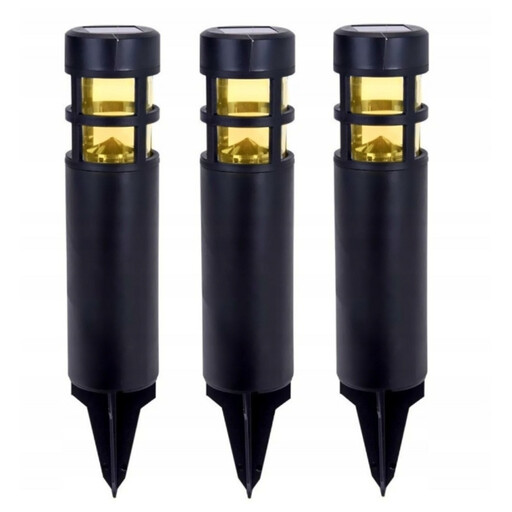
Why this product suits your needs: This set of three solar lights is a good option for small paths, flower-bed borders or your first step towards solar garden lighting.
The pack size is clearly stated, making it easier to plan how many lights you need instead of buying individual lights with unclear coverage.
Set of three; designed for paths, gardens and borders; position in direct sunlight.

Why this product suits your needs: The specifications state a charging time of around 4–6 hours, a lighting time of 8–12 hours and a colour temperature of 6500 kelvin.
The IP44 rating is clearly stated, so you can better judge whether the light is suitable for the weather conditions in your outdoor space.
Polycrystalline silicon panel; stainless-steel effect; Ra≥70; stated operating temperature range of -10 °C to 50 °C.
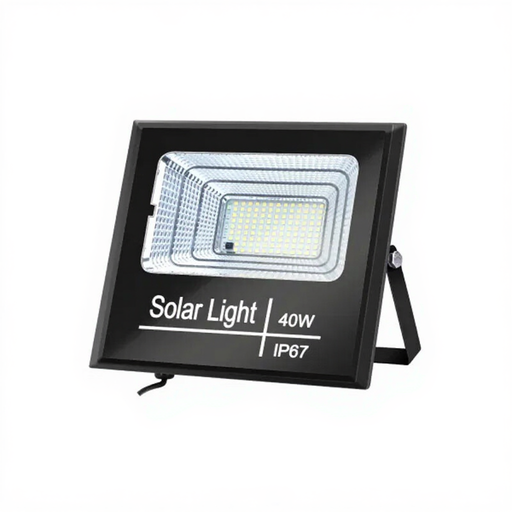
Why this product suits your needs: This solar floodlight with a separate panel is designed for larger outdoor areas where a model with a ground stake won’t be enough.
The separate panel gives you more flexibility over where you place it. You can mount the floodlight by the area you want to illuminate, while positioning the panel where it gets as much sun as possible.
40 W version according to the product name; 10,000 mAh battery according to the description; separate solar panel; stated lighting time of up to 12 hours.
We’ve put together a complete, regularly updated list of products that meet these strict selection criteria and fully comply with the safety regulations in force in the EU.
For reliable performance, position solar lights somewhere as free from shade as possible. Before first use, remove the protective film from the panel and charge the battery as instructed. Don’t force solar lights with ground stakes into the soil.
In autumn and winter, shorter days and less sunlight can reduce operating time. Before storing the lights for an extended period, keep them somewhere dry and frost-free, if the instructions recommend this. Don’t continue using damaged housings or batteries. Dispose of them in accordance with local requirements for waste electrical equipment.
The panel should get several hours of direct sunlight and shouldn’t be blocked by trees, walls or garden furniture. Lights with ground stakes should be placed in soft, stable soil. For paths, it’s best to space them evenly, while decorative lights can also be grouped around flower beds.
Their actual lifespan depends on the battery, LED, housing, weather conditions and care. Some models state an LED lifespan of up to 15,000 hours. This doesn’t necessarily indicate the lifespan of the whole product or its battery.
While switched on, solar lights draw energy from their built-in battery, which is charged by the solar panel during the day. The models mentioned don’t need to be connected to the mains. However, operating time and brightness depend on the charge level, sunlight and technical settings.