
Lieferung heute & morgen

Qualitätsgarantie

Willkommens-Angebote freischalten: KOSTENLOSE Lieferung | Bis zu 80 % RABATT | Kostenlose 30-Tage-JoyPlus-Testphase
App herunterladen
Solar lights for the garden provide outdoor lighting without power cables or a permanent mains connection. They’re suitable for garden paths, flower beds, lawns, patios and driveways. To make sure they’re a sensible choice for your outdoor space, though, don’t focus on design and light colour alone. Charging conditions, IP rating, battery capacity and installation all determine whether a light is suited to its intended use over the long term.
Claims such as “up to 8–12 hours” assume suitable charging conditions. In shady spots, with limited sunshine or a dirty solar panel, the actual run time may be shorter. There’s also less daylight available in autumn and winter.
So check the following:
The IP rating describes a light’s level of protection. An IP44-rated light is protected against solid objects 1 mm or larger, as well as splashing water from different directions. However, it isn’t designed to be submerged in water. IP54 offers additional, limited protection against dust.
An IP44 solar light may therefore be suitable for paths, flower beds and lawns, but shouldn’t be placed in ground that stays wet, near a water feature or in a dip where water collects.
Many solar garden lights provide mainly guidance or accent lighting. Small, low-power LEDs can mark a path or highlight a flower bed, but they won’t necessarily replace functional driveway or security lighting.
Check the actual details for light colour, luminous flux in lumens, number of LEDs and beam angle. A colour temperature of 2700 K gives a warm white light, while 6500 K describes a much cooler white. RGB solar lights, on the other hand, switch between different colours and are mainly suited to decorative use.
Solar lights with ground stakes can be pushed into soft soil or a lawn without tools. They’re less suitable for hard, stony ground. The stake should sit firmly in place, without putting too much pressure on the light housing as you push it in. For paved or concrete paths, solar ground lights or models designed for fixed installation are a better choice.
Choose the spacing between lights to suit their purpose:
Product details often state a charging time and possible operating time. A model with a charging time of 4–6 hours and 8–12 hours of illumination may stay lit overnight after a full day in direct sunshine. These figures depend, however, on the season, orientation, temperature and how clean the panel is.
Clean the solar panel regularly with a soft, slightly damp cloth. Don’t use abrasive cleaning products. If the light has a built-in Ni-MH or lithium battery, don’t open the housing or replace the battery yourself unless the product is specifically designed for this.
The IP rating is an important point of comparison for outdoor LED solar lights. According to the relevant product details, IP44 is suitable for outdoor use with protection against splashing water. IP54 offers greater protection against dust. Neither rating, however, means the light can be submerged.
It’s also worth checking the material description. A silver-coloured, stainless-steel-look finish may be made of plastic. That isn’t necessarily a drawback, but it’s worth bearing in mind when considering the light’s weight, appearance and resistance to physical impact.
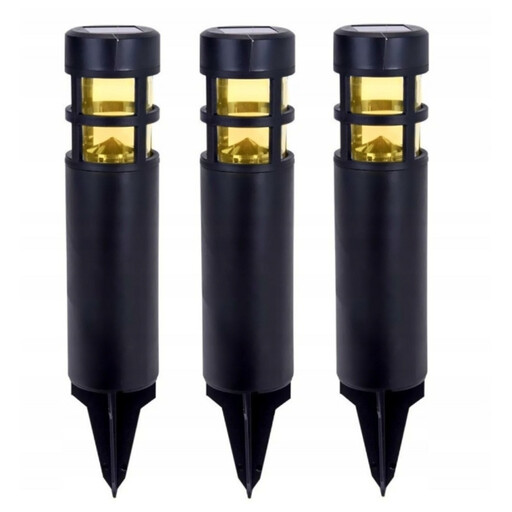
Why this product suits this profile: This set of three lights is ideal if you want to mark several areas, such as a path, flower bed or boundary, without complicated installation.
The number of lights is clearly stated, so there’s no need to combine several individual products with different specifications.
Three lights, automatic switching on at dusk and simple installation in a sunny spot.

Why this product suits this profile: The specifications, including 6500 K, Ra≥70, IP44 and a stated service life of 15,000 hours, make it easier to choose based on clear technical criteria.
The IP rating and specified operating temperature range of -10 °C to 50 °C are clearly stated, making it easier to assess whether the light is suitable for outdoor use.
Polycrystalline solar panel, NiMH battery, a charging time of 4–6 hours and a stated lighting duration of 8–12 hours in suitable conditions.
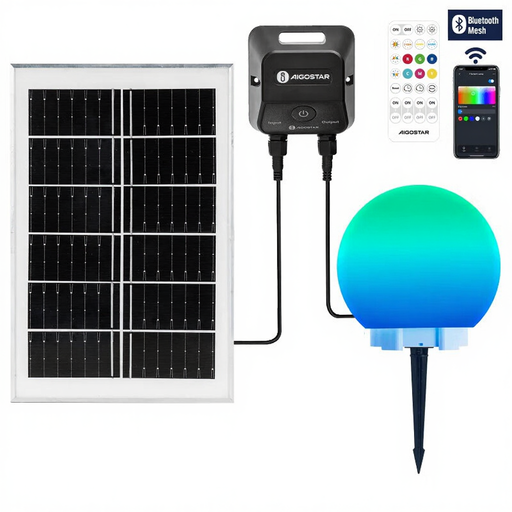
Why this product suits this profile: This model is for anyone looking for smart solar garden lights with RGB+CCT lighting, app control and group functions.
The control options are clearly specified: the AigoSmart app, Bluetooth Mesh and RGB+CCT from 2700 K to 6500 K. IP54/IP44 protection ratings are also listed.
Colour and white light options, adjustable brightness, schedules and the ability to group several lights, according to the product description.
We’ve put together a complete, regularly updated list of products that meet these strict selection criteria and fully comply with the safety regulations in force in the EU.
Place the solar panel in an open spot where it can get as much direct sunlight as possible. Trees, house walls and covered areas can reduce its charging performance. Models with ground stakes should go into soft soil or a lawn. The panel should face upwards and be kept clear of leaves and dirt.
Their lifespan depends on the LEDs, housing, battery, weather and care. Some product details state an LED lifespan of up to 15,000 hours. This isn’t necessarily the same as the lifespan of the battery or the light as a whole. So check whether the battery can be replaced, and clean the panel regularly.
Solar-powered outdoor lights don’t need to be connected to the mains while in use. Their solar cells charge the built-in batteries during the day. However, you may need to pay for replacement batteries or a whole new light. For a realistic estimate, consider the battery type, how easy it is to access and how often you expect to use the light, as well as the purchase price.