
Lieferung heute & morgen

Qualitätsgarantie

Willkommens-Angebote freischalten: KOSTENLOSE Lieferung | Bis zu 80 % RABATT | Kostenlose 30-Tage-JoyPlus-Testphase
App herunterladen
Solar lights for the garden don’t need a mains connection and can usually be installed without tools. However, not every model is suitable for every outdoor space. The right choice depends on factors such as where you’ll place the lights, the colour of light you want, the IP rating and the battery’s actual capacity.
If you buy based only on design or the stated lighting time, it’s easy to overlook important details. These three common buying mistakes are particularly easy to make with solar garden lights:
The IP rating indicates how well a product’s casing is protected against the ingress of solid objects and water. Many decorative solar ground lights and solar stake lights have an IP44 rating. This means they’re suitable for exposure to splashing water, such as rain in the garden. However, it doesn’t automatically mean they can be cleaned with a garden hose or placed somewhere that stays wet.
Models with an IP54 rating offer additional protection against dust. As always, check the manufacturer’s specific information and the installation instructions. Position outdoor solar lights so that water can’t collect in hollows.
Charging performance depends on the size and type of solar panel, its position and the available light. Figures such as 4 to 6 hours’ charging time and 8 to 12 hours of lighting should be treated as manufacturer’s estimates for suitable conditions.
Keep the following in mind:
If you need paths to stay brightly lit for long periods, a mains-powered system may be more suitable. Solar lights are particularly useful when you want a flexible, wireless installation.
Warm white solar lights at around 2700 K produce a yellowish, warm glow, making them suitable for seating areas, flower bed borders and decorative accents. Cool white solar lights at around 6500 K have a bright, bluish appearance and can help make paths or property boundaries more clearly visible.
RGB solar lights change colour or create coloured lighting effects. They’re primarily designed for decoration. If you want even lighting to help people find their way along a path, the spacing, light distribution and mounting height are more important than the range of colours.
If you’re choosing solar stake lights for a path, check that the ground is soft enough. The stake may be damaged if you push it into very hard or stony ground. For hard surfaces, consider recessed solar lights or other mounting options.

Why this product suits this profile: This solar light has a simple design, cool white light and a ground stake, making it suitable for paths, lawns and flower beds.
The product information clearly states the charging time, lighting time and IP44 rating. This helps you set realistic expectations about where to place the light and how well it’s protected from the weather.
6500 K, NiMH battery, 4–6 hours’ charging time and a stated lighting time of 8–12 hours.
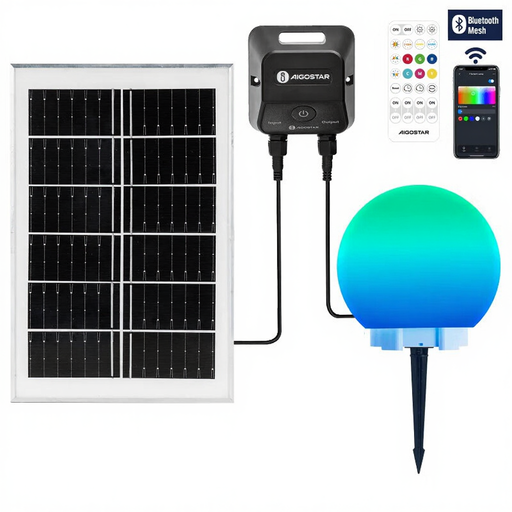
Why this product suits this profile: This smart solar garden light is designed for buyers who want to manage colours, brightness and schedules using an app.
The IP54/IP44 ratings indicate that the light isn’t designed to be submerged. You may need a hub to control it via the app.
Bluetooth Mesh, the AigoSmart app and RGB+CCT with a colour temperature range of 2700 K to 6500 K.
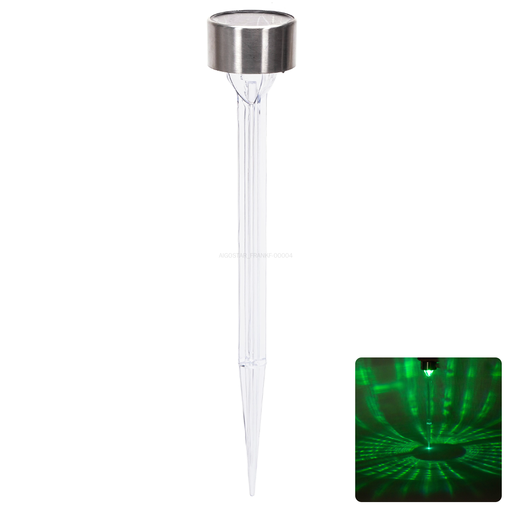
Why this product suits this profile: This RGB version is suitable for garden paths, lawns and decorative splashes of colour when you want to create different lighting effects.
The technical specifications list the IP44 rating, battery type, charging time and lighting time. This makes it clear that the light is intended for decoration rather than powerful security lighting.
RGB lighting, automatic on/off and a stated lighting time of 8–12 hours.
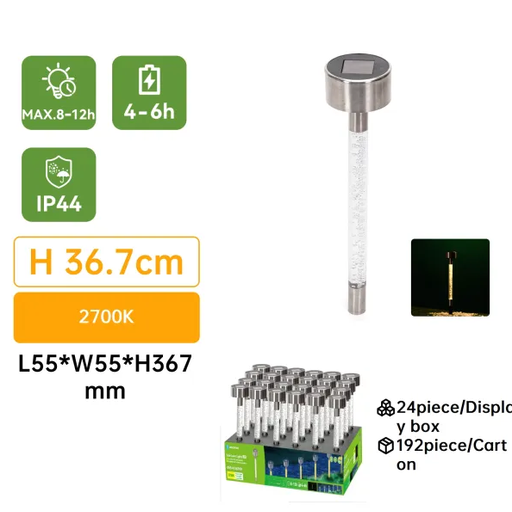
Why this product suits this profile: The warm white bubble design is ideal for decorative pools of light among flower beds, on lawns and along a patio.
The light is listed as IP44 and has a clearly stated operating temperature range of -10 °C to 50 °C. Even so, keep it somewhere protected from standing water.
2700 K, Ra≥70, 36.7 cm tall and switches on automatically at dusk, according to the product description.
We’ve put together a complete, regularly updated list of products that meet these strict selection criteria and fully comply with the safety regulations in force in the EU.
For even lighting, don’t arrange solar lights based only on the space available. First, mark out the routes of paths, steps and flower beds. Then position the lights so their solar panels are in as little shade as possible.
Also keep the following in mind:
How long they stay on depends on the charge level, sunlight, battery capacity, temperature and operating mode. Many of the models listed here are rated for 8 to 12 hours in suitable conditions. The lighting time may be shorter in winter or on heavily overcast days.
This depends on the manufacturer’s information for each model. An operating temperature range such as -10 °C to 50 °C indicates the conditions the light is designed for, but doesn’t protect it from prolonged exposure to ice, snow or standing water. During extended periods of frost, it may be worth storing the lights somewhere dry.
They don’t need to be connected to the mains while in use. The solar panel charges the built-in battery during the day. This means there are no ongoing mains electricity costs, although you should factor in the initial purchase price and the possible cost of batteries and replacement parts.