
Lieferung heute & morgen

Qualitätsgarantie

Willkommens-Angebote freischalten: KOSTENLOSE Lieferung | Bis zu 80 % RABATT | Kostenlose 30-Tage-JoyPlus-Testphase
App herunterladen
Solar lights for the garden provide cable-free lighting without a fixed mains connection. The solar panel charges the battery during the day, and the light switches on automatically at dusk, depending on the model. To make sure your solar garden lighting is right for your outdoor space in the long term, look beyond the design and light colour.
A solar panel can only absorb enough energy if it receives several hours of direct daylight. Under trees, on a north-facing wall or behind tall fences, the lights may run for less time than stated in the product description. Claims such as ‘8–12 hours’ generally refer to suitable charging conditions.
The term ‘weatherproof garden lights’ alone says little about how well a light is protected. A light with IP44 is protected against solid objects 1 millimetre or larger, and against water splashing from any direction. However, it should not be left standing in water or submerged. A higher IP rating is a sensible choice for solar ground lights in a dip or in areas where water collects.
RGB solar lights and colour-changing solar lights add splashes of colour, but they are not necessarily a substitute for bright path lighting. For finding your way along a path, warm-white or cool-white solar path lights may be more suitable. You should also check whether the brightness, battery, charging time and beam angle are specified.
Light colour does not indicate brightness. So, also check the lumen rating if the retailer provides one. With decorative solar stake lights, the focus is usually on accent lighting.
A stated charging time of 4 to 6 hours and a run time of 8 to 12 hours are comparison figures based on suitable conditions. In autumn and winter in the UK, shorter days, cloud cover and the low angle of the sun can affect the actual run time. The solar panel should face south or another sunny direction, and be cleaned regularly with a soft cloth.
Solar ground lights and solar stake lights with ground spikes are suitable for lawns and soft flower beds. Before installation, make sure the ground is loose enough. On hard or stony ground, do not force the spike in, as this could damage the housing or ground anchor.
Also check:
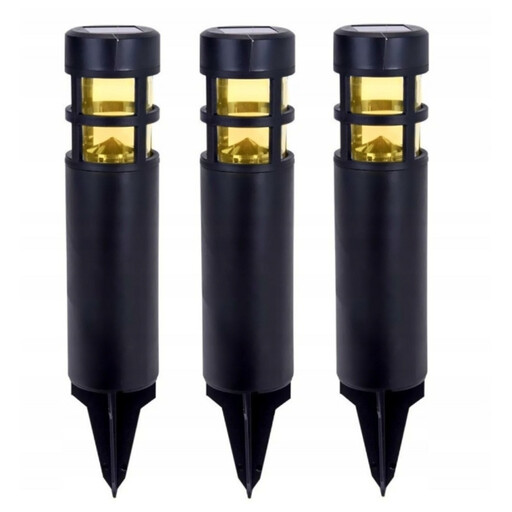
Why this product suits this type of user: This set of three is ideal for adding a little accent lighting along flower bed edges, small paths or lawns. It installs without cables or a fixed mains connection.
The product description mentions automatic operation at dusk and says the lights are designed for paths, gardens and flower bed edges. With three lights, you can try out different installation spots.
Three lights per set; automatic on/off; easy to position outdoors.

Why this product suits this type of user: The stated colour temperature of 6500 K makes this a good fit for buyers who prefer a clearer white light along paths. It is designed with a ground spike for use in soft soil.
The specifications include the charging time, run time, IP44 rating and temperature range. This makes it easier to assess where the light is suitable than a design description alone would.
6500 K; NiMH battery; stated charging time of 4–6 hours and run time of 8–12 hours in suitable conditions.
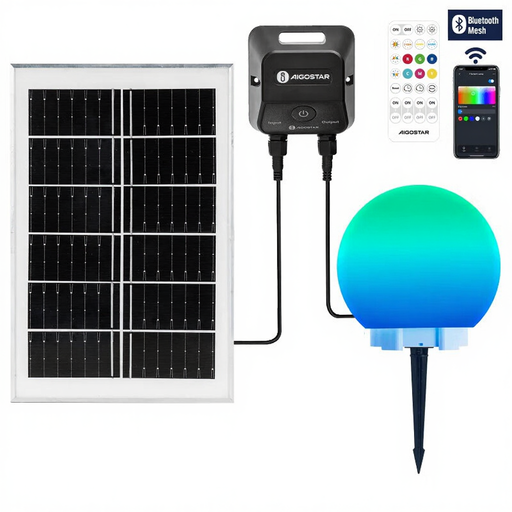
Why this product suits this type of user: The combination of Bluetooth Mesh, app control and RGB+CCT lighting is designed for users who want to control several lights and switch between 2700 K, 6500 K and coloured light.
The specifications distinguish between solar power, a lithium battery, app control and IP54/IP44 ratings. Before installation, check which rating applies to the specific installation location.
RGB+CCT from 2700–6500 K; Bluetooth Mesh connection; control via the AigoSmart app and the option to group several lights.
We’ve put together a complete, regularly updated list of products that meet these strict selection criteria and fully comply with the safety regulations in force in the EU.
Solar-powered outdoor lighting does not need a mains connection while in use. However, ongoing costs still depend on battery replacements, the purchase price and the product’s lifespan. Keeping the solar panel clean helps it charge effectively. For NiMH or lithium batteries, follow the manufacturer’s advice on replacement and disposal.
Avoid placing the lights right beside busy walkways if their ground spikes could become a trip hazard. If the casing or battery is damaged, stop using the light and dispose of it in accordance with local rules for electrical waste.
Many models have a stated charging time of around 4 to 6 hours in suitable sunlight. Cloud cover, shade and short winter days can reduce charging performance. Before first use, it’s a good idea to fully charge the light in accordance with the manufacturer’s instructions.
IP44 is suitable for many sheltered outdoor areas and provides protection against splashing water. However, the lights should not be left standing in water or submerged. For installation spots exposed to the elements, check that the rating is suitable for the specific location.
While in use, solar lights draw power from the battery they have charged and do not need a fixed mains connection. This means they do not add to your household electricity costs. However, the battery may need replacing after a while, depending on the model and how often it is used.