
Lieferung heute & morgen

Qualitätsgarantie

Willkommens-Angebote freischalten: KOSTENLOSE Lieferung | Bis zu 80 % RABATT | Kostenlose 30-Tage-JoyPlus-Testphase
App herunterladen
Solar lights for the garden don’t need a fixed electricity supply and can usually be set up without tools. However, not every solar garden light is right for every location. A decorative garden stake for a flower bed has different requirements from solar path lighting for a frequently used entrance or a smart solar light with app control.
The IP44 rating means protection against solid objects 1 millimetre or larger, as well as splashing water. A solar light with this rating is suitable for many sheltered outdoor areas, but shouldn’t be left standing in water or exposed to heavy rain for long periods. For more exposed locations, a light with IP65 may be a better choice. Even then, it isn’t automatically suitable for submersion.
Claims such as 8 to 12 hours of light apply under suitable charging conditions. In shade, during prolonged cloudy weather, if the solar panel is dirty or at low temperatures, the actual running time may be shorter. Ideally, a solar light should receive several hours of direct daylight. Trees, walls and tall hedges can significantly reduce the amount of charge it receives.
A warm white solar light at around 2700 Kelvin gives off a gentle, slightly yellow light that’s well suited to patios, seating areas and flower beds. Cool white light at 6500 Kelvin looks much brighter and more neutral. An RGB solar light, on the other hand, cycles through colours and is best suited to decorative accents. For consistent visibility along a path, how the light is distributed matters just as much as the stated colour.
Check whether the panel type, battery capacity and charging time are specified. For example, the Aigostar models featured here are listed with charging times of around 4 to 6 hours and a running time of 8 to 12 hours under suitable conditions. Ni-MH batteries are common in small garden stake lights. More powerful smart systems may use lithium iron phosphate batteries instead.
It’s also important to make sure the solar panel is accessible. On a solar ground light or a low-profile solar garden light, it shouldn’t be covered by leaves, soil or plants. A soft cloth is usually all you need to clean it; abrasive cleaners may damage the surface.
For lawns, flower beds and paths, IP44 is often sufficient for decorative models, as long as the light isn’t placed in a hollow or left wet for long periods. Don’t choose a waterproof solar light based solely on the word ‘waterproof’ in the advertising. The specific IP rating in the technical details is what matters.
If your solar light has a ground stake, the soil should be soft enough to push it into. Don’t force the stake into hard or frozen ground, as this could damage the casing and connecting parts. For a driveway or a heavily used area, a sturdy, fixed installation is usually more suitable than a lightweight garden stake.
As well as colour temperature, the luminous flux in lumens matters for practical lighting. Small decorative models often provide gentle illumination to help you find your way, but they’re no substitute for powerful outdoor lighting. If you want to light paths or larger patio areas, also consider the beam angle, mounting height and number of lights.
A smart solar light can be grouped, dimmed or set to a schedule via Bluetooth Mesh. Compatibility, app support and connection range are all important. For decorative RGB models, check whether the colours change automatically or can be selected manually.

Why this product suits this profile: This black solar light is designed as compact path lighting for lawns, flower bed edges or a short garden path. Its ground stake means you can position it without cables.
The product details specify two LEDs, an integrated solar unit and automatic activation in the dark, rather than making vague claims about running time.
Dimensions of 6.5 × 34 cm, two LEDs and a weight of 402 g, according to the product details.
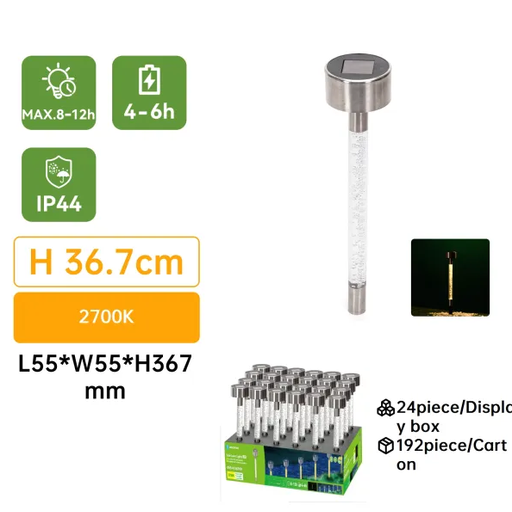
Why this product suits this profile: The warm white light at 2700 Kelvin is ideal for flower beds, paths and seating areas when you want a softer, more subtle light.
The product details specify the IP44 rating, charging time, battery type and operating temperature, making it easier to assess whether it’s right for your location.
2700 Kelvin light, Ni-MH battery, automatic dusk sensor and a stated running time of 8 to 12 hours under suitable conditions.
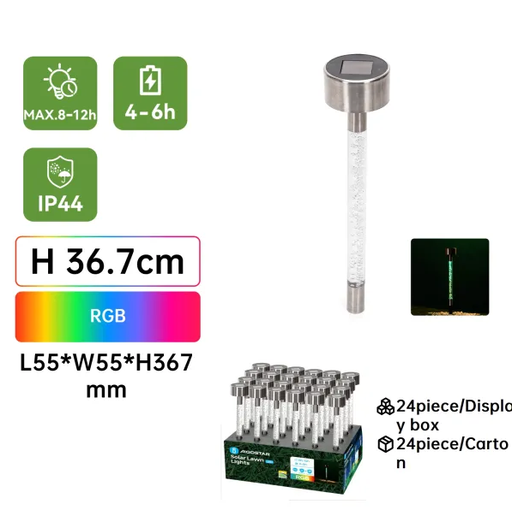
Why this product suits this profile: The RGB version is designed to add colourful accents to flower beds, lawns or patios, and doesn’t need to be connected to the mains.
The product description clearly specifies RGB lighting, an IP44 rating and outdoor use, making its decorative purpose clear.
RGB colour-changing light, 36.7 cm height, 40 mAh Ni-MH battery and a stated operating time of 8 to 12 hours under suitable conditions.
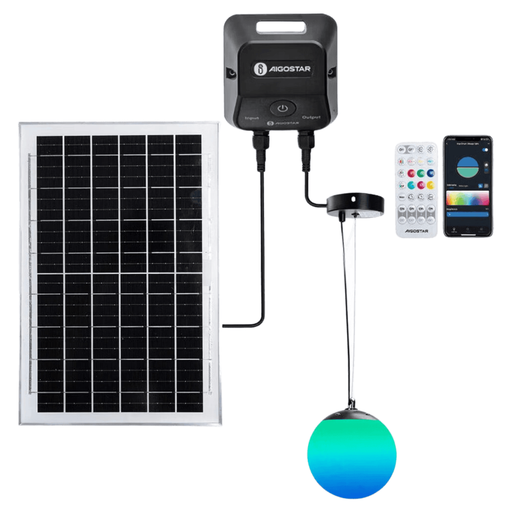
Why this product suits this profile: This model is for anyone who wants to connect multiple lights, adjust brightness and set schedules via Bluetooth Mesh.
The product details specify Bluetooth Mesh, 350 lumens, IP65 and a 10 W solar unit, so you can check the controls and IP rating before buying.
RGBCCT light, 120-degree beam angle, 8 Ah LiFePO4 battery and app features such as scheduling and brightness adjustment.
We’ve put together a complete, regularly updated list of products that meet these strict selection criteria and fully comply with the safety regulations in force in the EU.
It depends on the panel, battery, time of year and location. The Aigostar models mentioned are listed with a charging time of around 4 to 6 hours. Direct sunlight, without shade, helps the battery charge fully. Before using the light for the first time, charge it according to the manufacturer’s instructions.
Lifespan depends on the battery, LED, casing, exposure to moisture and how well the light is maintained. Some product details give the LED a lifespan of up to 15,000 hours. This isn’t necessarily the same as the lifespan of the battery or the entire light. Depending on how they’re used, batteries may lose capacity over time.
While in use, they draw power from the battery charged during the day. The models featured here don’t need to be connected to the mains. Ongoing costs mainly arise if the battery or light needs replacing later on. Smart models also require use of an app or Bluetooth connection.