
Lieferung heute & morgen

Qualitätsgarantie

Willkommens-Angebote freischalten: KOSTENLOSE Lieferung | Bis zu 80 % RABATT | Kostenlose 30-Tage-JoyPlus-Testphase
App herunterladen
A solar light with a motion sensor promises a simple and cost-effective solution for more security and convenience in your outdoor spaces. No wiring, no electricity costs – the benefits are clear. However, the market is flooded with products whose marketing promises often fall short in practice. Many homeowners invest in lights that fail after the first winter or whose brightness is disappointing from the start.
This guide shows you the three common pitfalls to avoid when buying and which technical features truly matter to find a durable and functional solar light for your garden, garage, or driveway.
Before we turn to the recommended features, it's important to know the typical flaws that often lead to a bad purchase.
To make an informed decision, you should focus on objective, technical parameters rather than marketing buzzwords.
The term "waterproof" is flexible. The crucial factor is the IP rating, which consists of two digits. The first digit describes protection against solid particles (dust), and the second describes protection against water. For an outdoor light that is exposed to UK weather year-round, a minimum standard of IP65 is recommended.
Lights with a lower rating like IP44 are more suitable for sheltered areas (e.g., under a porch roof).
The brightness of a solar powered outdoor LED light is measured in lumens (lm). But the lumen count is only half the story. Pay attention to the interplay between brightness and beam angle:
solar security light or outdoor solar floodlight: For illuminating driveways, carports, or larger garden areas, models with 800 to over 3000 lumens are practical. A wide, often adjustable beam angle (e.g., 270° via multiple light heads) is crucial here to cover a large area.Modern solar lights offer various operating modes that control energy consumption and functionality. Three settings are common:
A precise motion sensor with a good range (at least 5–8 metres) and a wide detection angle (120°–180°) is essential for reliable performance as a solar garden light.
Based on the criteria above, we have compiled a selection of products suitable for different user profiles.
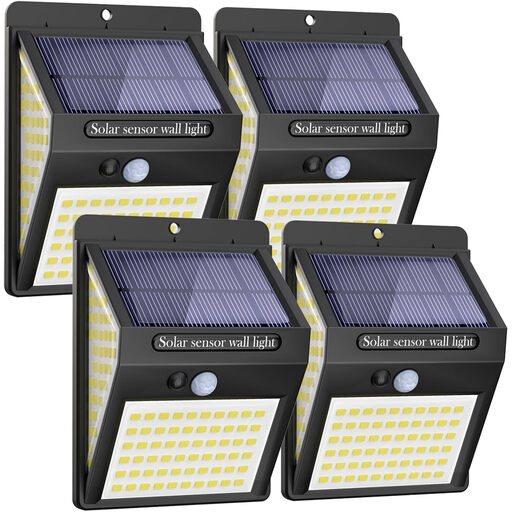
Why it's a match: Ideal for users looking for a cost-effective starter kit to provide solid baseline lighting for multiple areas like a garden path, shed, and front door simultaneously.
This set offers a solid IP65 certification and three practical lighting modes. It avoids the trap of the cheapest products that fail quickly in bad weather.
Excellent value for money with the 4-pack, which allows for wide coverage for basic security and orientation lighting.

Why it's a match: Perfect for homeowners who want not just light, but active surveillance. This device combines a `solar wall light` with an AI-powered camera, with no recurring fees.
With a high protection rating of IP66 and smart person detection, this device goes far beyond simple lighting and addresses the need for robust, smart security.
Combination of a `solar security light` and a surveillance camera with local storage, which eliminates the need for monthly cloud fees.

Why it's a match: Optimal for illuminating large areas such as driveways, yards, or the entire side of a house where a single, but very powerful, light source is needed.
This model delivers a high, verifiable light output of 3000 lumens and combines it with three adjustable heads for a wide 270° beam angle. This distributes the brightness effectively instead of just lighting up a small spot.
High light output and flexible positioning thanks to three light heads for maximum and needs-based area coverage.
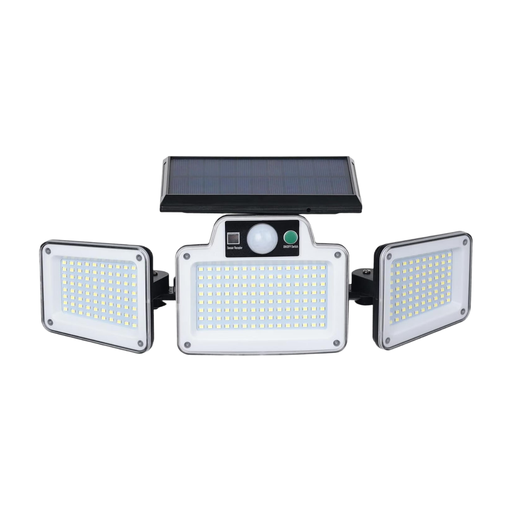
Why it's a match: The ideal solution for installation spots where the light itself must be in the shade (e.g., under a porch roof or on a north-facing wall), but the solar panel can be placed in the sun.
This model solves the problem of inefficient charging with a separate solar panel on a long cable (approx. 4.7m). This ensures optimal sun exposure and thus reliable operation even in less-than-ideal mounting locations.
Maximum installation flexibility for optimal charging efficiency. The included remote control significantly enhances user convenience.
We have compiled a complete, up-to-date list of products that fully meet these strict selection criteria and UK safety regulations.
The runtime in winter depends heavily on sunlight exposure, battery capacity, and the selected mode. On short, cloudy days, charging performance is naturally reduced. To maximise runtime, it's advisable to choose a model with an efficient solar panel and a high-capacity battery. Using the motion-only mode instead of a permanent dim light will significantly extend the available illumination time.
The crucial factor is the solar panel: it should receive several hours of direct, unobstructed sunlight per day, ideally with a south-facing orientation. The light itself is best mounted at a height of 2 to 3 metres. This ensures a good range for the motion sensor and effective illumination of the area. Avoid mounting it in close proximity to other strong light sources (e.g., streetlights), as they can interfere with the dusk-to-dawn sensor.
Yes, modern solar powered outdoor LED light models can achieve considerable brightness. For simple pathway lighting, 100 to 300 lumens are often enough. For deterrence in driveways or as a solar security light for the garage, models with 500 to 3000 lumens are very effective. In particular, the sudden, bright flash of light upon detecting motion has a strong deterrent effect on unwanted visitors.