
Lieferung heute & morgen

Qualitätsgarantie

Willkommens-Angebote freischalten: KOSTENLOSE Lieferung | Bis zu 80 % RABATT | Kostenlose 30-Tage-JoyPlus-Testphase
App herunterladen
Solar lights are a practical way to illuminate paths, façades and seating areas without a fixed power supply. However, claims such as ‘long-lasting light’, ‘waterproof’ or ‘smart control’ don’t automatically mean a product is right for you. The key factors are where you plan to use it, how much sunlight is available and what the technical specifications say.
This guide explains what homeowners, tenants and people with gardens or balconies should look out for. Our recommendations are based on clear product information and a range of different uses.
Wattage isn’t the only important figure to consider with solar lights. You should also look at luminous flux in lumens, colour temperature, beam angle and battery capacity. A solar floodlight with neutral or cool white light may illuminate a path more effectively than a decorative light with lots of LEDs, which is designed mainly to create ambience.
For paths and entrance areas, check how the light is distributed. For flower beds, balcony railings or parties, a solar string light with multiple light points may be a better choice.
The level of protection is shown by the IP rating. The first digit indicates protection against solid objects, while the second indicates protection against water. IP65, for example, means protection against dust and water jets, but not prolonged immersion. An IP67-rated solar light also offers protection against temporary immersion under specified conditions.
That doesn’t mean every component can be left wet without concern. The solar panel on a solar string light should not be submerged. Position cable connections, switches and battery compartments as instructed in the installation guide.
Claims such as ‘up to 12 hours’ or ‘8–14 hours’ are based on specific charging conditions. The light will run for less time in the shade, during short winter days, in cloudy weather or when the solar panel is dirty. The brightness setting and light mode also affect energy use.
A garden light without a mains connection therefore needs to be installed somewhere with as much direct sunlight as possible. With a solar wall light that has a separate panel, you can position the panel more favourably than with a light whose panel is built into the housing.
Battery capacity is usually given in milliampere-hours (mAh). A higher figure may mean longer operating time, but you should consider it alongside the LED output and the solar panel’s charging capacity. Also check:
A solar light with motion or dusk detection can save energy because it doesn’t stay on at full brightness all the time. For decorative lighting, a constant or changing light programme may be more suitable.
For freestanding lights, solar floodlights and façade lighting, the stated IP rating is an important point of comparison. Depending on their design, aluminium, ABS plastic, PE and glass can all be suitable for outdoor use. However, the quality of the construction, seals and fixings, as well as the installation position, still matter.
When installing the light, make sure the solar panel won’t be in constant shade from trees, roof overhangs or railings. For waterproof outdoor lighting, check the product description carefully to see whether it refers to protection against splashes, water jets or immersion.
Cool white light can be useful for driveways, paths and work areas. Warm white light often feels more subtle on a patio or balcony. An RGB solar light offers additional colours and modes, but isn’t necessarily designed to provide practical security lighting.
A smart solar light with Bluetooth control is most useful if you want to coordinate several lights or regularly adjust their colours. Check the range, app requirements, compatibility and position of the solar panel.
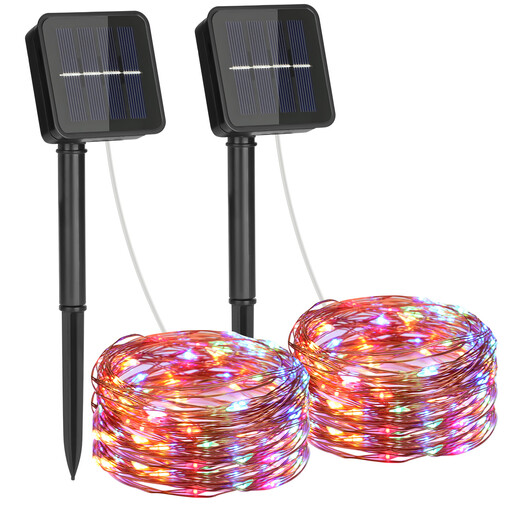
Why this product suits you: Two string lights, each 12 metres long and featuring 120 LEDs, are ideal for balconies, patios, garden parties and seasonal decorations without the need for fixed wiring.
The specifications state the charging time, lighting time and IP65 rating, and warn that the solar panel must not be submerged. This makes it easier to understand what to expect in different weather conditions.
Eight lighting modes, a memory function, automatic on/off switching and a stated lighting time of 8–14 hours under suitable conditions.
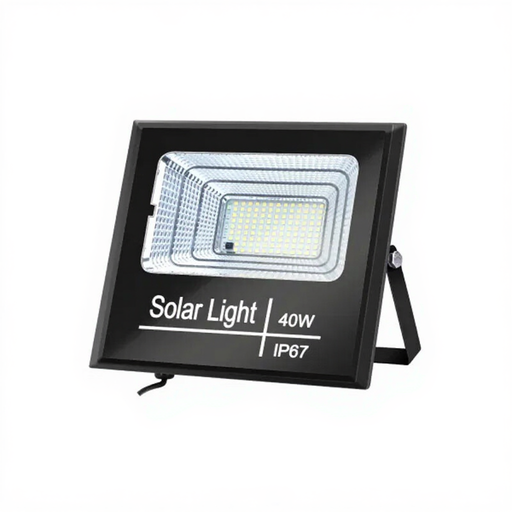
Why this product suits you: The separate solar panel gives you more flexibility when positioning it, while the floodlight is designed to provide focused illumination for gardens, paths and outdoor areas.
The product details specify a separate panel, a 10,000-mAh battery and a stated lighting time of up to 12 hours. Check the current product page to confirm the IP rating before installation.
40 W output, a 6500 K colour temperature, an aluminium and glass construction, and no need to connect it to the mains.

Why this product suits you: The combination of RGB lighting, adjustable white light and Bluetooth Mesh is designed for users who want to control several lights and create different lighting scenes.
The control method, 5 W solar panel, 4000-mAh battery and 5-metre panel cable are all clearly specified. Before buying, check the app requirements and Bluetooth range.
RGB lighting plus adjustable white light from 2700 to 6500 K, Bluetooth Mesh control for multiple devices and a stated charging time of 4–6 hours.
We’ve put together a complete, regularly updated list of products that meet these strict selection criteria and the safety regulations in force across the EU.
If you rent your home, check with your landlord or property manager before drilling into the façade or balcony. For paths and stairs, position lights to avoid glare and make sure they’re securely fixed.
Lighting time depends on battery capacity, hours of sunlight, panel position, light mode and temperature. Manufacturer claims such as 8–14 hours or up to 12 hours are guidelines based on specific conditions. In winter, or after several cloudy days, the lights may run for less time.
An IP rating describes the level of protection tested; it doesn’t mean a product is completely impervious to water. IP65, for example, protects against dust and water jets, but not prolonged immersion. Make sure you follow the installation instructions for the solar panel, cables and battery compartment.
Solar-powered lights don’t need to be connected to the mains when in use. They charge their battery through the solar panel. However, batteries can lose capacity over time and may need replacing after extended use, depending on the design. In some cases, you may need to replace the whole light.