
Lieferung heute & morgen

Qualitätsgarantie

Willkommens-Angebote freischalten: KOSTENLOSE Lieferung | Bis zu 80 % RABATT | Kostenlose 30-Tage-JoyPlus-Testphase
App herunterladen
Reliable outdoor lighting is essential for the safety and comfort around your home. Dark driveways, unlit garden paths, or shadowy entryways can not only create tripping hazards but also compromise security. Many homeowners are therefore looking for a solution that is effective, cost-effective, and easy to install. A solar light with a motion sensor meets these exact requirements: it needs no complex wiring, incurs no electricity costs, and only turns on when it's truly needed.
This article serves as a guide. It explains the most important features to look for when making your selection and presents a variety of models to help make your decision easier.
By the Joybuy Product Recommendation Officer
To find the right light for your needs, it's helpful to understand a few technical specifications. These determine how well the light will perform its job.
The brightness of an outdoor solar LED light is measured in lumens (lm). A higher lumen value means a stronger light output. For simple orientation on a path, lower lumen values are often sufficient, whereas models with several hundred or even a thousand lumens are ideal for illuminating an entire driveway or serving as a security light with a motion sensor.
Many lights also offer various operating modes:
Since a solar light for the garden or garage is exposed to the elements year-round, weather resistance is a critical factor. The IP rating indicates how well a device is protected against the ingress of foreign objects and water. A light with an IP65 waterproof rating is dust-tight and protected against water jets from any angle. This ensures reliable operation in rain, snow, and dust.
The effectiveness of a motion sensor depends on its range and detection angle. A wide angle (e.g., 180°) and a long range (e.g., 5–8 metres) are ideal for covering larger areas like a driveway or garden.
The biggest advantage of solar lights is their wireless installation. They can be flexibly mounted on walls, fences, or posts. Some models, often referred to as outdoor solar floodlights, feature a separate solar panel connected to the light by a cable. This allows the light to be mounted in the shade (e.g., under an eave) while the panel is placed in a sunny spot to maximise energy absorption.
Here is a selection of solar lights that cover different requirements for design, brightness, and functionality.
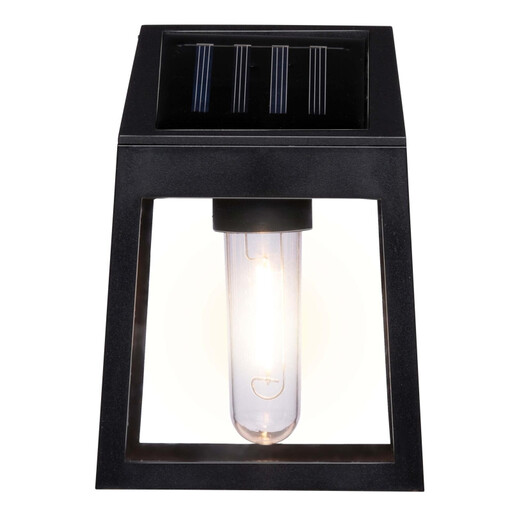
Why it stands out: This light is distinguished by its minimalist design and warm white light, which creates an inviting atmosphere rather than a harsh glare.
Pros:
Who it's for? For users seeking an unobtrusive and stylish solar wall light for accent lighting on paths, patios, or entryways, who value a warm lighting mood.
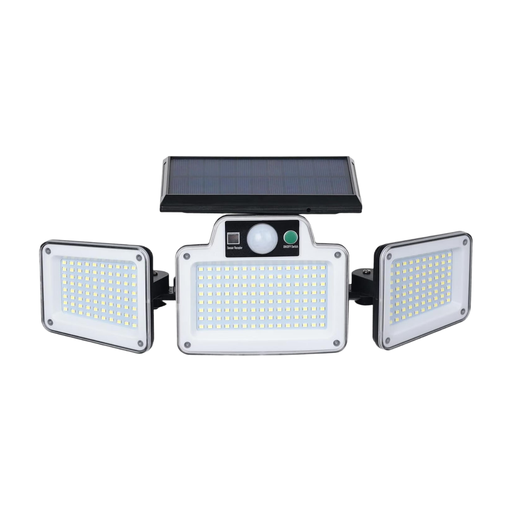
Why it stands out: The three individually adjustable light heads and the separate solar panel offer maximum flexibility in illumination and installation.
Pros:
Who it's for? Ideal for large-area outdoor lighting for the garage, driveways, or yards where flexible light direction and high brightness are needed for deterrence.

Why it stands out: This set offers a cost-effective solution for outfitting multiple areas with identical lights simultaneously.
Pros:
Who it's for? Practical for homeowners who need a comprehensive lighting solution for longer paths, property lines, or multiple dark corners around the house.
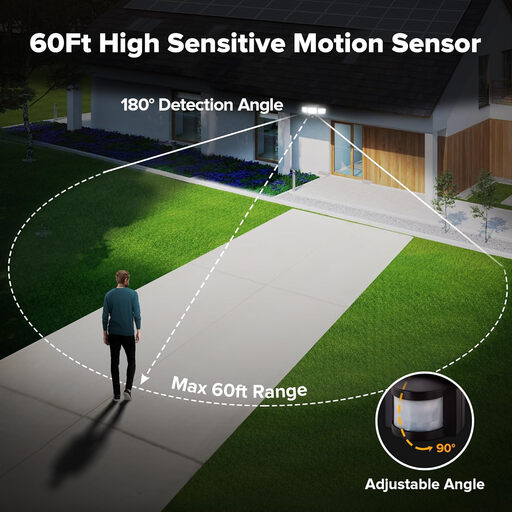
Why it stands out: With 3000 lumens and 302 LEDs, this model delivers exceptionally high brightness, making it a powerful outdoor solar floodlight.
Pros:
Who it's for? For users who need maximum brightness and wide-reaching illumination for large areas such as car parks, gardens, or as a primary security light with a motion sensor.
The selection presented here already covers many use cases. However, the market offers an even greater variety of shapes, sizes, and functions. If you are looking for a model with specific features or simply want to compare more alternatives, you can find additional products in our main category.
Discover our entire range of Outdoor Sensor Lights and find the perfect solution for your home.
The runtime depends on the battery capacity (measured in mAh), the intensity of the sunlight during the day, and the selected operating mode. On a full charge, most models offer a runtime of 8 to 12 hours, which is usually sufficient for the night. In pure sensor mode, the operating time can be significantly longer.
Yes, modern solar lights also work in winter and on overcast days. However, the charging performance is reduced due to fewer hours of sunlight and lower intensity. This can lead to a shorter runtime at night. It is therefore especially important in winter to position the solar panel so that it can absorb as much daylight as possible.
The ideal mounting location for a solar wall light is a position that receives direct sunlight for several hours a day. For models with an integrated panel, the light itself should be placed in a sunny spot. For lights with a separate panel, the lamp can also be installed in the shade (e.g., under a roof overhang), as long as the panel is attached to a sunny location. Avoid locations that are permanently in the shade of trees, buildings, or other obstacles.