
Lieferung heute & morgen

Qualitätsgarantie

Willkommens-Angebote freischalten: KOSTENLOSE Lieferung | Bis zu 80 % RABATT | Kostenlose 30-Tage-JoyPlus-Testphase
App herunterladen
A well-lit outdoor area deters unwanted visitors and enhances safety for you and your family. A solar spotlight with a motion sensor is a cost-effective and eco-friendly solution for this, as it operates without an electrical connection. However, the market is flooded with products whose performance claims often don't hold up in practice. Many homeowners invest in an outdoor solar light only to find it fails after the first winter or never achieves its advertised brightness.
Before you make a decision, it's crucial to understand the most common pitfalls that can lead to a purchase you'll regret:
To find a durable and functional solution, you should check three core technical parameters. These critically determine the performance and reliability of your solar-powered LED outdoor spotlight.
The true brightness of a light is measured in lumens (lm), not watts. For effective security lighting, such as for a garage and driveway, values of 800 lumens or more are recommended. A high-performance solar floodlight can even reach 2000 lumens or more. Also, pay attention to adjustable lighting modes:
For permanent outdoor use, a high protection rating is essential. A solar wall light with a motion sensor should be at least IP65 waterproof. The first digit (6) signifies complete protection against dust, while the second digit (5) indicates protection against water jets from any angle. This ensures the electronics are reliably protected even during heavy rain and snow.
The battery capacity, measured in milliampere-hours (mAh), determines the runtime. For long winter nights, a capacity of at least 2000 mAh is advisable. Equally important is the efficiency of the solar panel. Models with a panel that is separate from the light offer a crucial advantage: you can mount the solar garden light in a dark area (like under an eave) and place the panel in a sun-exposed location to maximise charging performance.
Based on these objective criteria, we have identified several models suitable for the specific profiles of homeowners and property owners.

Why This Fits Their Persona: Ideal for users who need maximum brightness and wide coverage for deterrence. Perfect for large driveways, yards, or fully illuminating the sides of buildings.
Addresses the trap of insufficient brightness with a specified value of 3000 lumens. The IP65 certification ensures the necessary weather resistance for year-round use.
High Luminosity: The 302 LEDs produce 3000 lumens according to the manufacturer. Wide Illumination Angle: Three adjustable heads allow for flexible lighting up to 270°.
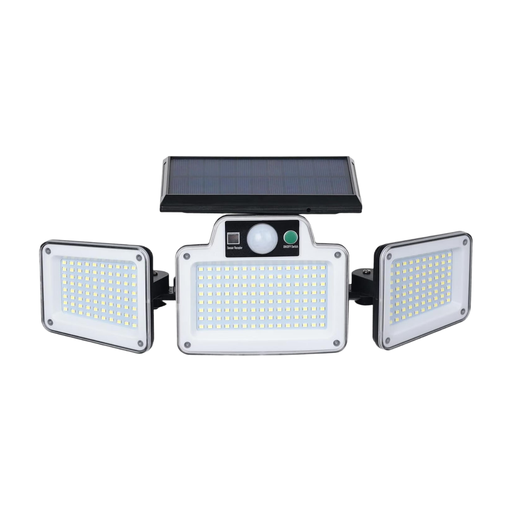
Why This Fits Their Persona: Perfect for installation spots where the light must be placed in the shade (e.g., under a carport or on a north-facing wall), but the solar panel can be positioned in full sun.
Solves the problem of inefficient charging with a separate solar panel and a long cable. This bypasses the pitfall of a weak power supply in suboptimal installation locations.
Flexible Installation: The approx. 4.7-meter (15.4 ft) cable allows the light and panel to be mounted separately. Good Battery Capacity: The 2400mAh battery provides a solid foundation for runtime.
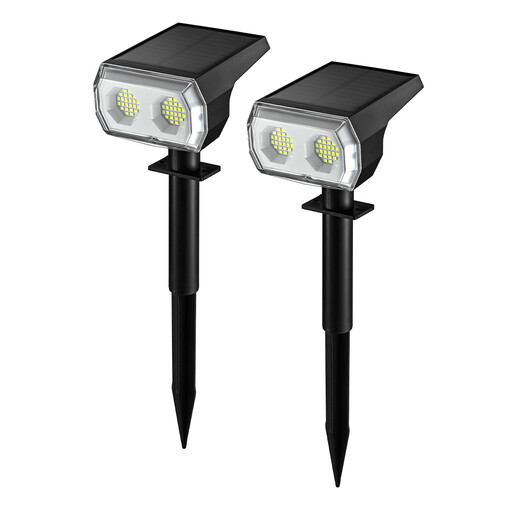
Why This Fits Their Persona: A practical and versatile solution for illuminating garden paths, flower beds, or accenting plants. The warm white light creates a pleasant atmosphere instead of harsh security lighting.
Offers two lighting modes to actively manage battery life. The IP65 rating and robust ABS construction provide the necessary durability for outdoor use.
2-in-1 Installation: Can be flexibly staked into the ground or mounted on a wall. Great Value: The set includes two spotlights.
We've compiled a complete, up-to-date list of products that fully meet these strict selection criteria and safety standards.
Yes, modern solar spotlights also work in winter. However, charging performance is reduced due to shorter days and a lower sun angle. Models with high-efficiency solar panels and large batteries have a clear advantage here. Selecting an energy-saving light mode (e.g., pure sensor mode) also helps conserve energy to last the entire night.
The ideal location for the solar panel is an unshaded, south-facing area to capture maximum sunlight throughout the day. The light itself can be placed wherever light is needed. Models with a separate panel offer the greatest flexibility in this regard. Avoid mounting the panel directly under eaves, trees, or on north-facing walls.
The lifespan depends on the quality of the components. A high-quality spotlight with IP65 protection and a robust housing can last for several years. The battery is often the component with the shortest lifespan, typically lasting 2-4 years depending on charge cycles and quality. Regularly cleaning the solar panel of dust and debris can also extend its lifespan and efficiency.