
Lieferung heute & morgen

Qualitätsgarantie

Willkommens-Angebote freischalten: KOSTENLOSE Lieferung | Bis zu 80 % RABATT | Kostenlose 30-Tage-JoyPlus-Testphase
App herunterladen
Solar outdoor lighting is ideal for the garden, courtyard, garage, terrace, balcony and pathways where there’s no mains connection or you’d prefer not to run extra cabling. Claims like “powerful floodlight”, “waterproof” or “long runtime” only make sense in context with the technical data. What really matters are the mounting location, sun exposure, your lighting needs and the actual protection rating.
With LED lights and solar products, the wattage alone tells you little about visible brightness. For comparisons, the luminous flux in lumens is more meaningful. A solar light with 500 lumens is better suited for wayfinding or as decorative lighting, while a solar floodlight with 3,000 lumens can illuminate larger areas.
Terms like “40 W” or “50 W” can also refer to an equivalent output. Check whether the figure means actual power consumption, an incandescent equivalent, or a maximum rated output.
Protection is defined by the IP classification. The first digit indicates protection against solid objects and dust; the second digit indicates protection against water.
Even with an IP65 waterproof solar light, you shouldn’t place it in standing water or mount it where it will sit under a puddle. For balconies, terraces and gardens, it also matters whether cable connections, the solar panel and the housing are all equally suitable for the intended outdoor environment.
Battery life is usually quoted for defined charging conditions. In a German winter, under cloudy skies, with shading from buildings or a dirty solar panel, available lighting time can be shorter. Pay attention to:
A separate panel can be useful if the light itself needs to be in the shade while the panel is mounted somewhere sunnier.
Colour temperature is given in Kelvin:
An LED outdoor light with 5,000 K or more can render outlines and surfaces clearly. For seating areas, warm white light is often more inviting. With RGB or CCT models you can change the light colour to suit the mood.
An outdoor wall light with motion sensor shouldn’t just promise a long range. Also check the detection angle, mounting height, adjustable on-time and sensitivity. A sensor that’s too sensitive may trigger for passing cars or moving branches. One that’s too limited may only pick up people late.
For paths and entrances, a moderate sensor is often sufficient. For driveways or larger courtyards, a wide-angle solar floodlight for outdoor use with multiple LED heads may be the better choice.
Solar lights without a mains connection need a spot with the most direct, unobstructed sunlight possible. Before fitting, check whether the wall, fence or ceiling can safely support the weight. For hardwired lights, installation must be carried out by a qualified electrician.
Aluminium, glass, ABS and polycarbonate each have different properties. Aluminium can provide a robust housing base, while plastic is lighter. Whatever the material, seals, screw joints and cable routing should be checked regularly for visible damage. Clean the solar panel with a soft, slightly damp cloth.
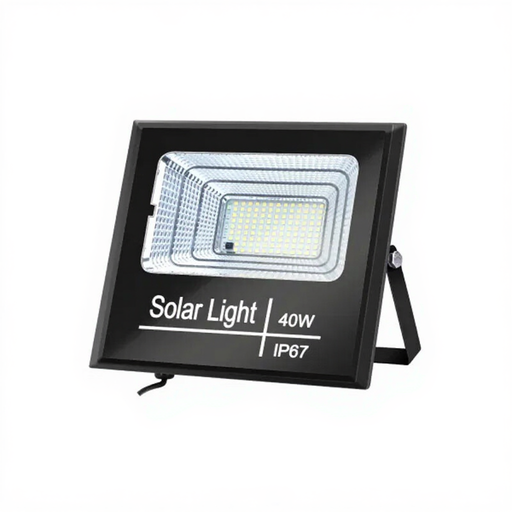
Why this product fits the profile: The separate panel allows flexible, cable-free installation without a mains connection, for example on a garden shed, a garage or along a path.
The product description specifies a 10,000 mAh battery and up to 12 hours of lighting time. The protection rating is listed as IP67.
Separate solar panel, wireless installation and clear suitability for gardens, pathways and outdoor areas.
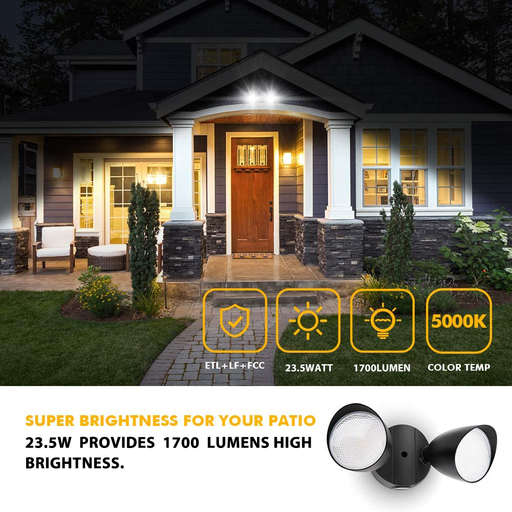
Why this product fits the profile: This mains-powered light is aimed at buyers planning a permanently available outdoor light for a garage, shed or driveway.
The light source is specified at 5,000 K; the two LED heads can each be adjusted by 180 degrees. Electrical installation is required.
Die-cast aluminium housing, tempered glass lenses and two adjustable lamp heads.
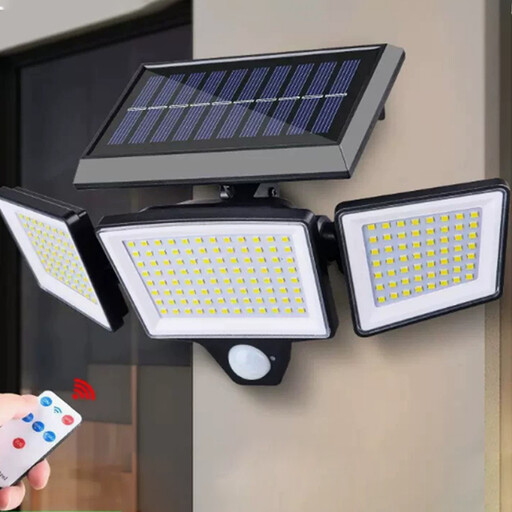
Why this product fits the profile: Three lamp heads, a 180-degree detection angle and three operating modes suit driveways, courtyards and larger garden areas.
The description cites 3,000 lumens, a detection distance of around 18 metres and IP65. For correct operation, the panel and sensor must remain unobstructed.
302 LEDs, three adjustable heads, motion detection and a stated two-year warranty.
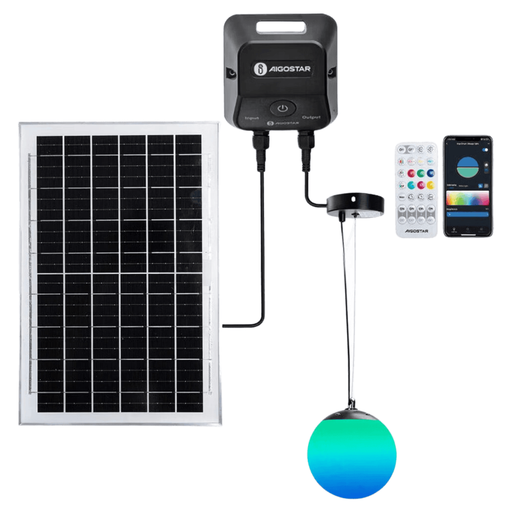
Why this product fits the profile: This smart solar light offers app control, schedules and adjustable colours for gazebos, terraces and garden zones.
The product data lists 350 lumens, IP65, a 10 W monocrystalline panel and an 8 Ah LiFePO4 battery. That keeps the key performance data transparent.
Bluetooth Mesh connectivity, RGB and white light control, plus a stated runtime of up to 24 hours on a full charge.
We’ve compiled a complete, continuously updated list of products that fully meet these rigorous selection criteria and the safety regulations in force in the EU.
For an LED security light at the entrance, choose an easy-to-reach mounting point with an unobstructed view of the detection area. For solar garden lighting along a path, make sure individual lights aren’t shaded by hedges or walls. A solar pendant light with a separate panel can be used under a gazebo if the panel is positioned outside the shaded area.
Battery-powered pendant lights without a solar panel are another option for decorative purposes. However, they don’t count as solar outdoor lighting and will need regular battery replacement. With a solar light there are no ongoing mains electricity costs during operation; still factor in the potential replacement of the battery or the light after its service life.
Actual lifespan depends on the battery, LED module, temperature, humidity and care. Clean the solar panel regularly and check the housing and seals. The stated lighting time refers to suitable charging conditions and may be shorter in winter.
For fully exposed areas, models with IP65 or higher are often a better fit than IP44 lights. IP44 is more suitable for protected, covered spots. The protection rating is no substitute for proper installation: connections should be protected according to the manufacturer’s instructions, and lights should not be operated under water on a permanent basis.
While in use, a solar light draws energy from its charged battery and does not need a mains connection. There are therefore no ongoing electricity costs from your household supply. However, charging performance and lighting time depend on sunlight, panel position, the battery and the brightness setting you choose.