
Lieferung heute & morgen

Qualitätsgarantie

Willkommens-Angebote freischalten: KOSTENLOSE Lieferung | Bis zu 80 % RABATT | Kostenlose 30-Tage-JoyPlus-Testphase
App herunterladen
Solar outdoor lighting can mark pathways, illuminate the entrance area or create atmosphere in a gazebo – without the need for additional wiring. In practice, however, satisfaction depends less on high wattage figures and more on luminous flux, IP rating, battery capacity and installation location. The Joybuy Product Recommendation Officer shows which specifications are relevant before purchase and which solutions suit different usage scenarios.
With solar products, a figure like "50 W" does not always indicate the actual power consumption. It may refer to an incandescent lamp equivalent or a theoretical maximum power. For comparison, the luminous flux in lumens is more meaningful:
The designation IP65 means: dust-tight and protected against water jets from various directions. This is suitable for many outdoor areas, but does not mean the light can be submerged in water. IP44 protects against solid foreign objects and splashing water, while IP54 combines dust protection and splash water protection.
An IP44 solar light should therefore be installed in a sheltered position under a roof, on a covered patio or in an area without standing moisture. For exposed walls and harsher weather, an IP65 outdoor light is generally more appropriate, provided the installation instructions also permit this.
A solar panel needs as much direct, unobstructed sunlight as possible during the day. Trees, roof overhangs or a permanently north-facing area can reduce charging performance. With models featuring a separate panel, the light can be hung in the shade while the panel is mounted in a sunnier spot.
Luminous flux is given in lumens (lm). For decorative pathway lighting, lower values are often sufficient. For illuminating a driveway or work area, higher lumen values make sense. A solar light with a motion sensor can remain dimmed in standby mode and shine brighter when movement is detected.
Light colour is given in Kelvin (K):
Some models offer a switchable colour temperature. With a solar light featuring 3CCT, you can choose between warm white, neutral white and cool white.
Runtime depends on sunlight, season, temperature, brightness level and battery condition. Figures such as "up to 12 hours" or "up to 24 hours" should therefore be understood as maximum values under certain conditions.
LiFePO₄ batteries are often used when high cycle stability and a comparatively stable battery concept are desired. However, a larger capacity alone does not guarantee longer runtime, as light output and control must also be taken into account.
Solar lights normally do not require mains wiring. Nevertheless, before purchasing you should check:
A mains-powered LED outdoor light such as a recessed spotlight or ceiling light is not the same as a cordless solar light. With dimmable LED recessed spotlights, the cut-out dimensions, installation depth, dimmer compatibility and IP rating must all match.
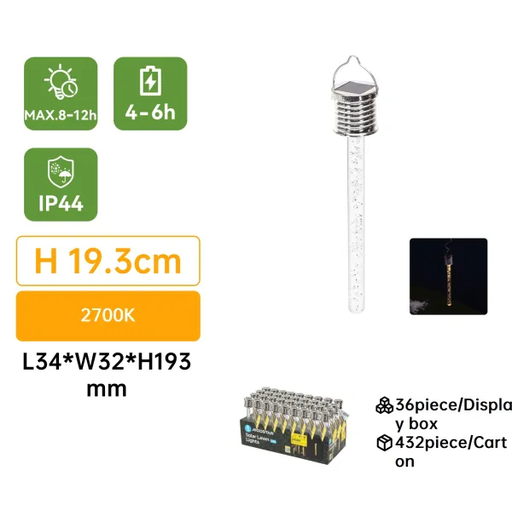
Why this product suits the profile: The compact solar pendant light is designed for decorative areas such as balconies, patios or sheltered garden spots and requires no mains connection.
The product specifications state 2700 K, a charging time of approximately 4–6 hours and a runtime of 8–12 hours. However, the IP44 rating does not make the light suitable for every exposed outdoor area.
Warm white light at 2700 K, lightweight at approximately 40 g and integrated Ni-MH battery.
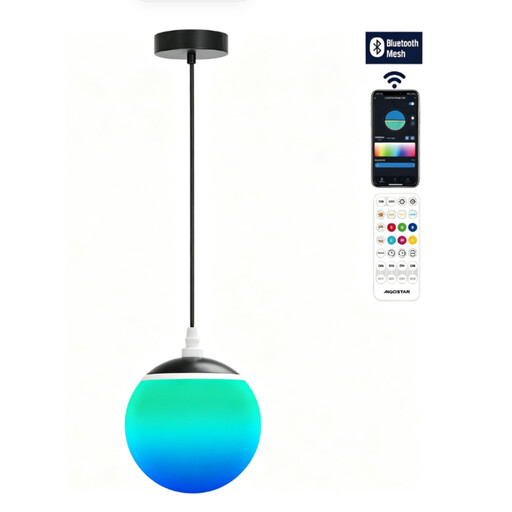
Why this product suits the profile: For gazebos and patios with changing lighting moods, the smart solar light offers app control, Bluetooth Mesh and separate panel positioning.
The light specifies 200 lm, IP65, a LiFePO₄ battery and a separate 6 W solar panel. This allows brightness and panel location to be planned independently.
RGBCCT with 2700–6500 K, Bluetooth Mesh 5.0, app control and stated runtime of up to 24 hours.
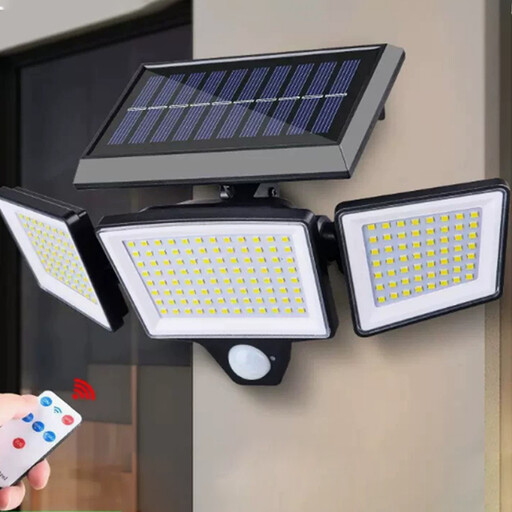
Why this product suits the profile: For the garage, driveway, yard or large garden areas, a solar floodlight with motion sensor and three adjustable light heads is provided.
The selection is based not only on the LED count, but on the stated 3000 lm, IP65, 180° sensor angle and up to 60 feet detection distance.
Three light heads with 270° coverage, three operating modes and cordless wall mounting.
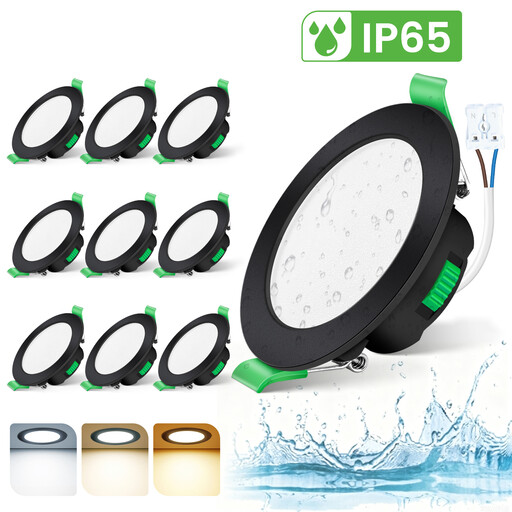
Why this product suits the profile: This mains-powered LED outdoor lighting is suitable for bathrooms, kitchens, balconies and covered areas where a fixed power supply is available.
The specifications state 230 V, 7 W, 500–600 lm, IP65 and a ceiling cut-out of 67–75 mm. This allows installation requirements to be checked in advance.
Dimmable from 10–100 %, three colour temperatures and aluminium-polycarbonate housing.
We have compiled a complete, regularly updated list of products that fully meet these strict selection criteria and the safety regulations in force in the EU.
The lifespan depends on the battery, LED module, housing, temperature and maintenance. Regular cleaning of the solar panel removes dust and leaves that can impair the charging process. In frost or prolonged rainy periods, the runtime may decrease. The stated IP rating should match the installation location.
During operation, there are no ongoing electricity costs from the mains supply, as the energy is obtained via the solar panel. However, the actual performance depends on sunlight, panel size, battery and the chosen brightness. For reliable continuous lighting in permanently shaded spots, a mains-powered light may be more practical.
The installation location should cover the desired area while also receiving several hours of direct sunlight. The sensor and panel must not be obstructed by roof edges, plants or other lights. For driveways and garages, the mounting height should also be chosen so that the motion sensor detects people without unnecessarily reacting to passing vehicles or animals.