Whether you're camping in the great outdoors, on a long road trip in your RV, or preparing for a power outage at home, an independent power supply is becoming increasingly essential. A power station with a solar panel, often called a solar generator kit, offers a flexible and eco-friendly solution. However, the market is vast, and technical specifications can be overwhelming.
This article serves as a practical guide. It explains the most important criteria to consider when making your selection and introduces several models suitable for various use cases. Our goal is to provide you with a solid basis for making an informed decision so you can find the perfect portable power supply for your needs.
What to Look for in a Solar Generator Kit
Choosing the right kit depends on your individual power requirements. Three key aspects will help you find the ideal combination of a power station and a solar panel.
Understanding Capacity (Wh) and Power (W)
These two values are crucial but are often confused.
- Capacity, measured in watt-hours (Wh), indicates how much energy the power station can store. A higher capacity means you can run your devices for longer. To determine your needs, add up the consumption of the devices you plan to charge. For example, a laptop requires about 50-60 Wh for a full charge.
- Power, measured in watts (W), describes how much electricity the power station can deliver at once. This value determines which devices you can connect. A hairdryer rated at 1,200 W requires a power station with a correspondingly high output, whereas 300 W may be sufficient for charging smartphones and laptops.
Ports and Charging Options
A modern power station for an RV or camping should offer versatile connection options. Look for a good mix of:
- AC Outlets (230V): Standard household sockets for devices like laptops, coolers, or projectors. A pure sine wave is essential here to protect sensitive electronics from damage.
- USB-A and USB-C: For charging smartphones, tablets, and cameras. A USB-C port with Power Delivery (PD) enables exceptionally fast charging for compatible devices.
- DC Ports and 12V Car Socket: Useful for specialised camping gear or for running devices designed for a car's power outlet.
Furthermore, the portable solar system with storage should be flexible to recharge—via a wall outlet, the 12V port in your car, and, of course, a solar panel.
Choosing the Right Solar Panel
The foldable solar panel is the heart of your off-grid power supply. Efficiency and compatibility are the deciding factors here. Monocrystalline solar cells generally offer higher efficiency than polycrystalline ones, meaning they generate more power from the same surface area. The panel's power rating (e.g., 100W or 200W) should be matched to the power station's maximum charging input to achieve optimal charging times.
Our Top Picks for Power Stations and Solar Panels
Here is a selection of components that can be combined to create a powerful solar emergency generator or a mobile energy solution for your adventures.
The High-Performance Combo for Demanding Use
For users who need high capacity and power for extended trips or as an emergency backup, a combination of a mid-sized power station and a powerful panel is an excellent choice.
SWAREY Portable Power Station 518Wh, S500 Solar Generator
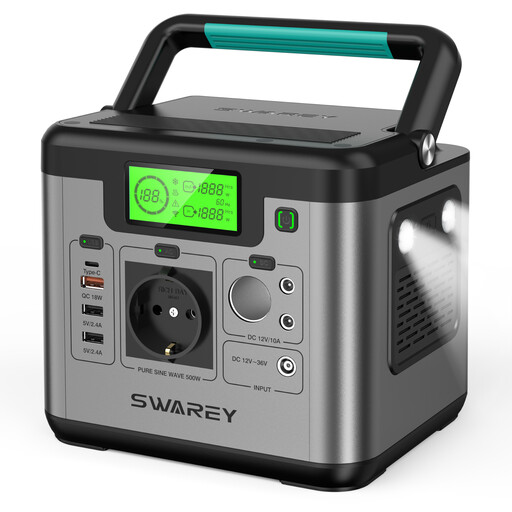
- Why it stands out: The SWAREY S500 offers a solid 518 Wh capacity and a pure sine wave output of 500 W (1000 W peak). This allows it to safely power sensitive devices like laptops, drones, or medical equipment.
- Advantages:
- Charge up to 8 devices simultaneously
- Versatile outputs, including a 65W USB-C PD fast-charging port
- Three charging methods: wall outlet, car, or solar panel (up to 126W)
- Integrated BMS (Battery Management System) for protection against overcurrent and overheating
- Who is it for?: Ideal for RV owners, multi-day camping trips, or as an emergency power supply for essential household appliances during an outage.
SWAREY 200W Foldable Solar Panel
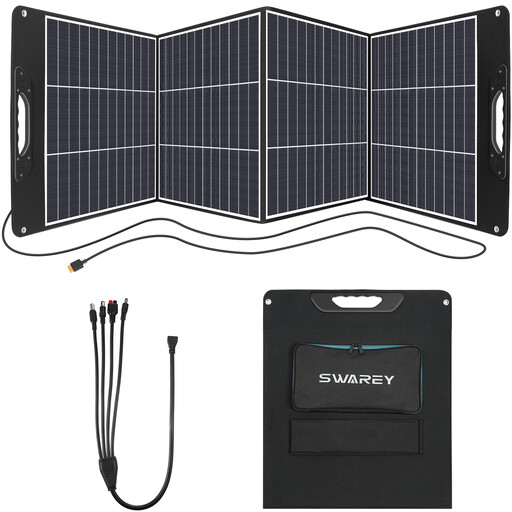
- Why it stands out: This panel uses high-efficiency monocrystalline cells that, according to the manufacturer, achieve a conversion efficiency of up to 23%. With 200 W of power, it can quickly recharge the S500 power station or similar models.
- Advantages:
- High efficiency for maximum power generation
- Foldable design with a carrying handle for excellent portability
- Direct charging ports (USB-A, QC3.0, 18W PD Type-C)
- Compatible with most power stations thanks to its XT60/Anderson connector and 4-in-1 cable
- Who is it for?: For users who need fast and efficient solar charging for larger power stations and value a robust design.
The Compact Solution for On the Go
If you're looking for a lightweight and easy-to-transport solution for weekend getaways, festivals, or mobile work, a smaller power station with a matching panel is a great fit.
SWAREY Portable Power Station 300W, 222Wh
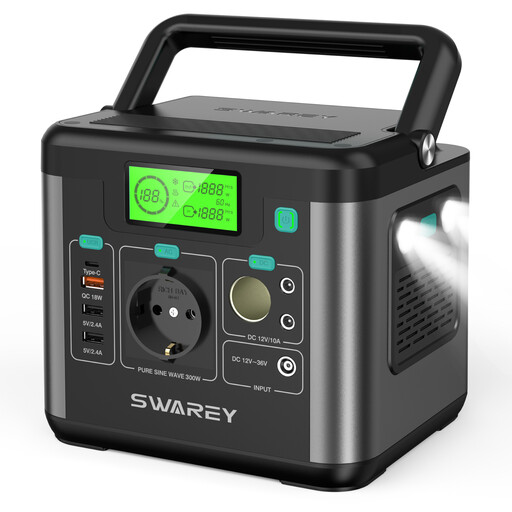
- Why it stands out: Weighing only about 3.2 kg, this power station is extremely portable. Despite its compact size, it delivers a pure sine wave output of 300 W (600 W peak) and has a capacity of 222 Wh.
- Advantages:
- Very lightweight and compact with an integrated carrying handle
- Fast recharging via 65W USB-C PD
- Can power up to 8 devices at once
- Manufacturer-stated charging time of approx. 2 hours with a 150W solar panel
- Who is it for?: Perfect for day trips, photographers, drone pilots, or as a portable power supply for camping on short trips where every gram counts.
SWAREY 100W Foldable Solar Panel
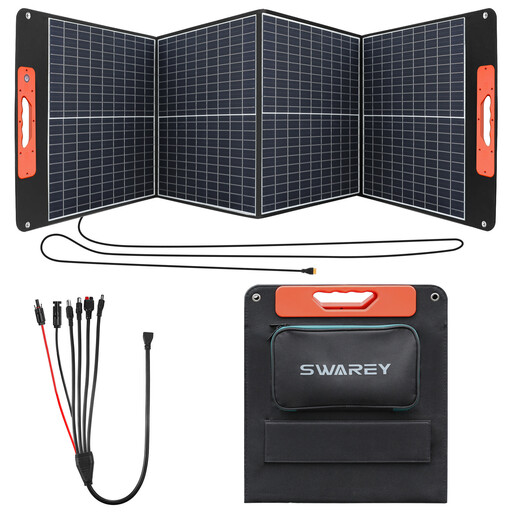
- Why it stands out: This 100W panel combines portability with high efficiency. A special feature is the "Ray Tracer" technology, a target that helps you find the optimal alignment with the sun.
- Advantages:
- High 23% efficiency rating from monocrystalline cells
- Direct fast charging for devices via 60W USB-C PD and 18W USB-A QC3.0
- Lightweight and compact 4-panel folded design (approx. 3.5 kg)
- Wide compatibility with the included 5-in-1 cable
- Who is it for?: An excellent companion to the 300W power station or as a standalone charging solution for laptops, tablets, and smartphones directly in the sun.
Looking for More Options?
The products featured here cover common use cases. However, if you have different requirements for capacity, power, or portability, there are many other models to discover.
Explore our entire range of camping equipment and find the right gear for your next adventure.
Frequently Asked Questions
What does "pure sine wave" mean for a power station?
A pure sine wave produces an electrical current quality that matches the power from your home outlet. This is essential for operating sensitive electronic devices such as laptops, cameras, drones, or medical equipment. Power stations without a pure sine wave (which use a modified sine wave) can damage this sensitive electronics over time.
How do I choose the right solar panel size for my power station?
As a rule of thumb, the nominal power of the solar panel (in watts) should match the maximum solar input power of the power station to ensure efficient charging. A 100W panel will charge a 500Wh power station in about 6-8 hours under optimal sun conditions. Check the technical specifications of both devices to ensure compatibility.
Can I use my devices while the power station is charging?
Yes, the SWAREY models featured here support "pass-through charging." This means you can power connected devices while the power station itself is being recharged—for example, by a solar panel. This is especially convenient for an uninterrupted power supply when camping or in an RV.


