
Lieferung heute & morgen

Qualitätsgarantie
App herunterladen
Kategorien
An outdoor solar light with a motion sensor is a self-sufficient and energy-efficient solution for illuminating and securing outdoor areas. Independent of the power grid, it uses the sun's energy to provide light when needed. Choosing the right model depends on specific technical parameters that should be tailored to the particular use case. This article analyses the crucial criteria and presents a selection of models based on their specifications.
The functionality of solar garden lighting is determined by the interplay of several technical components. An informed decision is based on the analysis of these key metrics.
The brightness of a light is measured in lumens (lm). A higher lumen value means a greater light output. For illuminating pathways, values between 300 and 800 lumens are often sufficient. For securing driveways or as an outdoor security light, models with 1000 to 3500 lumens or more should be considered. Modern solar lights exclusively use LEDs (Light-Emitting Diodes) as their light source, as they offer high efficiency and a long lifespan.
The motion sensor is the core component for on-demand lighting. Two parameters are crucial here:
The stored energy determines the runtime at night. The battery's capacity is specified in milliampere-hours (mAh). A typical value for high-performance models is 2000 mAh or higher. The efficiency of the solar panel, often stated as a percentage conversion rate, affects how quickly the battery charges in daylight. Some models feature a separate solar panel connected to the light by a cable. This allows for optimal alignment of the panel towards the sun, while the light can be mounted in the shade.
Since an LED outdoor light with a motion sensor is permanently exposed to the elements, its protection rating is a critical feature. The IP (Ingress Protection) rating indicates the level of protection against foreign objects and water. A waterproof solar light should have at least an IP65 rating. This certification means:
The following models have been selected based on their technical specifications and functional design.
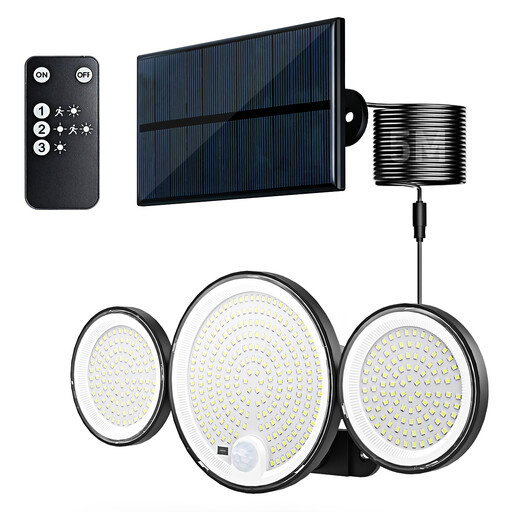
Why We Recommend This Product: This model stands out for its high flexibility. The solar panel is separated from the light unit by a 4.7-metre cable, allowing for sun-optimised placement of the panel regardless of where the light is mounted. The three adjustable light heads and remote control offer additional customisation options.
Pros:
Who It's For: Users who need to mount the outdoor solar spotlight in a shady location (e.g., under an eave or on a north-facing wall) but can position the solar panel in full sun.
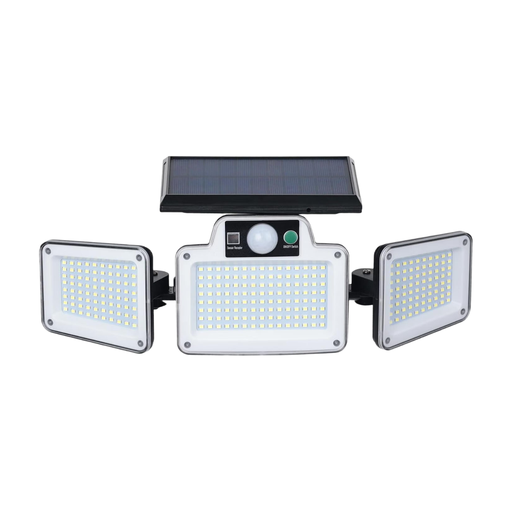
Why We Recommend This Product: With 446 LEDs and a stated brightness of 3500 lumens, this model is designed for maximum light output. The ABS plastic construction, combined with IP65 waterproofing, ensures durability in outdoor use. The three adjustable heads allow for wide and flexible area illumination.
Pros:
Who It's For: Users who need exceptionally bright lighting for large areas like yards, wide driveways, or parking lots and who prioritise maximum brightness.
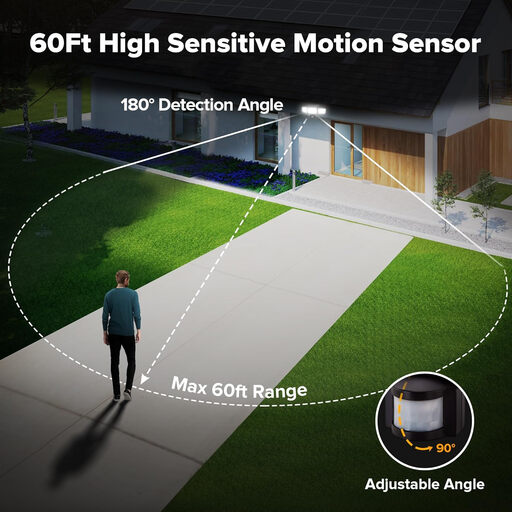
Why We Recommend This Product: This model focuses on above-average sensor performance. According to the manufacturer, the motion sensor offers a detection range of up to 18 metres (60 feet) and a wide 180° angle. Combined with 302 LEDs, 3000 lumens of brightness, and a 25% more efficient tempered glass solar panel, it is designed for security and efficiency.
Pros:
Who It's For: Users for whom early motion detection over a long distance is a priority, for instance, for monitoring long paths or large garden areas.
If the models presented here don't exactly meet your requirements, you can find a wider selection of solutions with different specifications and designs in our main category. There, you can filter specifically by parameters such as lumens, battery capacity, or special designs.
Discover more LED Outdoor Solar Lights on Joybuy.de
1. How long does a solar garden light stay on? The runtime depends on the battery capacity, the intensity and duration of sun exposure during the day, and the selected lighting mode. On a full charge, most models offer a runtime of 8 to 12 hours in sensor-only mode, where the light is activated only by motion. In continuous light mode, the runtime is correspondingly shorter.
2. Do solar lights work in winter or on cloudy days? Yes, solar lights also work in diffuse light, but with reduced charging performance. On cloudy days or in winter with shorter days, the battery charges more slowly and may not reach a full charge. This can lead to a shorter runtime at night. Therefore, an optimal, south-facing placement of the solar panel is advantageous year-round.
3. What does the IP65 certification mean for a solar light? The IP65 certification is a standard that defines the degree of protection an enclosure provides against the ingress of foreign objects and water. The first digit (6) stands for complete dust protection. The second digit (5) guarantees protection against water jets from all directions. A light with an IP65 rating is thus well-protected against rain, snow, and dirt and is suitable for permanent outdoor use.
Written by your Joybuy Product Recommendation Officer