
Lieferung heute & morgen

Qualitätsgarantie

Willkommens-Angebote freischalten: KOSTENLOSE Lieferung | Bis zu 80 % RABATT | Kostenlose 30-Tage-JoyPlus-Testphase
App herunterladen
A soundbar with subwoofer can significantly enhance your TV audio without the need for a traditional AV receiver and multiple speakers around the room. However, high wattage figures, terms such as Dolby Atmos and the description “wireless” often create unrealistic expectations. If you only look at the product description, it is easy to overlook connection limitations, room acoustics or the actual cabling required.
This buying guide explains what households, film fans, gamers and music lovers should look for when choosing a soundbar for TV.
Figures such as 420, 500 or 580 watts often describe the maximum output or the output specified by the manufacturer. On their own, they reveal little about how balanced voices, effects and music will sound. Other important factors include:
A high power rating is therefore no substitute for suitable connections and a sensible speaker configuration.
A Dolby Atmos soundbar with upward-firing speakers can create height effects by reflecting sound off the ceiling. However, the result depends on the ceiling height, surface, seating position and layout of the room. Very high, highly absorbent or open ceilings can weaken the effect.
With a 5.1.2 soundbar, “.2” generally refers to two height channels. A 5.1 soundbar, by contrast, operates without separate height channels. With a 7.1 soundbar featuring additional surround speakers, the spatial impression is created more by their positioning than by the soundbar alone.
A wireless subwoofer transmits the audio signal without a cable connection to the soundbar. It still requires a mains socket to operate. Systems with rear speakers may also require additional power supplies or speaker cables. Before buying, check where sockets are available and whether cables can be routed safely.
For a straightforward connection to your TV, HDMI ARC is usually sufficient. HDMI eARC offers greater bandwidth and can transmit compatible, uncompressed multi-channel formats. eARC is particularly relevant for lossless Dolby Atmos signals.
Check your TV:
An optical cable also works with many TVs, but it does not support all modern multi-channel formats.
The channel specification describes how the audio is divided. With 3.1.2, the focus is on three front channels, one bass channel and two height channels. A system with genuine rear speakers can place side and rear effects more precisely around the room.
For smaller living rooms, a compact 2.1 or 3.1 solution is often sufficient. In a larger room, a soundbar with surround sound and separate rear speakers may be the better choice. Pay attention to the seating position: rear speakers need space beside or behind the sofa.
Measure the space beneath your TV. A soundbar must not block the TV’s infrared sensor and, if it has upward-firing speakers, should not be placed directly beneath a low shelf. Its width should be visually and technically suitable for your TV.
A subwoofer will not sound the same everywhere. Bass is often stronger in room corners, while positioning it in the open space between the TV unit and side wall can produce a more even sound. As a wireless subwoofer still needs power, the mains socket should be within reach.
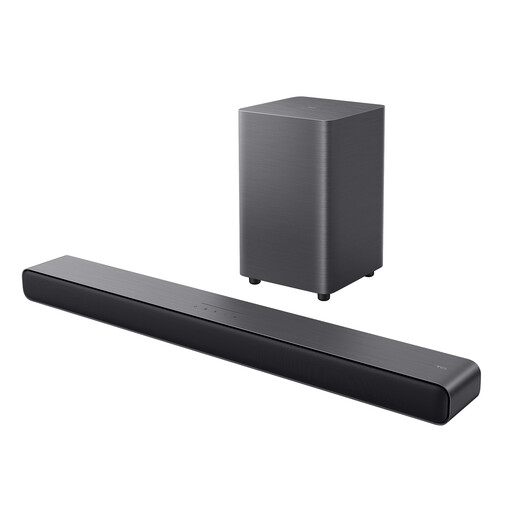
Why this product suits this profile: The 2.1 system is designed for TV, films and gaming, and does not require rear speakers. HDMI eARC, Bluetooth 5.3, USB and an optical input provide flexible connectivity.
The 220-watt rating is accompanied by a clearly specified 2.1 configuration. However, the wireless subwoofer still requires its own power supply.
Dolby Atmos, DTS Virtual:X, six sound modes and a wall-mounting option. The design is well suited to compact TV setups.
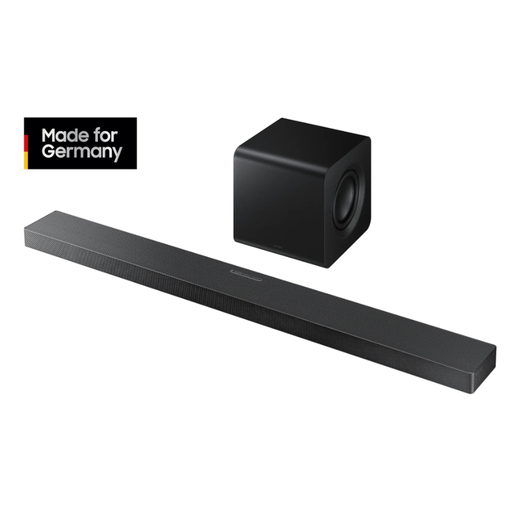
Why this product suits this profile: The 3.1.2 configuration combines a centre channel, upward-firing speakers and a 6.5-inch subwoofer. Q-Symphony is available for compatible Samsung TVs.
The product specifications list specific connections such as HDMI ARC, an optical input and 4K 60 Hz pass-through, rather than making only general streaming promises.
Dolby Atmos and DTS:X, Wi-Fi, Bluetooth 5.2, AirPlay 2, Chromecast compatibility, plus room and voice modes according to the product specifications.
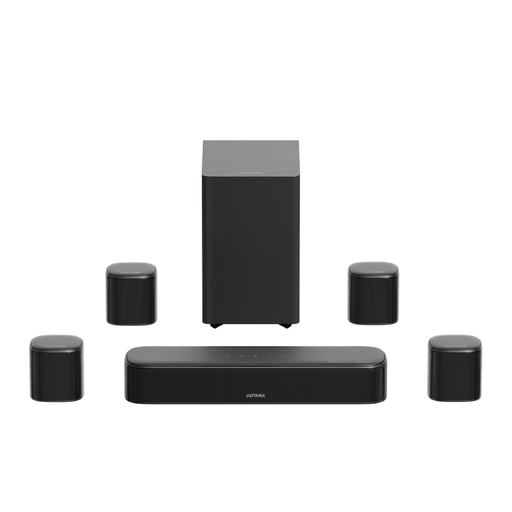
Why this product suits this profile: Four surround speakers, a 5.25-inch subwoofer and HDMI eARC are aimed at users who want to enjoy films, games and music across a larger seating area.
The rear speakers are not merely simulated virtually. At the same time, cables, sockets and safe positioning all need to be planned.
The specifications list 420 watts peak power, 7.1 channels, HDMI eARC, four surround speakers and app control with a 10-band equaliser.
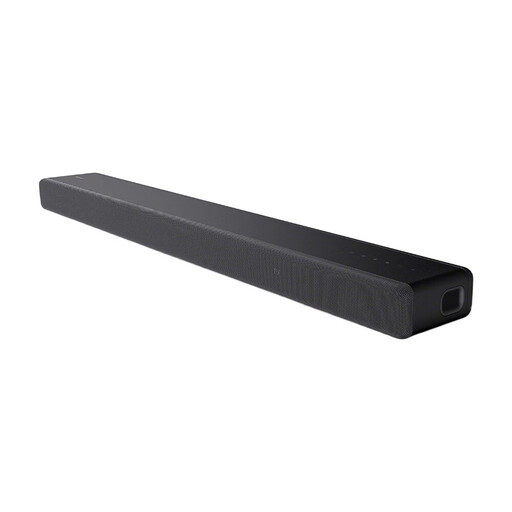
Why this product suits this profile: The soundbar has an integrated subwoofer, so no separate bass unit is initially required. Optional rear speakers can be added to expand the system later.
Room optimisation is carried out using integrated microphones. According to the product specifications, optional rear speakers are required for 360 Spatial Sound Mapping.
3.1-channel configuration, Dolby Atmos, DTS:X, integrated bass speakers and Bluetooth. Compatible BRAVIA TVs may support Acoustic Center Sync.
We have put together a complete, regularly updated list of products that fully meet these strict selection criteria and the safety regulations applicable in the EU.
Connect the TV soundbar via HDMI ARC or eARC wherever possible and enable the corresponding audio output on your TV. With a wireless subwoofer, first switch on the soundbar and bass unit close to one another, then pair them according to the instructions. The subwoofer can then be gradually moved to its intended position.
Night mode and voice enhancement are useful in rented homes, as they allow dialogue to be adjusted without having to turn up the bass fully. For gamers, input lag, HDMI pass-through and the number of HDMI ports are also important.
Clean the housing and ventilation openings with a dry, soft cloth. Do not cover any openings, and do not place the soundbar or subwoofer in damp or very hot areas. It is not possible to give a general figure for service life; this depends, among other things, on operating time, volume, ventilation and the power supply.
Yes, provided the dimensions and bass tuning are suitable for the room. In small rooms, a large subwoofer positioned close to a wall can produce overly prominent low frequencies. Sound modes or bass controls make it easier to adjust the sound.
Not always. It depends on the TV, soundbar and source device. However, HDMI eARC is the more suitable interface for higher data rates and certain lossless formats. Check the technical specifications of all the devices involved.
The subwoofer requires its own power supply. Actual consumption depends on the volume, operating time and standby functions. Figures such as operating and standby power consumption in the technical specifications allow for a more objective assessment than general claims about energy efficiency.