
Lieferung heute & morgen

Qualitätsgarantie

Willkommens-Angebote freischalten: KOSTENLOSE Lieferung | Bis zu 80 % RABATT | Kostenlose 30-Tage-JoyPlus-Testphase
App herunterladen
A soundbar with Dolby Atmos can significantly enhance your TV audio while offering a space-saving alternative to a traditional home cinema sound system. However, the designation alone does not automatically guarantee an impressive surround experience. The speaker arrangement, suitable connections and the characteristics of the room are what really matter.
Many buyers initially focus on high wattage figures or terms such as “3D sound”. Important details can easily be overlooked: Does the TV actually support eARC? Are upward-firing drivers included? Does the subwoofer need its own power socket? The following criteria help you distinguish marketing promises from practical features.
Dolby Atmos is an audio format in which sound objects can also be positioned above the listening position. The soundbar must be able to process the signal for this to work. Upward-firing speakers or additional surround speakers can enhance the sense of space.
By contrast, a purely virtual simulation uses signal processing and reflections. This can work in certain room conditions, but it is not the same as a system with separate height or rear channels. A 5.1.2 soundbar, for example, has five main channels, one bass channel and two height channels. A 7.1 soundbar can create a broader soundstage to the sides and behind you when used with additional speakers.
The power rating is only meaningful when considered alongside the method used to measure it. Some manufacturers quote maximum or peak power, while others use RMS values. A high figure alone therefore says little about dialogue clarity, bass control or suitability for a particular room.
When choosing a soundbar for TV, films and gaming, the speaker configuration, frequency ranges, subwoofer and sound modes are usually more useful indicators than an isolated wattage figure.
A wireless soundbar with a wireless subwoofer will generally still need power connections for both the soundbar and subwoofer. The main benefit is that no audio cable needs to run between the two devices. Depending on the model, rear speakers may require additional power or speaker cables.
HDMI eARC supports greater audio bandwidth than the older ARC standard. This is particularly relevant for multi-channel audio and lower-compression Dolby Atmos signals. Before buying, check whether your TV has an HDMI eARC port. With ARC or an optical connection, limitations may occur depending on the TV, streaming app and audio format.
HDMI also offers control benefits: HDMI-CEC often allows you to adjust the volume using the TV remote. A soundbar with HDMI eARC is therefore often the more practical choice for modern TVs, games consoles and streaming devices.
Pay attention to the actual configuration:
Upward-firing drivers need a suitably positioned ceiling so that reflections can work effectively. With very high, sloped or heavily absorbent ceilings, the effect may be less pronounced.
A soundbar with subwoofer is well suited to films, music and games if you want to emphasise low frequencies. Positioning affects the bass: it often sounds more powerful in corners, but can also become uneven there.
Bluetooth is convenient for playing music from a smartphone or tablet. For TV audio, HDMI eARC is generally preferable, as Bluetooth can cause delays depending on the device. Wi-Fi, AirPlay, Chromecast or a manufacturer’s app are additional features that are particularly relevant to music lovers and multi-room users.
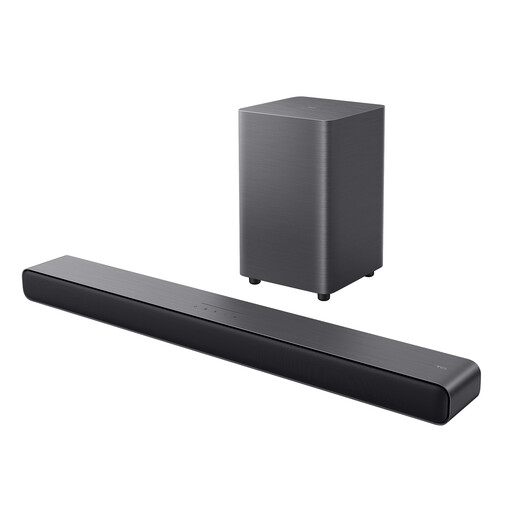
Why this product suits this profile: The 2.1 system combines a compact soundbar with a wireless subwoofer, making it suitable for TV, films and occasional gaming.
Dolby Atmos and DTS Virtual:X are specified, while the configuration remains straightforward, with two front drivers and a subwoofer.
HDMI eARC, Bluetooth 5.3, six sound modes and a wireless 4-inch subwoofer according to the product specifications.
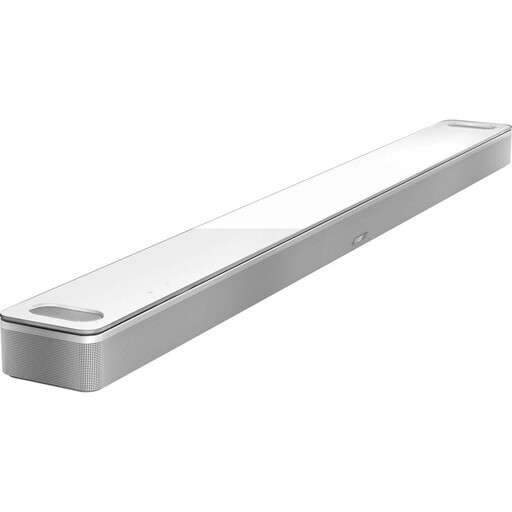
Why this product suits this profile: The combination of Dolby Atmos, TrueSpace, Wi-Fi and room calibration is aimed at users who value an extensive range of features.
The 5.1.2 specification describes the channel structure more clearly than a simple 3D sound marketing claim. ADAPTiQ is designed for room calibration.
HDMI eARC, Wi-Fi, Bluetooth, AirPlay 2, Chromecast and AI Dialogue Mode according to the product description.
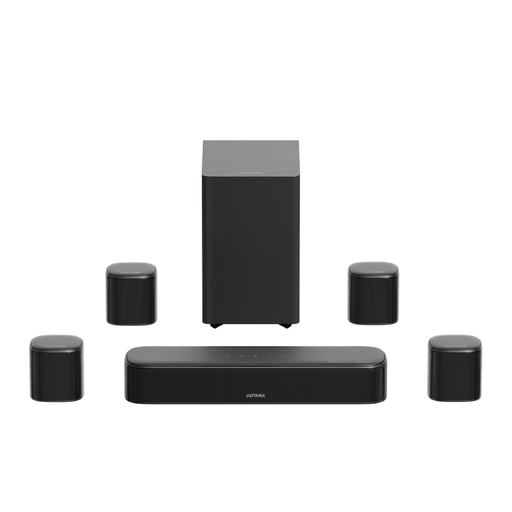
Why this product suits this profile: Four surround speakers, a subwoofer and app control are well suited to film fans and gamers who want to create a more distributed soundstage.
The product specifications explicitly state the number of speakers, the hybrid connection used by the rear speakers and HDMI eARC.
7.1-channel configuration, 5.25-inch subwoofer, 420 W peak power and 10-band equaliser according to the manufacturer’s specifications.
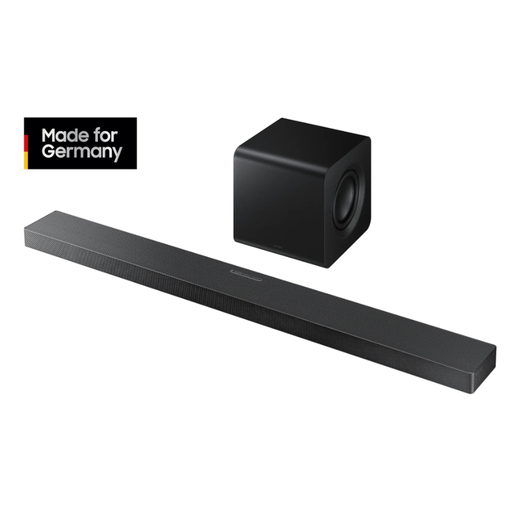
Why this product suits this profile: If you use a compatible Samsung TV, you can integrate features such as Q-Symphony and SmartThings into your existing device ecosystem.
The 3.1.2 configuration indicates a centre channel and two upward-firing drivers; according to the product specifications, the room optimisation takes the acoustics into account.
Dolby Atmos, DTS:X, Wi-Fi, Bluetooth 5.2, HDMI ARC and a wireless 6.5-inch subwoofer according to the product description.
We have put together a complete, regularly updated list of products that fully meet these strict selection criteria and the safety regulations applicable in the EU.
Place the soundbar as centrally as possible beneath the TV. The centre channel should not be blocked by the edge of the TV or furniture. Upward-firing drivers need clear space above them. The subwoofer may connect wirelessly, but it still needs a power socket and should not be placed directly inside an enclosed cabinet.
For films and series, the Film or Standard mode is a good starting point. When gaming, dedicated game modes can alter the sound balance. For music, it is best to start with a neutral mode before adjusting the equaliser. Automatic room calibration is useful, but it does not replace correct positioning.
No. The TV must be able to process the Atmos signal and pass it on through a suitable connection. HDMI eARC generally offers the most versatile options. With older devices, output may be limited to certain audio formats.
Its lifespan depends on usage, ventilation, power supply and software support. Keep the ventilation openings clear, avoid moisture and use the specified power supplies. With connected models, you should also check how long app and firmware support will be provided.
The soundbar and subwoofer each require power, even when the audio connection is wireless. Many devices switch to standby mode when idle. For specific consumption figures, refer to the technical details for the relevant model and consider the actual usage time.