Cooking with one appliance
If you’re short on worktop space and want to heat and blend ingredients in the same appliance, check that the specific model does both. The term ‘blender’ on its own doesn’t tell you whether it can also heat food.


For soup prepared with just one appliance, a soup maker is only suitable if the specific model is explicitly listed as having both heating and blending functions; a standard blender does not automatically do both. Before deciding how much you need, compare the hot-fill mark, the programmes available for chunky or smooth soup, and the cleaning process. You’ll also need a separate plan for chilling or keeping your soup hot during transport: a keep-warm function on the appliance does not prove that soup will stay at a safe temperature in your lunch container until your break.
If you’re short on worktop space and want to heat and blend ingredients in the same appliance, check that the specific model does both. The term ‘blender’ on its own doesn’t tell you whether it can also heat food.
If you won’t be eating your soup straight away, you’ll need to plan how to store and transport it. A keep-warm function while the soup is being prepared doesn’t guarantee its temperature in a container while you’re out and about.
If you’re preparing several lunches at once, check the permitted fill level for hot soup against your recipe and the consistency you want.
First, check whether the appliance really can heat and blend in one step. Then consider the hot-fill capacity, the soup programmes you need, and how easy it is to clean and transport.
| Priority | What to check before buying | Who is this particularly important to? |
|---|---|---|
| Heating and blending | Check whether the specific model is listed as having both a heating element and a blending function. | If I only have one cooking appliance, I want to heat and blend in the same machine. This is a priority for around 31% of consumers. |
| Transporting soup for lunch | Plan how to chill or keep the soup hot separately from the appliance, and check that your lunch container is suitable for the journey. | I need to know how to keep my soup at the right temperature until lunchtime. Around 25% of consumers focus mainly on transporting lunch safely. |
| Quantity per batch | Compare the total amount you plan to make with the fill mark for hot liquids. | If I’m preparing several portions for lunch, I want to plan the right quantity in one batch. Around 19% of consumers say portion planning is their main priority. |
| Soup consistency | Check whether the exact model has programmes for chunky and smooth soup. | I want to be able to choose the consistency I prefer, rather than relying on a blending function that isn’t clearly described. Around 13% of consumers are primarily interested in chunky or smooth soup. |
| Cleaning | Check which parts can be removed or are listed as dishwasher-safe in the instructions. | If I regularly batch-cook, I want to know how to clean the appliance and container after each use. Cleaning is the top priority for around 12% of consumers. |
For leftovers, the German Federal Institute for Risk Assessment (BfR) recommends cooling them to below +7 °C within a few hours, storing them in the fridge and eating them within two to three days. For perishable food on the go, the BfR recommends keeping it chilled; if keeping food hot, it should reach at least 60 °C throughout. A lunch container on its own won’t automatically maintain these conditions.
For the Russell Hobbs 21480-56, the instructions distinguish between the MAX mark for cold ingredients and a lower SOUP-MAX mark for hot liquids.
Compare the quantity you plan to make with the hot-fill mark for the specific model.
If your batch exceeds this level, you may need to cook it in several batches rather than just one.
Krups describes the InfinyMix KB9158 as a high-speed blender; an integrated heating function is not listed for this model.
If you want to use just one cooking appliance, check that the exact model is explicitly described as having a cooking function.
Without this function, you may need an extra pan or another cooking appliance to heat your soup.
The keep-warm function listed for the Russell Hobbs 21480-56 applies to the appliance itself. You’ll need to consider the temperature in a separate container during the journey to your break.
Plan storage and transport separately from the soup maker, and don’t assume it will keep your soup hot for a certain length of time without checking.
You may also need to factor in a suitable lunch container and, where necessary, a way to keep your soup chilled.
Philips lists a 1.2-l container and six programmes for the Viva Collection HR2204/70. This model is therefore described as suitable for smaller batches.
DOMO lists a 2-l capacity and programmes for smooth and chunky soup for the DO705BL. The DO727BL is described as a more compact model with a 1.2-l capacity.
According to Russell Hobbs, the Soup & Blend 21480-56 combines a heating function with eight programmes and cold blending.
Rommelsbacher lists a maximum capacity of 1.3 l for the SVD 1400 Vera, with programmes for soup, porridge and plant-based drinks, among other things.
The German Joybuy product page describes the Foodi HB150EU as a blender with a heating element and blending functions.
The following Joybuy models are designed for electric soup cooking or have a specified soup programme. Check each model to see whether it can also blend in the same container.
 No image available
For anyone who wants to cook soup electrically and choose between two heat settings.
2.6L capacity; two manual heat settings; coated inner pot. Hot steam may escape when you open the cooker: switch it off and wait a few minutes before opening.
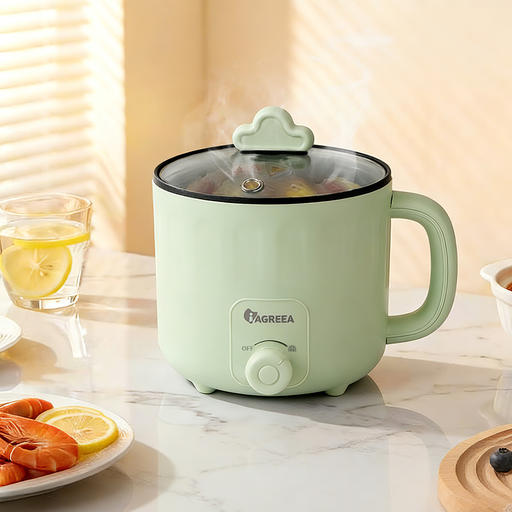 No image available
A compact electric cooking option for anyone who wants to prepare soup in a small appliance.
1.6L capacity. Do not immerse the body of the appliance or its power connection in water when cleaning; wooden or silicone utensils are recommended for the coated interior.
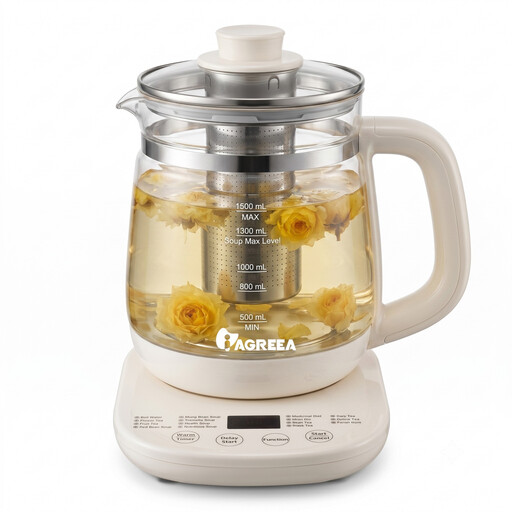 No image available
For anyone looking for an electric appliance with a specifically listed soup programme.
1.5L capacity and 14 preset programmes. The product description lists a wide opening and removable parts. Hot surfaces and liquids can cause burns; do not immerse the appliance, cable or plug in water.
 No image available
For anyone considering an appliance with a specified soup-making function and several inner pots.
4.1L capacity; the product description lists one main pot and four additional inner pots. Hot steam may escape during use; wait a few minutes after cooking before opening the lid.
 No image available
For anyone who wants to prepare a larger quantity of soup using a specified Soup/Broth programme.
8L capacity and 12 preset programmes. Do not force the lid open while the appliance is under pressure. Observe the fill mark; when cooking foods that expand, fill to no more than the halfway mark.
Yes, as long as you plan how to store and transport it properly. The BfR recommends cooling leftovers to below +7 °C within a few hours, storing them in the fridge and eating them within two to three days. The BfR’s kitchen hygiene infographic from March 2026 also recommends keeping perishable food chilled when you’re out and about; if keeping food hot, it should reach at least 60 °C throughout. Whether a particular lunch container will keep soup at this temperature until your break depends on how you use it.
Not necessarily: Philips explicitly states that the motor unit and housing of the HR2204/70 must not be immersed in water. Check the instructions for your specific model and distinguish removable parts from the electrical appliance itself.
For a consumer purchase in the EU, you generally have a legal guarantee of at least two years from the date you receive the goods, with the seller. Your Europe, the European Union’s information portal, distinguishes this legal guarantee from an additional manufacturer’s warranty. Before buying, check who is listed as the seller and the terms of any voluntary warranty.
No. According to information from the European Union, the CE marking is the manufacturer’s declaration that the product meets the applicable EU requirements; it is not proof of an independent soup-making or cleaning test. The requirements for a specific appliance depend on the relevant regulations.