Sourdough alone doesn’t make a pretzel a suitable choice for someone with diabetes. When comparing products, the key factors are the carbohydrates in the portion you actually eat, along with the wholegrain, fibre and salt information. The word ‘sourdough’ on its own doesn’t tell you that a particular pretzel has a lower glycaemic index.
Who should pay attention to this information?
People who keep an eye on portion size
If you’re planning to include a pretzel in a diabetes-conscious meal, the most important thing is to know the carbohydrate content of the portion you actually eat. diabetesDE points out that portion size needs to be taken into account when considering glycaemic load.
People looking for wholegrain options
If you want to compare wholegrain content and fibre as well as sourdough flavour, check the ingredients list and nutritional information. diabetesDE recommends choosing baked goods with a high wholegrain and fibre content.
People keeping an eye on salt and ingredients
If you need to take salt or certain ingredients into account, you’ll need information about the specific product. This is particularly important when buying loose products or items supplied by different suppliers.
What should you look for when buying?
Start with the amount you eat and its carbohydrate content, then compare wholegrain, fibre and salt. diabetesDE recommends checking wholegrain and fibre content, while information on glycaemic load highlights why portion size matters.
| Criteria |
What to check when buying |
Who it matters to |
| Carbohydrates and portion size |
Carbohydrates per 100 g and the weight of the amount you actually eat. |
If I’m planning to include a pretzel in my meal, I want to be able to work out the carbohydrate content of the piece I eat. For around 46% of consumers, this ability to plan would be the priority. |
| Wholegrain and fibre |
Wholegrain ingredients and fibre per 100 g. |
Verifiable wholegrain content matters more to me than the word ‘sourdough’ on the packaging. For around 36% of consumers, this would be the main buying priority. |
| Salt and ingredients |
Salt per 100 g, plus the ingredients and allergen information for the specific product. |
I want to be able to check the salt and ingredients even when buying a pretzel over the counter. For around 18% of consumers, this information would be the priority. |
Common mistakes when comparing products
-
Assuming ‘sourdough’ means a particular effect on blood sugar
The type of dough alone doesn’t tell you how a specific pretzel fits into your diet in relation to the portion you eat and the rest of your meal.
Check the carbohydrate content and portion size, along with the wholegrain and fibre information, rather than choosing based on the word ‘sourdough’ alone.
-
Confusing information per 100 g with information per pretzel
The weight of a loose pretzel isn’t always clear. Without knowing its weight, you can’t reliably use the nutritional information per 100 g to work out what’s in the amount you eat.
Ask how much the pretzel weighs or weigh your portion before calculating its carbohydrate content from the nutritional information.
-
Overlooking salt and salty toppings
Ditsch’s pretzels and the Ihle product listed by REWE contain 2,02 g and 1,6 g of salt per 100 g respectively. The portion size and any extra salt on the pretzel should therefore also be taken into account when comparing them.
Compare salt information on the same basis, and consider how much of the pretzel and topping you actually eat.
-
Assuming the recipe stays the same when suppliers change
ALDI SÜD notes that its pretzels may come from different suppliers and that nutritional information may vary.
Check the information for the specific product again when you buy it if carbohydrates, salt or certain ingredients are important to your choice.
Brands and products to help you compare
The information below relates to the specific pretzels listed, not to a brand’s entire range or to pretzels specifically labelled as sourdough.
Ditsch
Ditsch describes a ready-baked pretzel weighing 100 g.
- For this product, Ditsch lists 46,4 g of carbohydrates, 5,4 g of fibre and 2,02 g of salt per 100 g.
- The published ingredients list includes wheat flour and yeast, but no sourdough. This doesn’t tell you anything about other Ditsch pretzels.
Ihle W Ihle bei REWE
REWE lists an Ihle pretzel; availability may depend on the location.
- REWE gives the listed product’s carbohydrate content as 51,4 g and its salt content as 1,6 g per 100 g.
- The ingredients list includes wheat flour and yeast, but no sourdough. You’ll also need to know the pretzel’s weight to work out the carbohydrates per piece.
MEINE BACKWELT bei ALDI SÜD
ALDI SÜD sells a Swabian-style pretzel under its MEINE BACKWELT brand.
- The product information gives the carbohydrate, fibre and salt content per 100 g.
- According to ALDI SÜD, the product may come from different suppliers, so the nutritional information may vary. Always check the information on the specific product you’re buying.
Spelt pretzels at Joybuy
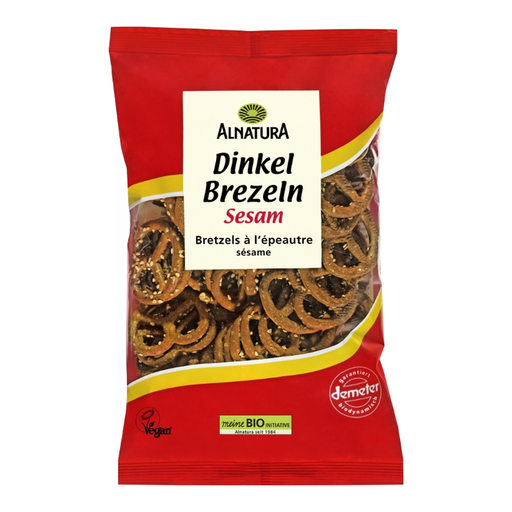
This selection features spelt pretzels with sesame. If you’re specifically looking for a sourdough pretzel, check the type of dough and the ingredients for the specific product; the product name alone doesn’t confirm either.
 No image available
Alnatura organic spelt pretzels with sesame, 125 g
If you’re considering spelt pretzels with sesame, note that the pack size is 125 g, which isn’t necessarily the same as the portion you eat. Check the weight of your portion and the carbohydrate information, as well as the ingredients if sourdough is an important factor in your choice.
View at Joybuy
Frequently asked questions
Is a sourdough pretzel automatically a better choice if you have diabetes?
No. The word ‘sourdough’ doesn’t mean that a particular pretzel has a lower glycaemic index or a specific effect on blood sugar. diabetesDE recommends looking at wholegrain and fibre content in baked goods; the portion you eat also matters when considering glycaemic load.
How can I compare a loose pretzel if I don’t know its weight?
Ask how much it weighs or weigh the pretzel before using the nutritional information per 100 g to work out the figures for your portion. Lebensmittelklarheit points out that loose baked goods may be sold without a weight given for each item.
What should I look out for if I want to avoid wheat or gluten?
Check the allergen information for the specific pretzel and ask before buying if anything is unclear. The ingredients lists for the Ditsch and Ihle products mentioned include wheat; ‘sourdough’ doesn’t mean ‘gluten-free’.
Does removing the salt sprinkled on top change how I should compare pretzels?
It may change the amount of salt in the pretzel you eat, but it won’t change the carbohydrate content of the dough. To compare products, look at the declared salt content and the portion you actually eat. The German Nutrition Society gives a guideline of up to 6 g of salt per day for general salt intake.


