
Lieferung heute & morgen

Qualitätsgarantie

Willkommens-Angebote freischalten: KOSTENLOSE Lieferung | Bis zu 80 % RABATT | Kostenlose 30-Tage-JoyPlus-Testphase
App herunterladen
Living space is at a premium in many cities. Whether in a city flat, a shared apartment, or a private home, the challenge is often the same: how can you make the most of the available space without making rooms feel cluttered? Space-saving furniture promises a solution, but not every option delivers on its promise. Often, impulsive purchases lead to more frustration than order.
Before you invest, it's crucial to understand the common pitfalls. Many buyers focus solely on price or an appealing design, overlooking critical flaws that can quickly render a piece of furniture useless:
To avoid these problems, you should focus on a few fundamental parameters that distinguish a good storage solution from a bad one.
Intelligent storage solutions are distinguished by their thoughtful details. Instead of being swayed by marketing promises, check three essential criteria before buying to create more storage space in the long run.
The durability of a piece of furniture depends directly on its material. For areas with high humidity, like the bathroom or kitchen, furniture made from MDF boards (E1 standard) with a water-repellent lacquer or melamine resin coating is a good choice. These materials are more resistant to moisture than simple, uncoated particleboard and are also easier to clean. An under-sink cabinet should be explicitly designated for damp rooms to prevent swelling and mould growth. For kitchen organisation, robust surfaces that can withstand daily use are also important.
The term "space-saving" is relative. A piece of furniture only saves space if it fits perfectly into its intended area. Therefore, measure the niche, hallway, or space under the sink with millimetre precision before making a decision. For an alcove shelf or a slim cabinet, pay attention not only to the width but also to the depth. For under-sink cabinets in the bathroom, the size and position of the P-trap cut-out are crucial. Carefully check the product dimensions to ensure that pipes and connections are not in the way.
Stability isn't a luxury; it's a necessity. Tall and narrow furniture, such as hallway furniture for small spaces or a children's room organisation system, should always be secured to the wall with an anti-tip kit. Reputable manufacturers include these as standard. In households with children, rounded corners and edges are also an important safety feature. Functionality is also evident in details like adjustable shelves, smooth-gliding drawers, or doors that open wide enough to allow convenient access to the contents.
Based on these objective criteria, we have identified several products that offer a well-thought-out solution for specific requirements and user profiles.
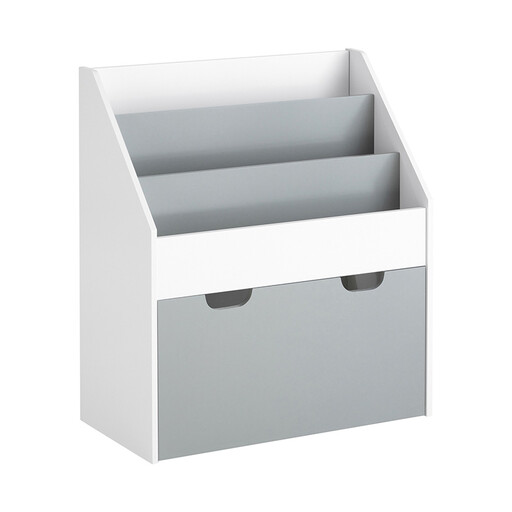
Why this product is a good fit: This shelf is designed as a children's room organisation system. The low height of 70 cm allows children to access books and toys on their own. The combination of open compartments for books and a large, wheeled box for toys encourages independent tidying.
The shelf addresses safety risks with its softened corners and edges. The MDF wood construction provides the necessary stability to counteract the pitfall of unstable furniture. The included anti-tip kit provides additional security.
Combines book and toy storage in one child-friendly piece of furniture. The removable toy box on wheels is particularly practical.
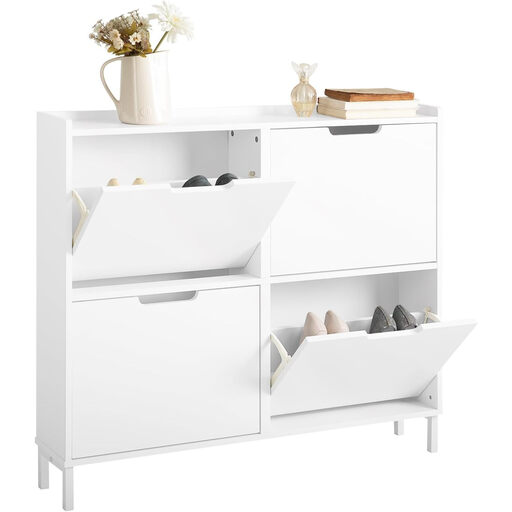
Why this product is a good fit: This piece of furniture is a targeted solution for narrow entryways. With a depth of just 19 cm, it barely protrudes into the walkway and efficiently uses wall space to store shoes out of sight and free of dust. Ideal as hallway furniture for small apartments.
This shoe cabinet solves the problem of impractical dimensions by being specifically designed for narrow niches and hallways. The construction from E1-MDF and the included anti-tip kit ensure stability and safety.
Extremely shallow depth of 19 cm while offering high capacity thanks to the four flap compartments. The closed front ensures a tidy appearance.

Why this product is a good fit: This cabinet is a classic solution for transforming the often-unused space under the sink into a practical storage compartment for cleaning supplies, toilet paper, or towels. It creates order where normally only pipes are visible.
It solves the fit problem with an integrated P-trap cut-out. The material, made of lacquered MDF boards (Class E1), is suitable for the damp environment of a bathroom and prevents swelling, a typical flaw in unsuitable furniture.
The precisely fitting cut-out for the P-trap and the moisture-resistant surface make it a functional and durable solution for the bathroom.
We have compiled a complete, up-to-date list of products that fully meet these strict selection criteria and safety regulations.
1. How do I correctly measure a niche for a shelf or cabinet? Measure the height, width, and depth in at least two different places (e.g., top and bottom) to ensure the walls are straight. Use the smallest measurement as your maximum dimension and plan for an additional 1-2 cm of clearance to easily install the furniture. Also, take baseboards or light switches into account.
2. How can I tell if a piece of furniture is suitable for the bathroom? Look for the material description. Terms like "MDF E1," "lacquered," "melamine-coated," or "moisture-resistant" are good indicators. Avoid furniture made from untreated particleboard. Additionally, metal parts like hinges or handles should be rustproof (e.g., made of stainless steel or coated metal).
3. Is an anti-tip kit necessary for all narrow furniture? Yes, it is strongly recommended. Any piece of furniture that is taller than it is wide has the potential to tip over, especially when doors or drawers are opened. Securing it to the wall is a simple and effective measure to prevent accidents and should always be done with narrow shelves, dressers, and cabinets.