
Lieferung heute & morgen

Qualitätsgarantie

Willkommens-Angebote freischalten: KOSTENLOSE Lieferung | Bis zu 80 % RABATT | Kostenlose 30-Tage-JoyPlus-Testphase
App herunterladen
Living space is at a premium in many cities. Anyone living in a city apartment or a house with compact rooms knows the challenge: How do you create order without sacrificing valuable floor space? Space-saving storage furniture is the solution. However, the market is full of products that promise more than they deliver. This guide will help you avoid common purchasing pitfalls and make an informed decision.
Before you invest, it's important to know the weaknesses of many furniture items on the market. Often, small but crucial defects render a piece of furniture useless after a short time or make daily life more difficult.
To avoid the problems mentioned above, focus on three objective parameters. These will help you realistically assess the functionality and longevity of a piece of furniture.
The material is the foundation for stability and durability. Look for the following specifications:
Measure the available space precisely – not just the width and depth, but also the height. Tall, narrow furniture makes optimal use of vertical space without taking up much floor area. A tall bathroom cabinet with a width of just 20-30 cm can offer a surprising amount of storage for towels and cosmetics. Check if the dimensions also fit into niches next to the toilet, the washbasin, or in a narrow hallway.
A good multi-purpose cabinet or a dresser for small spaces is characterised by its adaptability.
Here are some recommendations tailored to specific use cases and the criteria mentioned above.
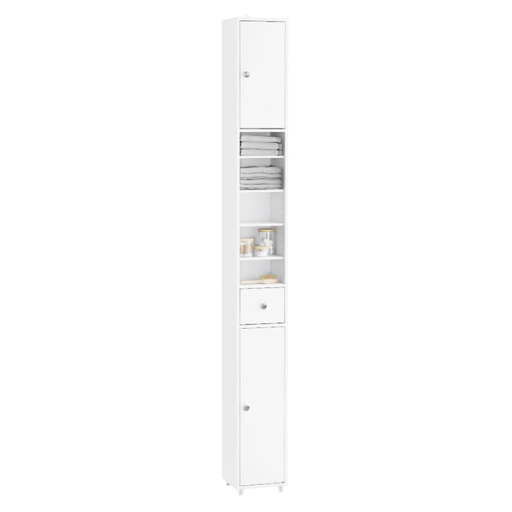
Why this model is a good fit: Ideal for those looking to transform unused niches next to the toilet or washbasin into functional storage. The extremely narrow 20 cm width is designed for the smallest of spaces.
The material (MDF E1) is suitable for damp environments. The included wall mount counteracts the instability of such a tall, narrow cabinet. The 6 height-adjustable shelves prevent a rigid compartment layout.
Maximum vertical space utilisation on a minimal footprint (20x20 cm). High flexibility thanks to adjustable compartments.
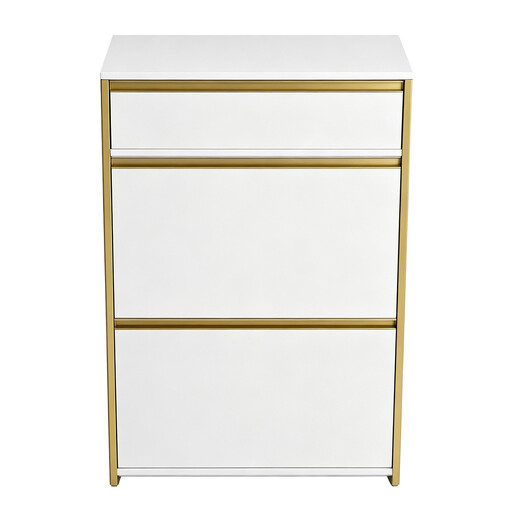
Why this model is a good fit: For anyone who wants to neatly store not only shoes but also keys, mail, and other small items in the entryway or hallway. The white and gold design fits well into modern interiors.
The internal dividers are height-adjustable and removable, which prevents a rigid layout. An anti-tip device for wall mounting is included, addressing the stability issue of narrow cabinets.
Multifunctional use as a shoe cabinet and a small dresser. The combination of flip-down compartments, a drawer, and a top shelf meets various needs.
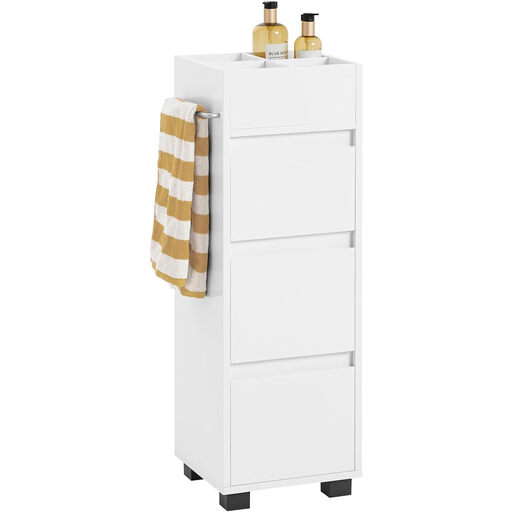
Why this model is a good fit: For users who need a mix of open and closed storage in a small area. It works well as a small dresser, whether in the bathroom, hallway, or a kitchen nook.
The construction from lacquered MDF (E1) is designed for damp environments and prevents swelling. The combination of drawers and open shelves offers far more flexible use than a cabinet with just one door.
Compact footprint (30x30 cm) with a versatile layout (3 drawers, 4 open compartments). The towel holder, which can be mounted on either side, is a practical extra feature.
We have compiled a complete, up-to-date list of products that fully meet these strict selection criteria and safety regulations.
1. How do I secure a tall, narrow cabinet to prevent it from tipping over? Most tall and narrow furniture pieces come with an anti-tip device. This usually consists of a bracket or a strap that is attached to the furniture and the wall. It is strongly recommended to use this device to ensure stability, especially in households with children.
2. What is the best material for a bathroom cabinet? MDF boards (E1 standard) with a water-resistant lacquer or melamine coating are a common and practical choice. These materials are more resistant to moisture than untreated particleboard and are also easy to clean. Check the product description, where suitability for damp environments should be explicitly mentioned.
3. Can I use a narrow shoe cabinet for other things? Yes, many models are designed as multi-purpose cabinets. A narrow cabinet with adjustable or removable shelves can easily be used in the hallway for storing scarves and hats, in the living room for books, or in the kitchen for supplies. The flexibility of the interior is the key factor here.