
Lieferung heute & morgen

Qualitätsgarantie

Willkommens-Angebote freischalten: KOSTENLOSE Lieferung | Bis zu 80 % RABATT | Kostenlose 30-Tage-JoyPlus-Testphase
App herunterladen
By Joybuy Product Recommendation Officer, July 17, 2026
Living space in cities is often at a premium, making the efficient use of every square foot a necessity. Storing clothes and laundry can be a particular challenge in rental apartments, student dorms, or compact flats. A poorly chosen wardrobe can consume valuable space, while drilling for permanent fixtures is often prohibited.
This article introduces various systems for space-saving clothes storage. Our goal is to provide you with an overview of functional and flexible solutions that adapt to different room situations and often require no complex assembly.
Before you decide on a system, consider a few objective criteria to find the perfect solution for your needs.
For renters, keeping walls and ceilings intact is a crucial factor. A no-drill clothes rack system is a practical alternative here. Such systems are typically clamped between the floor and ceiling, using tension to ensure stability. They leave no marks and can be easily disassembled and taken with you when you move. Wall-mounted systems, on the other hand, are well-suited for homeowners or when drilling is permitted, as they keep the floor completely clear.
The dimensions of rooms, alcoves, or balconies vary greatly. Look for products with adjustable dimensions. A telescopic clothes rail can be precisely adjusted in height and width to fit the available space. The same applies to a retractable wall-mounted drying rack, whose line length can be adjusted as needed. This flexibility allows for optimal use even in awkward or narrow areas.
An open wardrobe system must safely support the weight of your clothes. Check the manufacturer's specified maximum load capacity and the material. Systems made of metal tubes (e.g., steel or aluminum) generally offer greater stability and durability than all-plastic constructions. Ensure that the connecting pieces are also robustly made to prevent the rails from sagging.
Here is a selection of products that meet different requirements for clothes storage for small rooms.
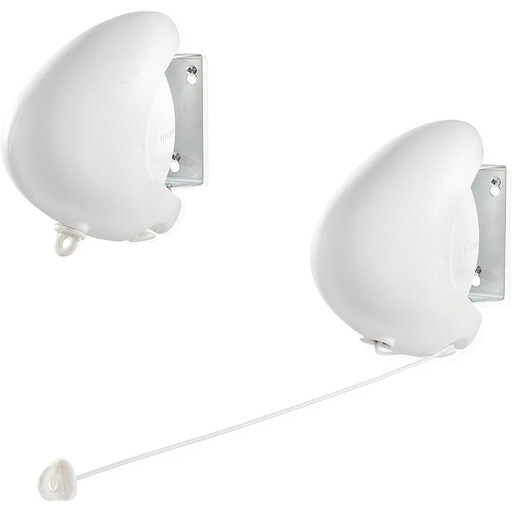
Why It Stands Out: This system is an exceptionally discreet solution for drying laundry. When not in use, the clothesline disappears completely into the wall-mounted housing. Its retractable function makes it ideal for narrow balconies, bathrooms, or basements.
Key Features:
Who It's For? For households looking for an inconspicuous and space-saving way to dry laundry on the balcony, in the bathroom, or in the laundry room. It's an excellent choice for anyone who doesn't have space for a freestanding drying rack.
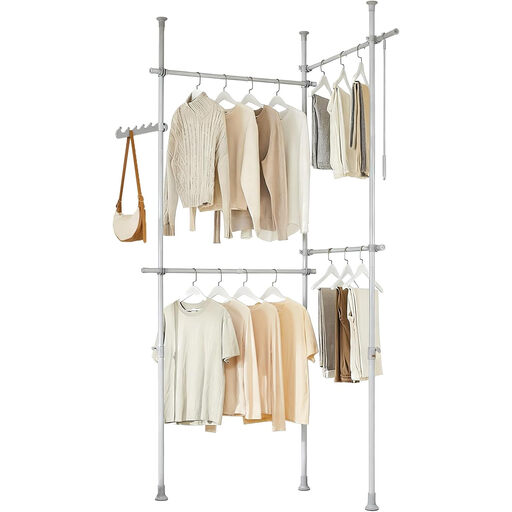
Why It Stands Out: This model serves as a complete wardrobe replacement without needing a single screw in the wall. With three telescopic poles and four clothes rails, it offers enormous capacity and can be flexibly adapted to the room's height and width.
Key Features:
Who It's For? Ideal for tenants in apartments or shared flats who need a generous and stable storage solution but are not allowed to install permanent furniture. It also works perfectly as an open wardrobe system in a dressing room.
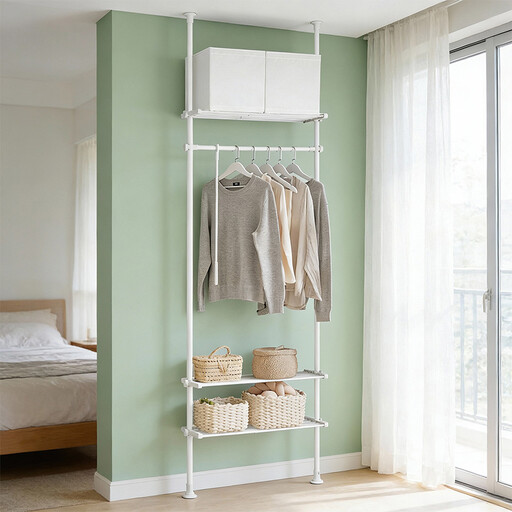
Why It Stands Out: This version combines a telescopic clothes rail with three adjustable shelves. This makes it an all-in-one compact solution for clothes, shoes, and accessories in the smallest of spaces.
Key Features:
Who It's For? Perfect for students in dorms or individuals with very small bedrooms. It makes optimal use of the room's vertical height, creating storage space where a conventional wardrobe wouldn't fit.
If these models don't exactly match your requirements, or if you're looking for other designs like ladder wardrobes or other open shelving systems, you can find a wider selection of organizational solutions in our Wardrobe Ladder category.
Open clothes rack systems, especially telescopic ones, are a common solution. They offer a lot of space on a small footprint. Other options include wall-mounted coat racks, hook rails, or storage boxes that can be stowed under the bed.
A telescopic clothes rack system consists of poles that are adjustable in length. It is clamped firmly between the floor and ceiling or between two walls using spring force or a screw mechanism. The main advantages are the no-drill installation and the flexible adaptation to different room heights and widths.
When installed correctly and within the manufacturer's specified maximum load capacity, these systems offer reliable stability for everyday use. It is important to ensure that the end pieces rest firmly and straight on the floor and ceiling to guarantee a secure footing.