
Lieferung heute & morgen

Qualitätsgarantie

Willkommens-Angebote freischalten: KOSTENLOSE Lieferung | Bis zu 80 % RABATT | Kostenlose 30-Tage-JoyPlus-Testphase
App herunterladen
A spanner set can make many assembly and repair jobs easier – as long as the sizes, drive and design are right for the task. Whether you’re working on a car, maintaining a bike, doing plumbing or assembling furniture, not every set is equally versatile.
Common buying mistakes often come down to three things:
A high tooth count shouldn’t be considered in isolation either. What matters is how small the swing arc needs to be, whether the head is easy to position and whether the sockets fit securely on the drive.
Metric sizes are particularly relevant for everyday jobs in the UK. When choosing a combination spanner set or ratcheting spanner set, check that it includes the sizes you actually need. For general jobs, 8, 10, 13, 17 and 19 mm are often useful, but vehicles and machinery may require other sizes too.
A socket set offers extra flexibility when the sockets, extensions and drive sizes are compatible. A 1/4-inch drive is better suited to smaller fixings, while 3/8 inch and 1/2 inch drives are used for larger jobs. The drive size must match the socket.
For tools you use regularly, it’s worth looking for clear material specifications. Cr-V steel, or chrome vanadium steel, is used for many ring, open-ended and socket spanners. Where possible, the product description should include details of the heat treatment, forging process or surface finish.
A chrome or black oxide finish can make cleaning easier and help protect against corrosion. It’s no substitute for storing tools somewhere dry and looking after them regularly, though. Clearly stamped size markings and a snug fit at the spanner ends are also useful practical features to check before you buy.
For confined spaces, a flex-head ratchet, flexible head or offset ring spanner can be useful. With ratchets, tooth count matters: according to the product specifications, a 72-tooth ratchet has a working angle of around 5 degrees, while a 90-tooth ratchet is listed at around 4 degrees. A 144-tooth ratchet is specified as needing around 2.5 degrees.
These figures can make a difference when there’s little room to move. They don’t automatically tell you how much load the tool can handle, though. For example, a long torque wrench or a suitable breaker bar is a better choice for stubborn wheel nuts than a small precision ratchet. Don’t exceed the stated maximum values.
The products below cover a range of needs – from a compact tool set for DIYers to specialist tools for vehicle and maintenance work.
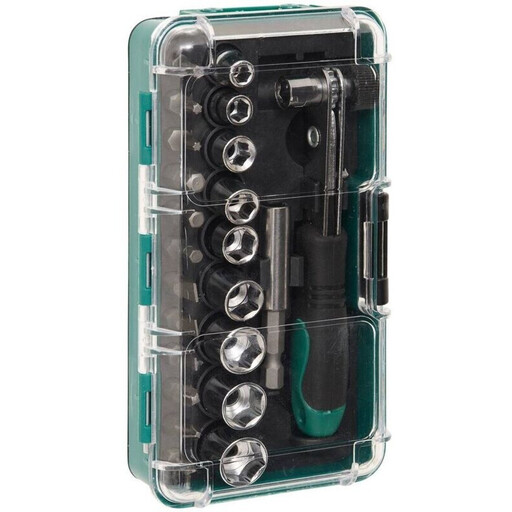
Why it suits this user: This compact 1/4-inch set combines 11 bits with 9 sockets ranging from 4 to 12 mm. It’s ideal for small repairs, furniture assembly and general jobs around the home.
The included sizes and bit types are listed clearly. That makes it less likely you’ll choose a set based on piece count alone.
Compact case, magnetic adapter and ergonomically designed ratchet handle.
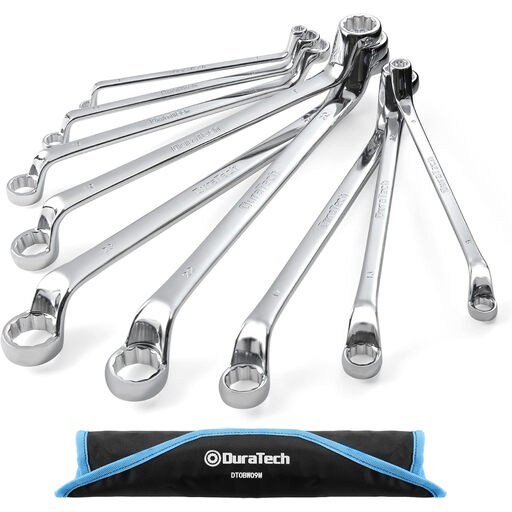
Why it suits this user: This double ring spanner set includes eight spanners in sizes from 6 to 22 mm. The 75-degree offset is designed for fixings in hard-to-reach places.
The sizes are marked at both ends of each spanner, and the storage pouch keeps all eight pieces organised by size.
Cr-V steel, 12-point ring ends, 75-degree offset and stated compliance with DIN 838.
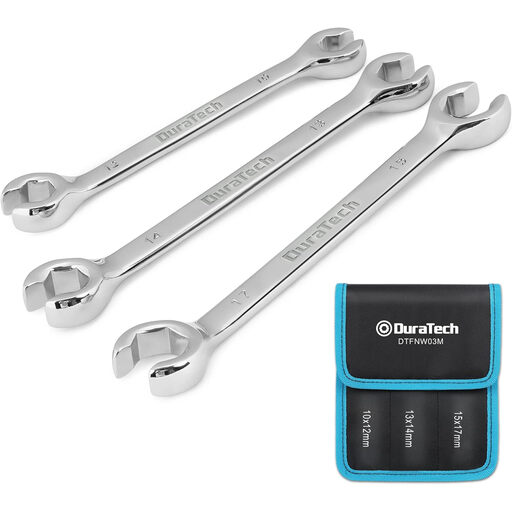
Why it suits this user: This brake line spanner set is for anyone working on brake line fittings or similar pipe connections that require an open ring profile.
It’s designed for pipe fittings. The sizes 10×12, 13×14 and 15×17 mm are clearly specified.
Heat-treated Cr-V steel, 15-degree offset and storage pouch.
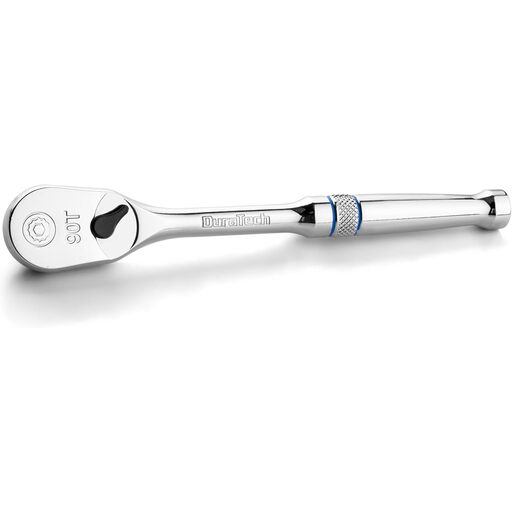
Why it suits this user: This 3/8-inch ratchet is compatible with commonly used sockets and, according to the product description, is designed for work on cars and light commercial vehicles.
The stated swing arc of around 4 degrees and enclosed ratchet head are designed for confined or dusty working areas.
90 teeth, reversible direction, 3/8-inch drive and fully enclosed head.
We’ve put together a complete, regularly updated list of products that meet these strict selection criteria and fully comply with the safety regulations in force in the EU.
For general repairs, a metric range of around 6 to 22 mm is versatile. A car tool set may also need 1/4-, 3/8- or 1/2-inch drives, as well as larger sockets. The sizes of the fixings on the specific vehicle or machine are what matter.
It depends on the space you’re working in. A ratcheting spanner saves movement because you don’t need to lift it off completely after every turn. A combination spanner has no moving mechanism, making it a straightforward alternative for certain fixings. Many people use both types.
There’s no single answer. It depends on the material, load, care and correct use. Regular visual checks, using the right spanner sizes and staying within torque limits all help reduce wear. Don’t continue using tools that are damaged, bent or worn.