Conversation trainers with remote participants
When questions, answers and interruptions are frequent, two-way speech and clear voice transmission matter more than music features.


For dialogue-based training with several people around a table, a speakerphone is a good fit if the specific model supports natural turn-taking and its microphone coverage and connections suit the group and your work computer. Noise filtering affects the voice being transmitted; it does not make the room quieter for people in it. If you’re taking part on your own, or don’t want others to overhear, a headset or a quieter spot may be a better option. The feature information given here comes mainly from manufacturers and is no substitute for testing a device in your own office conditions.
When questions, answers and interruptions are frequent, two-way speech and clear voice transmission matter more than music features.
If several people are taking part in the conversation in person, the microphone coverage and intended room size should suit the training space.
If you set up training on different computers, check the connection, exact device variant, portability and battery operation together.
First, work out whether several people in the room need to speak and listen together. For a tabletop device, then check that it supports natural turn-taking and that its microphone coverage and connection suit the specific variant.
| What you need | What to check before buying | Who is this especially important for? |
|---|---|---|
| Natural turn-taking | Check that the specific model supports full-duplex audio and echo cancellation; try a dialogue with interruptions. | If answers often follow one another or overlap, I want to be able to take turns without anyone’s words being cut off. Around 36% of consumers put natural turn-taking first. |
| Voice transmission in a noisy office | Distinguish microphone noise filtering from speaker playback; test the device in typical office conditions. | If nearby conversations could distract the person on the other end, I want to know how clearly they’ll hear me. Around 29% of consumers prioritise transmitting their voice with minimal interference. |
| Several people around the table | Check that the number of participants and the device’s position suit the coverage of the exact model. | If several learners are taking part in person, they should be able to join in comfortably from around the table. Around 21% of consumers focus primarily on taking part together around a table. |
| Set-up and moving between workspaces | Check whether the variant comes with USB-A or USB-C, Bluetooth for your computer and any adapters you need. | If I move the training set-up, I want to be able to connect the device without the wrong connection or missing accessories. Around 14% of consumers prioritise an easy set-up and moving between workspaces. |
A feature that processes the microphone signal won’t make the office quieter. People in the room may still find it difficult to hear the person speaking remotely.
Check how clearly your voice is transmitted and how well you can hear at the device’s intended position as two separate things.
Features and what’s included can vary between versions. For example, HP distinguishes between the Sync 20 and Sync 20+ in terms of PC connection and the supplied Bluetooth adapter; Yealink offers a dongle version of the SP92.
Check the full variant name and what’s actually included against your work computer.
If an adapter you need isn’t included, you may have to buy one separately or choose a different device variant.
Manufacturers’ range figures describe device specifications, but don’t prove that nearby conversations will be filtered out in your particular room.
Test the intended set-up with a typical conversation in the place where you’ll use it.
The Speak2 55 is a specific example for dialogue-based use with USB and Bluetooth. These details don’t apply to every Speak model.
The Sync range includes models for different workspaces and room sizes.
The OfficeCore M3 is a tabletop speakerphone designed for multiple voices and different connection types.
The SP92 is a portable speakerphone. The SP92, SP92 Lite and versions with or without a dongle should be considered separately.
The selection includes tabletop speakerphones for groups and an in-ear headphone as an alternative for taking part on your own. For each model, check that its connection type and features suit your training space.
 No image available
For moving between workspaces, Bluetooth and the stated built-in battery are useful features. For several people speaking, the product description lists multiple microphone pickup patterns.
Eight MEMS microphones; stated pickup range: 16.4 feet; touchscreen; 32 GB of storage for audio recordings; echo cancellation; daisy-chaining of up to three devices; stated battery life: 12 hours.
Noise cancellation won’t make the room quieter for people around the table. When making audio recordings, bear in mind the legal restrictions on unauthorised recordings and the relevant data protection requirements.
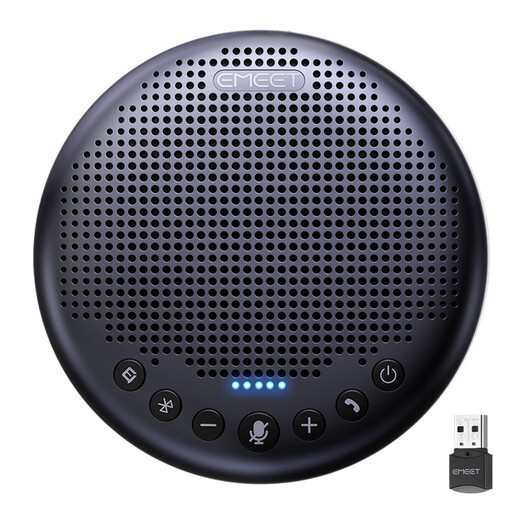 No image available
For several people around the table, the product description lists 360° voice pickup. Bluetooth and USB-C offer different connection options.
Eight microphones; 360° voice pickup; Bluetooth 5.3; USB-C; 5 W speaker; stated talk time: up to 10 hours.
The stated AI noise cancellation won’t make the office quieter for people around the table.
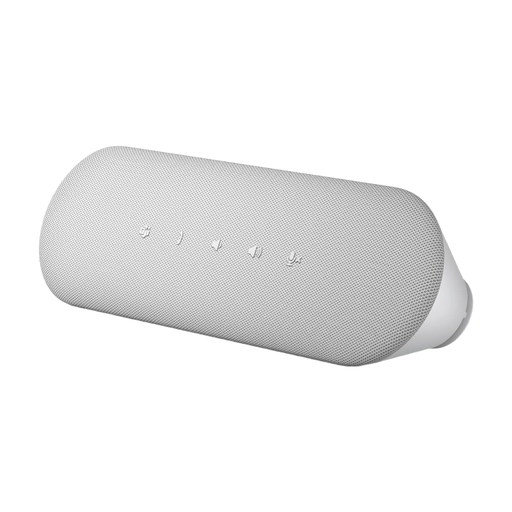 No image available
For a permanent training space, the product description lists a direct connection to your computer. Full-duplex audio and echo cancellation are useful for frequent turn-taking.
USB-A and USB-C connections; stereo playback; full-duplex audio; echo cancellation; stated AI noise cancellation.
Noise cancellation affects the microphone transmission; it doesn’t make the room quieter for people in it.
 No image available
As in-ear headphones with calling features, this model is better suited to one person than to a group sharing a tabletop speaker.
Adaptive noise cancellation; two beamforming microphones per earbud; multipoint Bluetooth.
If several people need to take part in person, in-ear headphones aren’t a substitute for a shared speakerphone.
You can’t tell from the stated microphone noise cancellation alone, as it mainly affects the signal transmitted to the other person. Check how well you can hear at the actual location; if you’re taking part on your own, a headset or quieter spot may be an option.
Position the device to suit the pickup range of the exact model and select it as the input and output device in your calling software. If you’re experiencing interference, AnkerWork recommends, among other things, testing its PowerConf devices with a USB cable. This advice is specific to those models.
Not with every variant. HP distinguishes between the Sync 20’s USB connection to a PC and the Sync 20+ version, which comes with a BT700 adapter. Yealink offers an SP92 version with a BT51C dongle. Check the exact version on offer and your computer’s connection options.
Under § 201 StGB, recording another person’s non-public spoken words on an audio device without authorisation is a criminal offence, as stated in the legislation published by Gesetze im Internet. If personal data is processed, an appropriate legal basis under the GDPR is also required. The Federal Commissioner for Data Protection and Freedom of Information points out that consent in an employment relationship is not automatically voluntary, because there may be an imbalance of power. Clarify the purpose and legal basis before making a recording; simply buying or using a speakerphone does not mean that a recording is taking place.