Batch cook making larger quantities
You want to make several portions in one go, so you’re comparing the stated capacity per batch. Springlane gives the Nina’s capacity in flour, while Rommelsbacher states the PM 220’s capacity in finished pasta.


If you want to make several portions without kneading the dough separately, compare automatic pasta makers by their stated capacity per batch and how you can add liquid. If you’d rather roll out thin sheets of dough and have control over your homemade spinach dough, a motorised roller may be a better choice – it won’t mix or knead the dough. Bear in mind that manufacturers’ figures for grams of flour and grams of finished pasta refer to different things, so they can’t be compared directly.
You want to make several portions in one go, so you’re comparing the stated capacity per batch. Springlane gives the Nina’s capacity in flour, while Rommelsbacher states the PM 220’s capacity in finished pasta.
You want to work spinach into the dough while keeping control over its moisture and how it’s processed. Marcato describes a motorised roller for homemade dough. Which type is right for you depends on how much of the dough-making you want to do yourself.
You want to portion and freeze pasta, so you’re thinking about both cleaning the machine parts and organising your supplies. The German Federal Centre for Nutrition recommends labelling frozen food packaging with details such as the contents, quantity and date.
When making a larger batch to freeze, the main things to consider are batch planning, how the machine handles moist dough, cleaning and the pasta shapes you can make.
| What matters to you | What to check before buying | Who is this important to? |
|---|---|---|
| Batch size for stocking up | Compare the stated capacity and what it measures; follow the manufacturer’s guidance for your recipe. | If I want to make several portions at once, I need to know whether the stated capacity suits my batch. Around 36% of consumers prioritise batch size. |
| Moisture and dough processing | Check whether the instructions for the specific model cover spinach and its moisture content. | If I’m adding spinach, I want to adjust the amount of liquid to suit the dough. Around 29% of consumers prioritise control over dough consistency. |
| Cleaning and portioning | Read the cleaning instructions for the specific model; plan suitable packaging and labelled portions. | If I’m making pasta to stock up, I want to clean the parts properly and package the portions neatly. Around 21% of consumers prioritise cleaning and freezer organisation. |
| Pasta shapes and appliance compatibility | Check which attachments are included and whether an accessory fits the machine you already own. | If I want to make particular pasta shapes or use an existing kitchen appliance, compatibility matters to me. Around 14% of consumers prioritise the choice of shapes and appliance compatibility. |
Springlane’s figure for the Nina refers to flour, while Rommelsbacher’s capacity figure for the PM 220 refers to finished pasta. They measure different things, so the figures aren’t directly comparable.
Plan using the same ingredient or the expected finished weight, and check the figures for the recipe you’re using.
Misjudging the batch size could mean you need to make extra batches.
Philips points out that the wrong flour-to-water ratio can make pasta brittle. Extra moisture can therefore affect how the dough needs to be prepared.
Start with the instructions for your specific model and check how they account for spinach and its moisture content.
If the dough doesn’t work out, you could waste ingredients.
A motorised roller doesn’t automatically mix and knead the dough. A pasta attachment for a food mixer also requires a compatible base machine.
First decide whether you want the machine to mix and knead as well. If you’re buying an attachment, check that it’s compatible with your specific appliance.
The Nina is a standalone automatic pasta maker for anyone who wants to plan batches by the amount of flour used.
The PM 220 Pastarella is a standalone automatic pasta maker with automatic water feed and the option to make manual adjustments.
The Pastamaker 7000 HR2665/93 is a standalone extrusion machine with a weighing function and a programme for flavoured pasta.
The Atlasmotor+ is a motorised roller and cutter for homemade dough, not a fully automatic pasta maker.
Pasta attachments such as the MAX980ME set are worth considering if you already own a compatible food mixer.
This selection includes electric dough rollers, automatic pasta makers and a food mixer attachment. Before buying, check the electrical safety and food-contact material information for the specific model: general EU requirements don’t prove that an individual appliance complies.
 No image available
For homemade spinach dough when you want to set the thickness before cutting it into pasta.
Seven thickness settings; cutters for pasta widths of 1.5 mm and 6.6 mm. The product description recommends dry cleaning the stainless steel surfaces; don’t immerse the appliance in water.
 No image available
For automatic dough preparation and a range of pasta shapes, if you’d rather not handle the steps yourself as you would with a roller.
The title lists nine shapes. According to the product description, you can use water or juice to prepare the dough; check how your spinach recipe will work with it.
 No image available
For automatic dough preparation with a choice of shaping discs, if you want to add vegetable liquid to the dough.
180 W; nine interchangeable shaping discs. The product description lists a separate opening for adding water or vegetable juice.
 No image available
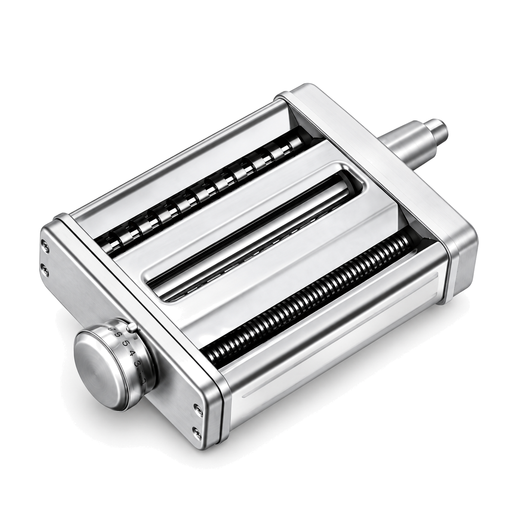
For rolling sheets of dough and cutting pasta if you already own a compatible KitchenAid food mixer.
The description lists eight thickness settings and rolling and cutting functions for lasagne, spaghetti and fettuccine. The attachment requires a compatible base machine with a Power Hub.
 No image available
For smaller portions of dough if the stated maximum capacity per batch suits your needs.
Up to 200 g of dough per batch and five shaping discs. According to the product description, don’t rinse the main unit; clean it with a cloth instead.
No. Springlane gives the Nina a flour capacity of 200–600 g, while Rommelsbacher states that the PM 220 can make up to 800 g of finished pasta. Compare like with like and check the instructions for your planned spinach mixture.
For frozen food, the German Federal Centre for Nutrition recommends suitable packaging, pre-measured portions and labels showing the contents, quantity and date. The guidance referred to here covers fruit and vegetables and doesn’t specify a storage time for raw spinach pasta, which may contain egg.
No, it depends on the model and the part. For the Philips HR2665/93, for example, the manufacturer excludes the front cover from its list of dishwasher-safe removable parts. Check the instructions for your exact model before cleaning it.
Your statutory consumer rights are against the seller; a manufacturer’s guarantee is separate and subject to its own terms. The consumer advice centre lists repair or replacement as possible remedies when a product is faulty.
The relevant EU electrical safety requirements apply to electrical equipment within the 50 to 1,000 V AC range. According to the European Union, CE marking is required where applicable harmonised legislation requires it. The European Commission also explains that materials intended to come into contact with food must meet the requirements of Regulation (EC) No 1935/2004. These general rules don’t prove that an individual model complies.