An automatic pasta maker is a good choice if you want flour and prepared ingredients to be kneaded and shaped during cooking; check the programme and instructions for the specific model. Philips notes that added liquid is not weighed by the HR2665/93, while motorised rollers such as the Marcato Atlasmotor+ and Imperia iPasta Classic require dough that has already been kneaded. If your dough is ready, a roller could be the right option. Also compare portion sizes and cleaning requirements, and keep perishable ingredients chilled until you use them, as recommended by the German Federal Institute for Risk Assessment.
Which type is right for you?
Spinach pasta with prepared ingredients
If you prepare spinach and other ingredients but want to mix and shape the dough when you’re ready to cook, check how liquid is measured and what steps the machine handles. Springlane and Philips describe automatic pasta makers for this process; the right recipe depends on the specific model.
Spinach pasta dough is already kneaded
If you make the dough yourself in advance and then want to roll it into sheets or ribbons, a motorised roller is a different type of machine from an automatic pasta maker. Marcato and Imperia describe motorised options for rolling and cutting.
You make different portion sizes
If you sometimes prepare smaller quantities and sometimes larger ones, compare the stated flour or dough capacity per batch with your recipe, and check how the individual parts are cleaned. Springlane provides information about flour capacity and cleaning, while Rommelsbacher describes the process and features of the PM 220.
What should you look for when buying?
For spinach pasta made with prepared ingredients, the right machine depends above all on whether you start with separate ingredients or dough that has already been kneaded.
| What matters to you |
What to check |
Who is it important to? |
| Spinach and liquid |
Check the programme, recipe and instructions for the specific model; you may need to measure out the liquid separately. |
If I’ve prepared spinach, I want to be able to control the amount of liquid to suit the recipe. Around 33% of consumers put spinach content and liquid first. |
| Steps handled by the machine |
Check whether the machine kneads and shapes the ingredients, or only rolls dough that is already made. |
If I want to do as little kneading as possible myself, I need to know which steps the machine actually handles. Around 27% of consumers focus above all on how much work the machine takes off their hands. |
| Shape and dough thickness |
Compare the included attachments or cutters with the pasta shapes you want to make. |
If I want to make particular sheets or pasta shapes from my prepared dough, I check the attachments and rolling thickness. Around 20% of consumers prioritise the shape of the dough they want to make. |
| Capacity and cleaning |
Compare capacities and batch sizes on the same basis, and check the cleaning instructions for each part. |
If I make different portion sizes, I want to know whether the capacity and cleaning afterwards fit into my routine. Around 20% of consumers prioritise portion planning and cleaning effort. |
Avoid common buying mistakes
-
The scales automatically measure all the spinach ingredients
An integrated scale doesn’t necessarily weigh liquids too. Philips makes this clear for its pasta maker.
Measure the prepared spinach and liquid according to the recipe and the instructions for your specific machine. Follow the steps for your model, especially when using automatic programmes.
-
A motorised roller kneads the dough
The motor functions described for the Marcato Atlasmotor+ and Imperia iPasta Classic are for rolling and cutting, not for combining ingredients to make dough.
Before buying, decide whether you want to start cooking with separate ingredients or spinach pasta dough that has already been kneaded.
-
Capacity and cleaning information applies to the whole machine
Springlane states the Nina’s capacity in terms of flour and says that removable parts are dishwasher-safe; this does not apply to the electrical base unit.
Check the flour quantity against your recipe and read the cleaning instructions for each component individually.
Brands and types at a glance
Springlane
The Nina is an automatic pasta maker that kneads and shapes ingredients as you prepare them.
- Springlane states a capacity of 200–600 g of flour per batch, seven attachments included and dishwasher-safe removable parts.
- The flour quantity does not indicate the weight of the finished spinach pasta. Also check that your recipe is suitable for the machine, following its instructions.
Philips
According to Philips, the 7000 Series Pasta Maker HR2665/93 combines mixing, weighing and shaping, and has a programme for egg or flavoured pasta.
- Philips states that this version operates at 220–240 V and has a programme for flavoured pasta.
- Philips notes that added liquid is not weighed. The range of shaping attachments varies by model.
Rommelsbacher
The Pastarella PM 220 kneads and extrudes dough, and offers automatic and semi-automatic programmes.
- The manufacturer’s instructions show weighing sensors, a water tank and seven dies.
- For automatic programmes, Rommelsbacher describes a set order for filling and taring the scales. This alone does not confirm that every spinach mixture is suitable.
Marcato
The Atlasmotor+ is a motorised roller for dough and sheets of pasta prepared separately.
- Marcato states that a motor is included and that you can adjust the dough thickness.
- The roller does not knead the ingredients beforehand.
Imperia
The Electric Imperia iPasta Classic is a motorised roller for rolling and cutting dough made separately.
- Imperia states that it has six rolling thickness settings, a Duplex cutter and operates at 230 V.
- The information does not describe automatic dough-making. Check the specifications and what’s included with the specific product.
Pasta makers at Joybuy
This selection includes automatic pasta makers that mix and knead, rollers and a stand mixer attachment for dough that has already been kneaded. For spinach pasta, check the recipe and liquid quantities against the instructions for the specific machine.
 No image available
FOHERE electric pasta maker with 7-level thickness control
For spinach pasta dough that has already been kneaded and that you want to roll into sheets and cut into pasta.
The description lists seven thickness settings from 0.5 to 3 mm, and cutters for pasta 1.5 and 6.6 mm wide. Wipe the surfaces dry and clean the blades with a brush.
View at Joybuy
 No image available
Electric pasta maker, 180 W, 9 interchangeable dies
An option if you want the ingredients to be mixed and kneaded in the machine.
The product name specifies 180 W and nine interchangeable dies. The description mentions an opening for adding water or vegetable juice; check the instructions and recipe before adding prepared spinach.
View at Joybuy
 No image available
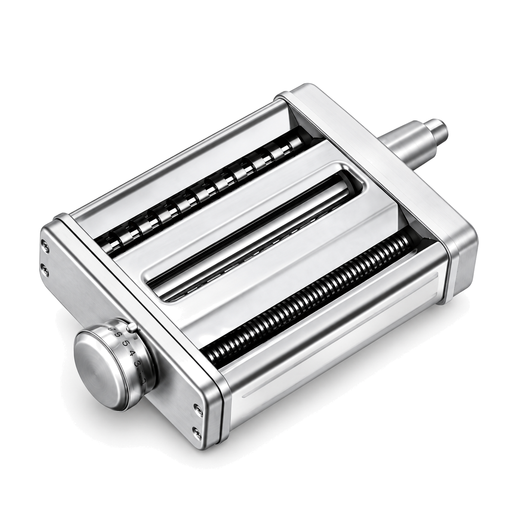
FOHERE 3-in-1 pasta attachment for KitchenAid stand mixers
For dough that has already been kneaded and households with a compatible KitchenAid stand mixer.
The description lists a roller with eight thickness settings and cutters for spaghetti and fettuccine. The attachment requires a suitable KitchenAid stand mixer; kneading remains a separate step.
View at Joybuy
 No image available
BEAR YMJ-K40Z7 pasta maker, up to 200 g of dough
For a routine where the stated dough capacity per batch suits the portion you plan to make.
The description lists a maximum capacity of 200 g of dough per batch and five shaping dies. According to the description, do not rinse the main unit; wipe it with a soft cloth instead.
View at Joybuy
Frequently asked questions
Can the machine automatically measure prepared spinach liquid?
Don’t assume that it can. Philips notes that its pasta maker does not weigh added liquid. Rommelsbacher describes a specific process for adding water when using the PM 220’s automatic programmes. For spinach, follow the instructions for your specific model and the recipe you’ve chosen.
What should I do before using an automatic programme on the Rommelsbacher PM 220?
Rommelsbacher recommends filling the water tank before selecting a programme and taring the scales correctly. These instructions apply to the PM 220 and are not a general rule for other pasta makers.
Can prepared spinach be left unrefrigerated?
The German Federal Institute for Risk Assessment recommends keeping perishable foods chilled until you use them. It also notes that improper storage of spinach can encourage nitrate to turn into nitrite. A pasta maker is no substitute for proper storage.
What should I look for in an electrical appliance in Germany?
As part of its market surveillance, the German Federal Network Agency lists the CE marking, an identifiable product and correct manufacturer details among the points to check. The CE marking is not an independent quality mark, and it alone does not establish whether a specific product complies with the relevant requirements.
Is a manufacturer’s guarantee the same as the statutory warranty?
No. The consumer advice centre distinguishes the statutory warranty against the seller from a voluntary guarantee with its own terms and conditions. If a product is faulty, the first step may be to have it repaired or replaced.


