Listeners with an existing living-room system
If you want to use your existing speakers, make sure the player’s phono or line output matches the input on your system. Audio-Technica points out that passive speakers also need an amplifier.


First, check whether your spoken-word records are LPs, singles or 78 rpm shellac records. Then make sure the record player’s output matches your system and speakers. For standard LPs and singles, a fully automatic model can make listening to longer recordings easier. Shellac records also need a suitable stylus. Set the player on a level surface, away from your speakers—not on or close to them.
If you want to use your existing speakers, make sure the player’s phono or line output matches the input on your system. Audio-Technica points out that passive speakers also need an amplifier.
If you want to handle the start and tonearm as little as possible, check the automatic features of the specific model. Sony and Denon describe automatic operation on their respective models.
If your collection includes shellac records, check not only the speed but also whether the stylus and cartridge are suitable for the record material. Audio-Technica stresses that 78 rpm alone is not enough.
Start with the record format and the equipment you already have. Then compare the controls, placement and options for changing the stylus.
| What matters | What to check when buying | Who is it important to? |
|---|---|---|
| Connecting to your system | Match the phono or line output to your system’s input; if you have passive speakers, factor in the amplifier you’ll need. | If I want to use my existing system, the signal connection needs to match its inputs. Around 30% of consumers put system connectivity first. |
| Less hands-on operation | Check automatic start, stop and tonearm return separately. | With longer recordings, I want to operate the tonearm as little as possible. Around 30% of consumers prioritise ease of use. |
| The right record format | Check your records’ speed; for shellac, also check that the stylus and cartridge are suitable. | If my collection includes older or differently cut spoken-word records, the player needs to suit each record. Around 20% of consumers put format compatibility first. |
| Placement and adjustment | Choose a level spot away from your speakers, and check whether the stylus or cartridge can be replaced. | If I want to position the player properly and possibly adjust it later, the available space and replacement options matter. Around 20% of consumers prioritise these points. |
According to Audio-Technica, a line signal connected to a phono input may sound distorted, while a phono signal connected to a line input may be very quiet without the right pre-amplification.
Check the labels on the inputs and outputs, and make sure the output switch on the record player is set correctly.
Depending on your existing system, you may need an external phono preamp.
Having the right speed alone doesn’t make a player suitable for shellac records. Audio-Technica distinguishes the stylus needed for shellac from those used for 78 rpm vinyl records.
Check your record’s material and whether the stylus on the specific player is compatible.
Shellac records may also need a suitable stylus or cartridge.
Passive speakers need an amplifier. Audio-Technica’s setup guide for the AT-LP120XUSB also advises against placing the player on or close to speakers.
Plan for the whole audio setup, and choose a level spot away from your speakers.
Depending on your existing equipment, you may also need an amplifier or suitable active speakers.
The AT-LP70XBT and AT-LP120XUSB ranges differ in areas including operation and record formats.
According to Sony, the PS-LX310BT combines fully automatic operation at 33⅓ and 45 rpm with Bluetooth, phono and line outputs.
Denon describes the DP-300F as a wired, fully automatic player for 33⅓ and 45 rpm, with a switchable phono preamp.
According to the manufacturer, the E1 Phono is a wired option with a built-in phono preamp and electronic switching between 33 and 45 rpm.
Dual describes the CS 329 as a pre-assembled, fully automatic model and the CS 429 as a model with an adjustable tonearm.
The players below combine record playback with built-in speakers or connections for a separate system. Before choosing, check that the speed, connections and features suit your records and listening space.
 No image available
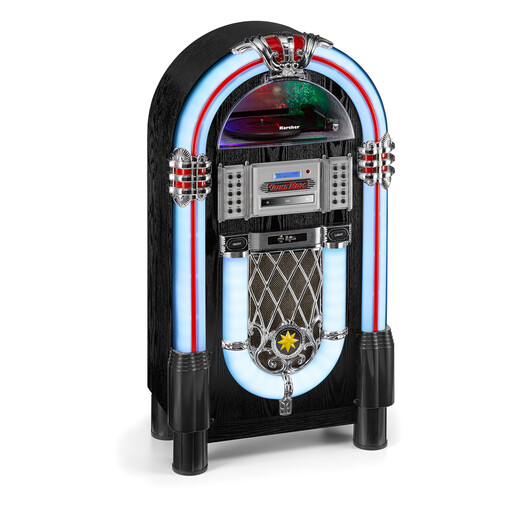
An option if you’d prefer built-in stereo speakers to separate speakers.
The description lists two stereo speakers with 40 W RMS, as well as 33, 45 and 78 rpm. Shellac records also need a suitable stylus.
 No image available
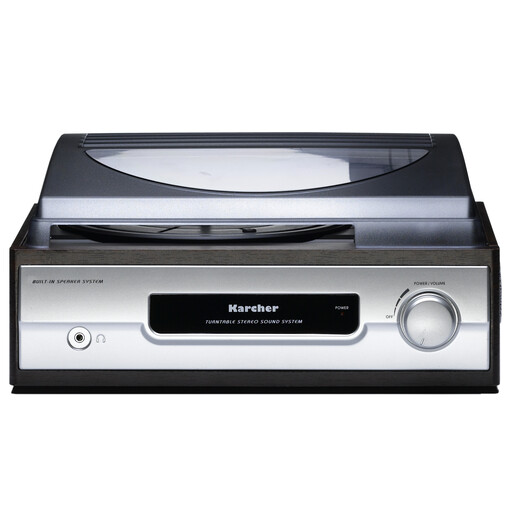
The built-in stereo speakers are useful if you want to listen without separate speakers.
The product title lists 33 and 45 rpm, auto-stop, a headphone socket and line-out.
 No image available
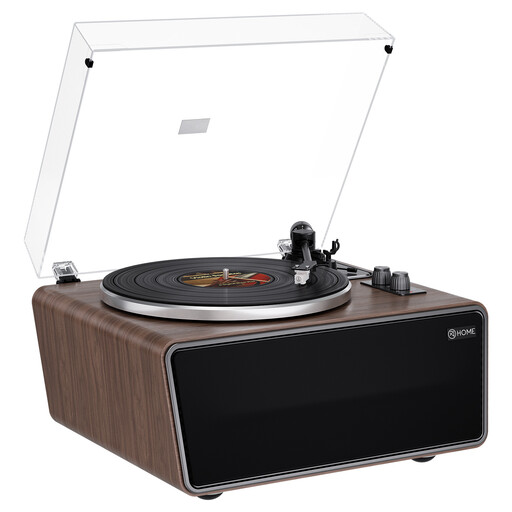
This all-in-one model is worth considering if you want built-in speakers and a phono preamp.
Features listed include four speakers, 33⅓ and 45 rpm, phono and line outputs, and an AT-3600L (MM) cartridge.
 No image available
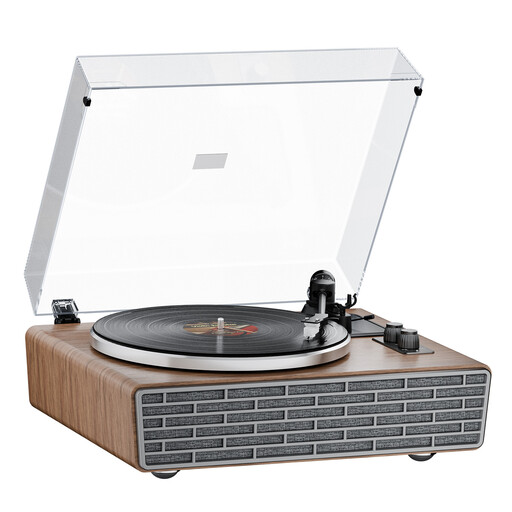
An option if you want to use the built-in speakers or connect the player to a separate system.
The description lists four speakers, 33⅓ and 45 rpm, Bluetooth, AUX, and RCA phono and line outputs.
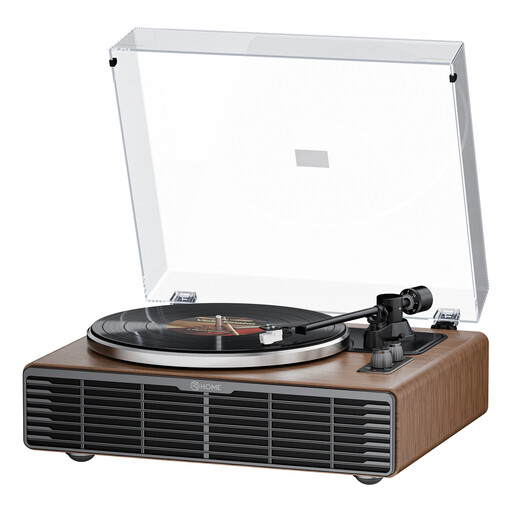 No image available
The built-in speakers are useful if you don’t want to connect separate speakers.
Features listed include four speakers, belt drive, an AT3600L cartridge, 33⅓ and 45 rpm, and RCA phono and line outputs.
It depends on the output and speakers. You can connect a suitable line output to compatible active speakers, while passive speakers also need an amplifier. A phono output needs a suitable phono preamp, unless your system already has one built in. Check the inputs and outputs on the specific devices.
Place it on a level surface, away from your speakers—not on or close to them. In the setup guide for the AT-LP120XUSB, Audio-Technica recommends leaving space to avoid the effects of vibration and sound pressure.
For a shellac record, the speed setting alone isn’t enough. Audio-Technica points out that you also need a suitable 78 rpm stylus, and that shellac records and 78 rpm vinyl records need to be distinguished.