Individual food and drink stains
If you want to tackle spilled drinks or food residue on suitable stool upholstery, look for a cleaner with an appropriate small upholstery attachment.


First, check whether the stool’s upholstery can be cleaned with water: Hoover explains that W means water-based cleaning, S means solvent-based cleaning, W/S means either method, and X indicates upholstery that must not be wet-cleaned. For individual marks, look for a suitable small attachment and easy handling; when cleaning several seats, tank capacity, reach and after-use care become more important. A steam setting does not automatically make a cleaner suitable for every fabric.
If you want to tackle spilled drinks or food residue on suitable stool upholstery, look for a cleaner with an appropriate small upholstery attachment.
If you need to clean several stools after having guests round, separate tank capacities, reach and attachment width can all affect how smoothly the job goes.
If you want to treat the fabric as gently as possible, check its care label first and choose your cleaning method afterwards.
The figures below each reflect the main concern when cleaning suitable upholstered stools after a family gathering.
| Priority | What to check when buying | Who prioritises it? |
|---|---|---|
| Material compatibility | Upholstery care label and permitted cleaning method | If I first need to find out whether my stool upholstery can be wet-cleaned at all, material compatibility comes first. Around 33% of consumers put this at the top of their list. |
| Targeted stain treatment | Size and shape of the upholstery attachment; hose and spray/extraction function | For individual drink stains, I want to be able to target the mark rather than clean a large seating area. Around 27% of consumers focus primarily on treating individual stains. |
| Cleaning several stools | Compare clean- and dirty-water tank capacities separately; check hose and cable length | If there are several suitable seats to clean after the gathering, I want to be able to plan refilling and emptying easily. Around 20% of consumers prioritise cleaning several seats. |
| Looking after the cleaner | Access for cleaning the tanks and hose; recommended cleaning products | After use, I want to be able to clean the parts that carry water without unnecessary hassle. Around 20% of consumers pay particular attention to maintenance and accessory requirements. |
A cleaner’s suitability claims do not replace the care instructions for the specific upholstery. Using an unsuitable wet-cleaning method can damage the fabric.
Check the care label and material guidance before using water or cleaning products. If the label says S or X, a spray-and-extraction cleaner is not automatically the right choice.
Manufacturers’ claims about a steam setting do not apply to every fabric or every use.
Only consider steam if the care instructions for the specific upholstery allow the treatment and you genuinely need the function.
When cleaning several stools, reach, attachments and cleaning the machine afterwards can all affect how smoothly the job goes.
Compare the clean- and dirty-water tanks, hose, cable, items included and how easy it is to access the parts that need cleaning on the exact model.
Parts that carry water need looking after after use; check how to clean the tanks, brushes and hose.
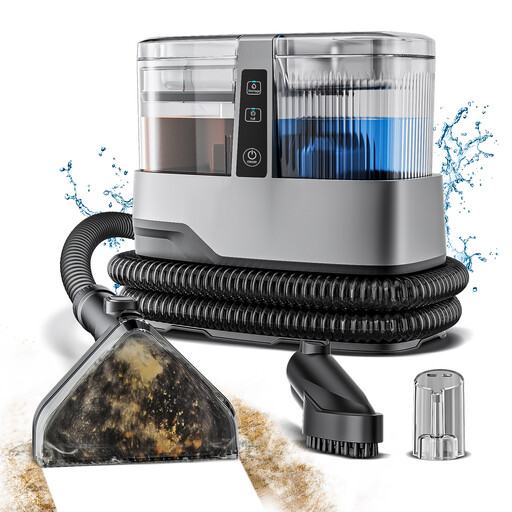
The SpotClean HydroSteam Pro 3700N combines spraying and suction with a steam setting and two brush sizes.
The Clean It IN5011F0 and IN5020F0 models spray, brush and extract stains from upholstery; features vary by version.
The HS5 HS530 011 may suit buyers who want to clean other manufacturer-specified surfaces as well as upholstery, using the appropriate attachments.
The Series 3000 XW3192/11 is a spot cleaner with a 3-in-1 nozzle for several soft surfaces listed by the manufacturer.
The StainStriker PX200EUT is an option for spot-cleaning upholstery and was covered in a test by F.A.Z. Kaufkompass.
These Joybuy products are designed for spot-cleaning suitable upholstery; some models also list separate water tanks.
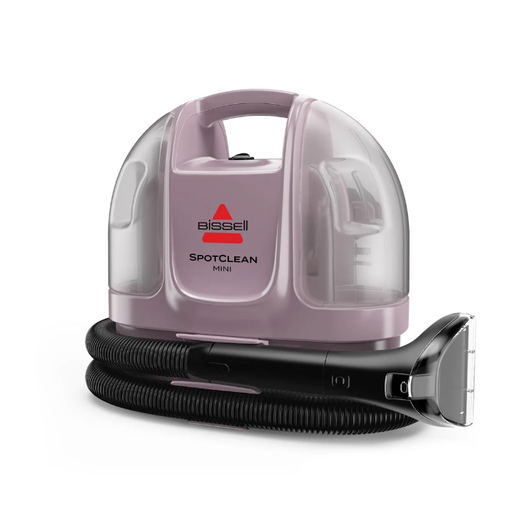 No image available
For individual stains on upholstery; the product name describes a compact cleaner that sprays, brushes and extracts.
Only use on upholstery whose care label permits water-based cleaning.
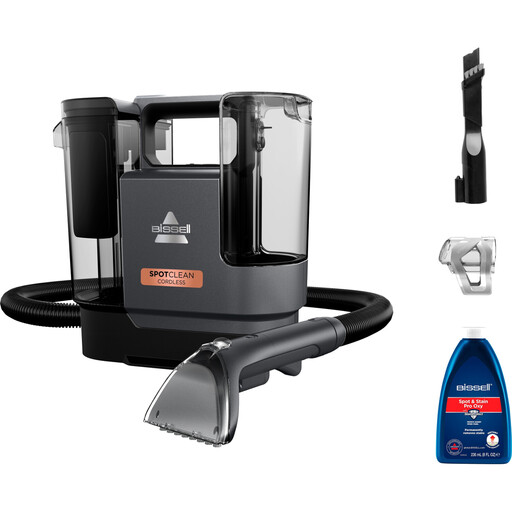 No image available
For stains on suitable upholstery; the product name lists an 18V Li-Ion battery and separate tanks.
Clean-water tank 0,9 l; dirty-water tank 0,8 l. The upholstery care label must permit water-based cleaning.
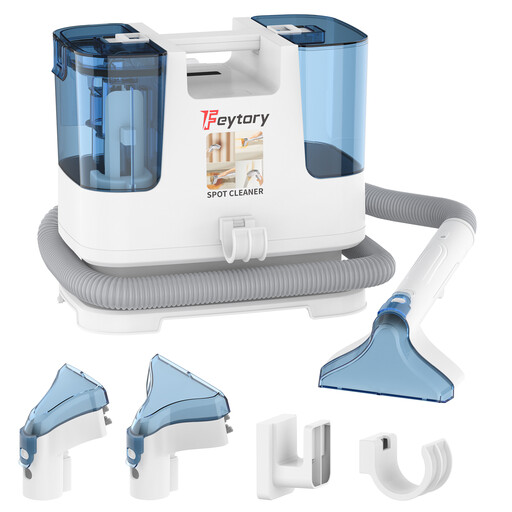 No image available
For individual stains on suitable upholstery; the product name describes a handheld cleaner with two water tanks.
Tank capacities: 0,6 l and 1,5 l. Check the upholstery care label before wet-cleaning.
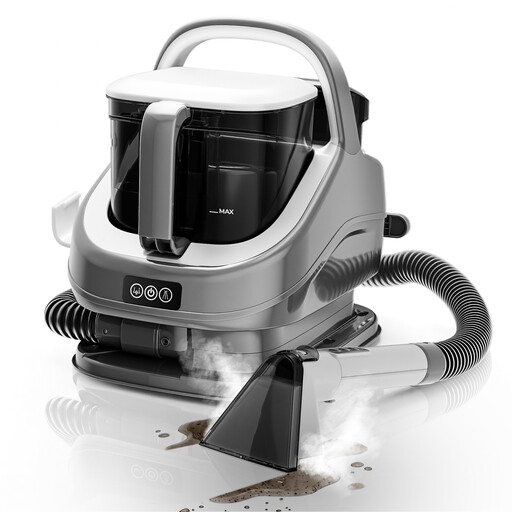 No image available
For stains on suitable upholstery; the product description lists spraying and extraction, as well as cold-water, hot-water and steam modes.
The description lists 13 kPa suction power, a 1.400-ml clean-water tank and a 1.200-ml dirty-water tank. Do not use on fabrics that are not water-resistant; follow the care label.
 No image available
For individual stains on suitable fabric upholstery; the product name describes a cleaner that sprays, brushes and extracts.
The product name lists 600 W and 17 kPa. Only use on water-safe surfaces and follow the upholstery care label.
No. First check the care label for the specific upholstery: Hoover explains that W means water-based cleaning, S means solvent-based cleaning, W/S means either method, and X indicates upholstery that must not be wet-cleaned. A cleaner’s product description does not automatically mean the stool is suitable for wet treatment.
First, follow the care instructions and remove any loose crumbs. Hoover recommends blotting fresh stains rather than rubbing them; only wet-clean if the upholstery is suitable.
Empty and clean the cleaner’s water-carrying parts in accordance with the instructions for the specific model. Leave the upholstery to dry and air the room; the German Environment Agency recommends airing rooms thoroughly to remove moisture. This does not establish a set drying time for every stool.
No. Your statutory rights for faulty goods apply against the seller, while a guarantee is an additional voluntary service subject to its own terms. The Verbraucherzentrale explains the difference in its article dated 28 September 2026.
As a general rule, goods bought online come with a right to cancel, usually within 14 days of receiving them; any exceptions and the specific cancellation information should be checked. The Verbraucherzentrale explains these rules in its article dated 13 August 2026. For household chemicals classified accordingly, hazard symbols and hazard and safety statements must also be visible online, as described by the Verbraucherzentrale in its article dated 13 November 2025. This does not mean that a special permit is required to operate an upholstery cleaner.