
Lieferung heute & morgen

Qualitätsgarantie

Willkommens-Angebote freischalten: KOSTENLOSE Lieferung | Bis zu 80 % RABATT | Kostenlose 30-Tage-JoyPlus-Testphase
App herunterladen
A springform cake tin makes it easier to bake cheesecakes, gateaux, tarts and desserts, thanks to a clasp that lets you open the sides. However, tins can vary considerably in how well they prevent leaks, their coating, maximum temperature and cleaning requirements. If you only consider the diameter or a low price, you could end up with a tin that doesn’t suit the way you bake.
A non-stick cake tin can make it easier to release your cake. However, the coating can be damaged by sharp knives, metal spatulas and scouring pads. Also, ‘non-stick’ isn’t a consistent, protected quality standard. Look for specific information about the material, cleaning instructions and maximum temperature.
The removable sides are handy, but they can also be a potential weak point. Thin batters can leak if the clasp doesn’t close precisely. So, look for a cake tin that’s explicitly described as leakproof or has a suitable seal or SafeClick mechanism. For very runny fillings, baking paper or a suitable tray underneath can also help.
A 20 cm springform tin is better suited to smaller cakes and households with modest baking needs. A 24 cm or 26 cm springform tin is often a more standard size for family recipes. A 28 cm or 30 cm springform tin offers more surface area, but also needs more mixture and enough room in your oven. Always compare the height, capacity and sides of the tin too.
Steel and carbon steel heat evenly and are commonly used for cake tins. The stated maximum oven temperature matters just as much as the material. For example, limits can vary between 230 °C, 240 °C, 250 °C and 280 °C. Don’t exceed the manufacturer’s stated limit.
A springform tin is designed for use in the oven. Don’t use it on a hob, induction hob or over an open flame unless the manufacturer specifically says it’s suitable. Don’t place a hot tin on a cold or wet surface either, as sudden temperature changes can put stress on the material and coating.
Check that the clasp feels sturdy and closes fully. A removable base makes it easier to release delicate cakes. Whether you choose a tin with a lift-out base or a classic springform tin, the base should fit neatly inside the sides.
For cheesecakes, tarts and very runny mixtures, look for a clearly stated leakproof design. A clasp on its own doesn’t guarantee a completely watertight seal.
Many tins can only be washed by hand. Some models have a base that’s dishwasher-safe, while the sides aren’t. Use warm water, mild washing-up liquid and a soft sponge. Wooden, silicone or plastic utensils can help reduce the risk of scratches.
A cake tin set can be handy if you regularly bake different quantities. Check whether the tins can be stacked inside one another and which sizes are actually included.
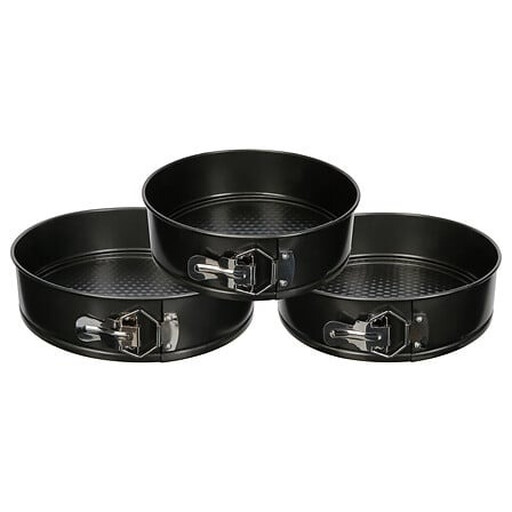
Why this product suits this type of baker: The set includes three sizes—22 cm, 24.5 cm and 26 cm—so you can choose the right tin for different recipe quantities.
The different diameters mean you don’t have to use the same tin for small and large batches. The tins are stackable.
Three steel tins with a non-stick coating and removable bases, with stated heat resistance up to 280 °C.
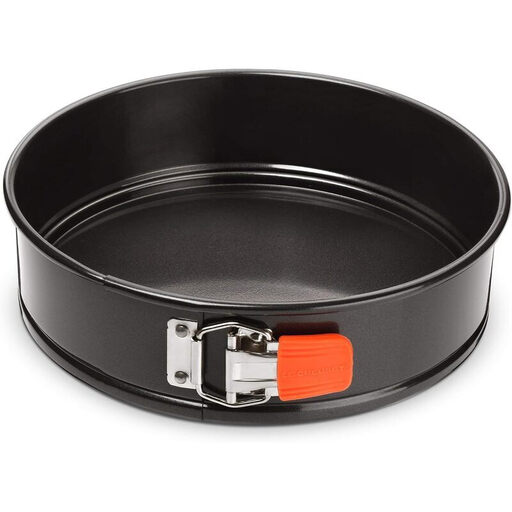
Why this product suits this type of baker: This 20 cm round springform tin is made for smaller cakes, gateaux and cheesecakes.
The side clip and removable base make the closure and cake release straightforward. The tin is specified for hand washing only.
Carbon steel construction, non-stick coating and heat resistance up to 240 °C; not suitable for use on a hob or over direct heat.
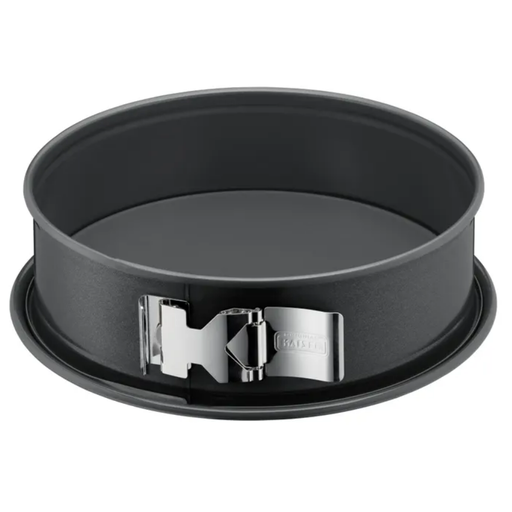
Why this product suits this type of baker: With a 4-litre capacity, this 30 cm springform tin is designed for large cakes, family-sized portions and regular baking.
The SafeClick system gives you specific information about the clasp. The product description also makes clear that only the base is dishwasher-safe.
Steel construction, non-stick coating, 30 cm diameter and heat resistance up to 250 °C.
We’ve put together a complete, regularly updated list of products that meet these strict selection criteria and the safety regulations in force across the EU.
A 24 cm or 26 cm springform tin suits many popular recipe quantities. A 20 cm tin is a good choice for smaller households, while 28 cm and 30 cm tins may need more mixture and longer baking times. When adapting recipes, always take the area and height of the tin into account.
Close the sides fully and check that the base sits evenly. For runny batter, choose a cake tin that’s described as leakproof. You can also place baking paper between the base and the sides. For very thin mixtures, consider using a different tin or a water bath with a suitable seal.
Its lifespan depends on the thickness of the material, the clasp, how often you use it and how well you care for it. Avoid using sharp or metal utensils with coated tins. Also follow the stated temperature limit and cleaning instructions. Replace the tin if the coating is visibly damaged or the clasp no longer closes securely.