
Lieferung heute & morgen

Qualitätsgarantie

Willkommens-Angebote freischalten: KOSTENLOSE Lieferung | Bis zu 80 % RABATT | Kostenlose 30-Tage-JoyPlus-Testphase
App herunterladen
A squat stand is a core component for free-weight strength training in a home gym. Its primary function is to provide a safe, height-adjustable rack for a barbell. This allows for the proper execution of fundamental exercises like squats and bench presses without needing a spotter. Selecting the right model depends on specific technical parameters that must align with individual training goals and spatial constraints.
The decision to purchase a squat stand for your home should be based on an analysis of objective criteria. The following technical aspects are crucial for functionality and safety.
The durability and stability of a stand are largely determined by the material used. High-quality models are made from powder-coated steel, which offers protection against corrosion and scratches. Pay attention to the gauge of the steel frame; dimensions such as 5 cm x 5 cm indicate a robust build. The quality of the welds is also a key factor in structural integrity.
A freestanding barbell rack must remain completely stable under load. H-shaped bases provide a wide and secure foundation, minimising the risk of tipping. Rubberised end caps on the feet are an important detail: they prevent the frame from slipping during exercises and also protect your flooring from damage.
Flexibility is a key advantage, especially in a home gym. A height-adjustable squat stand allows you to adapt it to the user's height and the specific exercise. Check the adjustment range (e.g., 100 cm to 170 cm) and the fineness of the increments (e.g., in 5 cm steps). Adjustable width is equally important for accommodating different barbell lengths and fitting around a weight bench for bench pressing.
The specified maximum load capacity is a non-negotiable safety feature. It should always be significantly higher than the maximum training weight you plan to lift. Capacities ranging from 200 kg to 300 kg will cover the needs of most home users. This capacity refers to the static load and should never be exceeded.
For training without a partner, adjustable safety spotters are essential. They catch the barbell if your strength fails during a repetition. Ensure that these Safety Spotter Arms are also height-adjustable so you can position them precisely below the lowest point of the movement, for instance, during a bench press or squat.
Based on the technical criteria mentioned above, we present two models that are well-suited for home gym use due to their specific features.
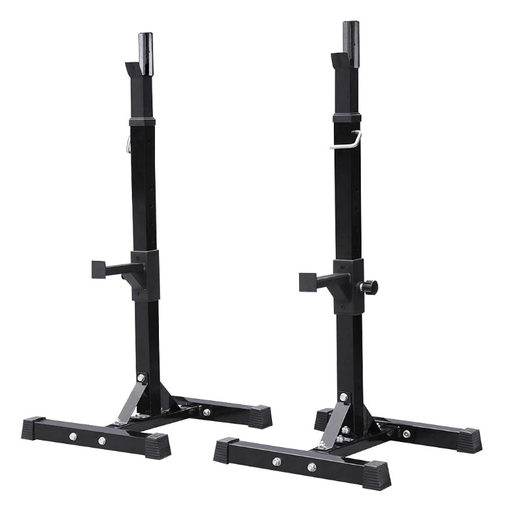
Why We Recommend This Product This model stands out for its high flexibility and a well-designed safety concept. The construction, featuring 5 cm x 5 cm steel tubes and H-shaped bases (54.5 cm x 50.5 cm), ensures solid stability. With a maximum load capacity of 250 kg, it is suitable for a wide range of strength athletes.
Its standout feature is its fine-tuned adjustability: the barbell rests can be adjusted through 14 levels from 102.5 cm to 167.5 cm, while the separate safety spotters offer 6 positions between 49 cm and 74 cm. This allows for precise customisation for exercises like squats, shoulder presses, and for use as a bench press rack.
Pros
Who It's For This model is an excellent choice for beginners and advanced athletes looking for a versatile and safe adjustable weight rack for their home workouts who value precise adjustment options.
More details on the Yaheetech Squat Stand (YA-00104079)
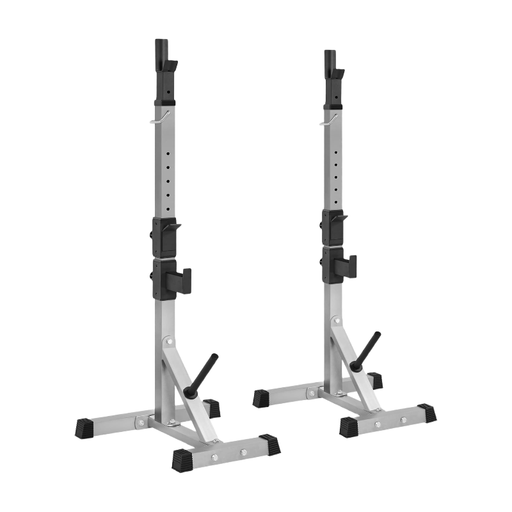
Why We Recommend This Product This squat rack is designed for users who train with heavier weights and appreciate efficient equipment organisation. Its powder-coated steel construction allows for a maximum load capacity of up to 300 kg, according to the manufacturer. The stable H-shaped feet (53 cm x 52 cm) with non-slip rubber caps ensure a secure footing.
A key functional feature is the integrated weight plate holders (2.5 cm diameter), which keep the training area organised and the weights within easy reach. Additionally, the rack has three different rest positions for the barbell, facilitating quick transitions between exercises like squats and shoulder presses without having to completely readjust the height.
Pros
Who It's For This model is aimed at ambitious strength athletes who require a higher load capacity and appreciate the convenience of integrated weight plate storage and multiple rest heights for seamless workouts.
More details on the Yaheetech Squat Stand (YA614694091901)
While a squat stand forms the foundation for barbell training, a home gym can be enhanced with additional equipment. For users seeking space-saving solutions for versatile training, we recommend exploring our Portable Accessories category.
1. What is the difference between a squat stand and a power rack? A squat stand typically consists of two separate, freestanding uprights. This offers flexibility in width adjustment and has a smaller footprint. A power rack is an enclosed cage-like structure made of four vertical posts connected by crossbars. Its cage design provides a higher degree of passive safety but requires significantly more space and is less mobile.
2. What should the load capacity of a home squat stand be? The load capacity should always have a safety margin well above your current and planned maximum weight. For most home users, a capacity between 200 kg and 250 kg is sufficient. If you plan to lift very heavy weights or are already an advanced lifter, a model with a capacity of 300 kg or more is a worthwhile investment.
3. Can a freestanding barbell rack also be used for bench pressing? Yes, that is one of its core functions. A freestanding barbell rack is ideal for use as a bench press rack because the two stands can be flexibly adjusted in width to fit a weight bench. The height-adjustable safety spotters are especially important here to safely rack the barbell in an emergency.