
Lieferung heute & morgen

Qualitätsgarantie

Willkommens-Angebote freischalten: KOSTENLOSE Lieferung | Bis zu 80 % RABATT | Kostenlose 30-Tage-JoyPlus-Testphase
App herunterladen
A hand blender can purée soup straight in the pan, blend fruit for smoothies and, with the right attachments, chop ingredients or whisk cream. However, many households buy a model whose features don’t suit their day-to-day needs. What matters isn’t the longest list of accessories, but the right combination of power, ease of use, materials and cleaning.
A powerful motor sounds impressive, but on its own it tells you little about how a blender will perform in practice. You should also consider the permitted operating time, speed control, blade design and included accessories. A powerful hand blender with 1,200 watts may be suitable for hard ingredients, but that doesn’t automatically mean it will give better results with every soup or smoothie.
Also look out for guidance such as ‘one minute of use, one minute of rest’. This instruction for the ROUNY model, for example, indicates that it should be used in intervals.
A hand blender set with a chopper, whisk, measuring beaker and other attachments is versatile. But if you mainly purée soup, you may not need a milk frother or several specialist blades. Conversely, a basic hand blender won’t be enough if you regularly prepare batter, diced vegetables or whipped cream.
Before you buy, check:
With almost all models, only the removable accessories can go in the dishwasher. The motor housing, cable and controls must not be immersed in water. Even with parts described as dishwasher-safe blender accessories, check the temperature limits and the manufacturer’s instructions. For example, the ROUNY model’s suitable accessories are stated to be washable at temperatures below 60 °C.
For occasional sauces or soft fruit, a model with mid-range power is often enough. According to the product details, the Bosch MSM 6B100 has a 280-watt motor and a turbo button. For more demanding tasks, such as chopping firmer ingredients, consider models with 1,000 to 1,200 watts.
Wattage is only one part of the picture, though. Stepless speed control or several speed settings make it easier to switch between roughly chopping and finely puréeing. If a model has a short maximum operating time, divide the work into smaller batches.
A stainless steel hand blender, or a model with a stainless steel blade and shaft, offers a durable, corrosion-resistant surface for contact with food. Plastic, on the other hand, can help keep the weight down, and some models have a heat-resistant blending foot.
A splash guard or scratch protector is useful if you’re using the blender with coated cookware. The shape of the blade guard also affects how much liquid splashes. Take extra care with hot ingredients: let food cool and follow the instructions, as steam and splashing liquid can cause injuries.
A lightweight model is easier to use for longer periods. The Bosch MSM 6B100 is listed as weighing 0.6 kg, while models with more accessories may be heavier. A non-slip grip, easy-to-reach buttons and a clear release mechanism are also useful for everyday use.
With a multifunction hand blender, all removable parts should be easy to access. Always clean the motor housing with a damp cloth only. Blades are sharp, so take care not to touch the cutting edge when washing them.
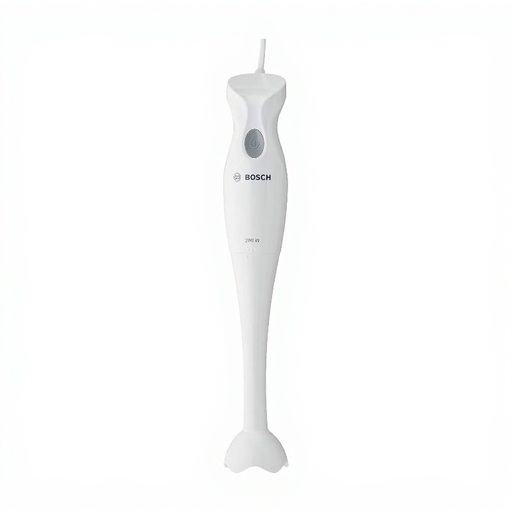
Why it suits this type of user: This compact hand blender focuses on puréeing, blending and chopping. It’s well suited to simple everyday tasks and comes with a modest selection of accessories.
The product details clearly state that it has 280 watts, a turbo button and a removable blending foot. This makes it easier to assess what it can do than with a vague list of accessories.
Weighs 0.6 kg, with a splash guard and a dishwasher-safe blending foot according to the product description.
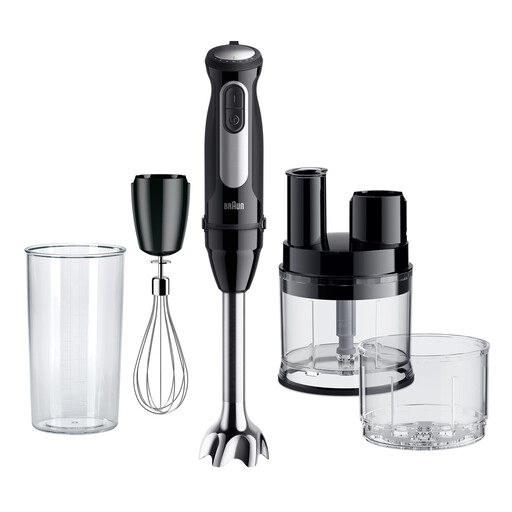
Why it suits this type of user: This model is for households that want to switch frequently between puréeing, chopping, slicing and whisking.
The 25 speed settings plus turbo allow for precise control. The EasyClick Plus system makes it easier to change attachments.
1,000-watt motor, stainless steel blending shaft, metal whisk and several accessories according to the product details.
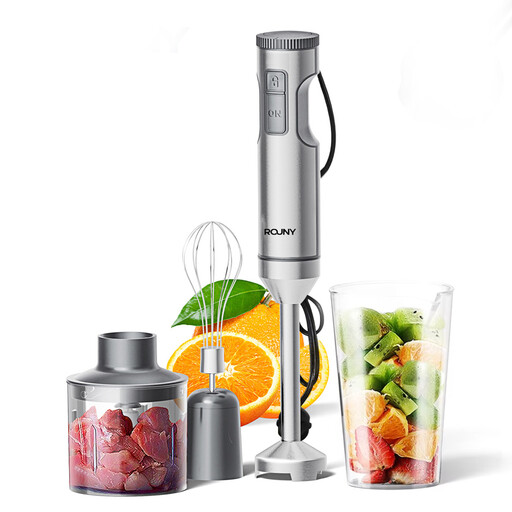
Why it suits this type of user: This 4-in-1 set combines a hand blender, a 700 ml beaker, a 500 ml chopper and a whisk for making soups, sauces, smoothies and baking ingredients.
The product description lists a rated power of 1,000 watts, a maximum of 1,200 watts, 15,000 rpm and stepless speed control.
Stainless steel blade and shaft, overheat protection and removable accessories; certain parts are stated to be dishwasher-safe up to 60 °C.
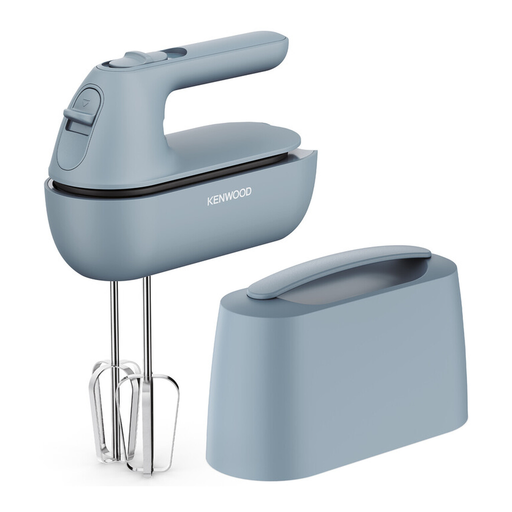
Why it suits this type of user: This traditional hand mixer is designed for cake batter, cream, egg whites and lighter doughs. It’s a useful addition to a hand blender.
Five speed settings with a slow start help reduce splashing when mixing ingredients. The accessories and cable are kept together in the storage solution.
350 watts, twin beaters, twin dough hooks and dishwasher-safe mixing attachments according to the product description.
We’ve put together a complete, regularly updated list of products that meet these strict selection criteria and fully comply with the safety regulations in force in the EU.
Many models can purée soup in the pan. However, hot liquids should not be boiling vigorously. Follow the manufacturer’s instructions, use a container with high sides and keep the blending foot fully submerged to prevent splashes.
Its lifespan depends on how often you use it, the ingredients you blend, how you clean it and whether you follow the recommended operating intervals. Hard foods, overloading and continuous use without breaks can put more strain on the motor. Regular cleaning, dry storage and following the instructions will help keep it working reliably.
The electricity costs are usually low for short blending jobs. The key factors are the appliance’s power rating and how long you actually use it. For a rough estimate, multiply the power in kilowatts by the usage time in hours and your electricity tariff per unit. A 1,000-watt appliance uses 1 kWh for each hour of operation; in everyday use, however, a hand blender is usually only used for a few minutes at a time.