
Lieferung heute & morgen

Qualitätsgarantie

Willkommens-Angebote freischalten: KOSTENLOSE Lieferung | Bis zu 80 % RABATT | Kostenlose 30-Tage-JoyPlus-Testphase
App herunterladen
By: Joybuy Product Recommendation OfficerDate: July 28, 2026
A messy entryway or an overflowing wardrobe with shoes piled haphazardly on top of each other is a common frustration. Stackable shoe boxes promise an elegant solution: order, protection, and a clear overview. However, the market is flooded with products of widely varying quality. Before you invest, it's crucial to understand the typical pitfalls that can quickly turn a supposedly smart purchase into a case of buyer's remorse.
Many buyers report similar problems. Instead of a stable and tidy storage solution, they end up with flimsy structures that buckle after a short time, or boxes that won't even fit their favourite shoes. This guide will show you what to look for to find a durable and functional solution for your shoe storage.
Promotional images often show perfectly aligned, tall towers of shoe boxes. The reality is frequently quite different. Pay attention to these three critical points to avoid disappointment:
To create a durable and practical shoe organisation system, you should carefully examine three technical features. These define the quality and functionality of a shoe organiser far more than mere marketing promises.
The stability of a plastic shoe box is determined by the material used and the design of its frame. Look for the following specifications:
A space-saving shoe storage solution is only effective if the shoes actually fit inside.
To ensure the longevity of your shoes, good air circulation is crucial.
Based on the criteria above, we have identified some products that offer a suitable solution for different user profiles and requirements.
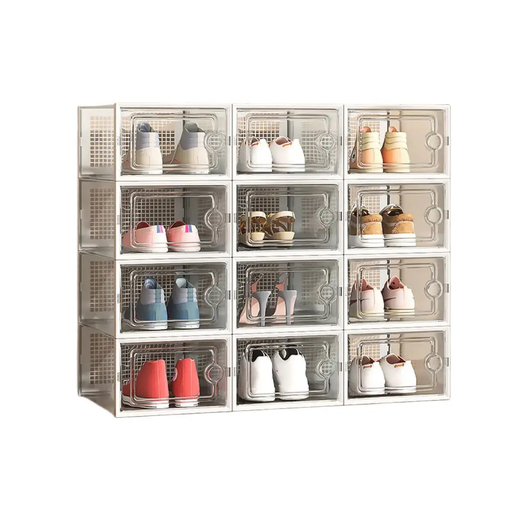
Why it's a match: Ideal for starting an organised system without a large budget. The 12-piece set offers enough capacity for a basic collection of flat shoes, sandals, and trainers up to a standard size (approx. EU 43). The transparent shoe boxes quickly create order and a clear overview.
The boxes are designed for standard loads and their rigid shape prevents the chaos of loose shoes. The dimensions of 33x23x14 cm are clearly stated and are well-suited for flatter shoes, thus avoiding the pitfall of an improper fit.
Good value for money thanks to the 12-piece set. Features integrated ventilation holes and a dust-proof design.
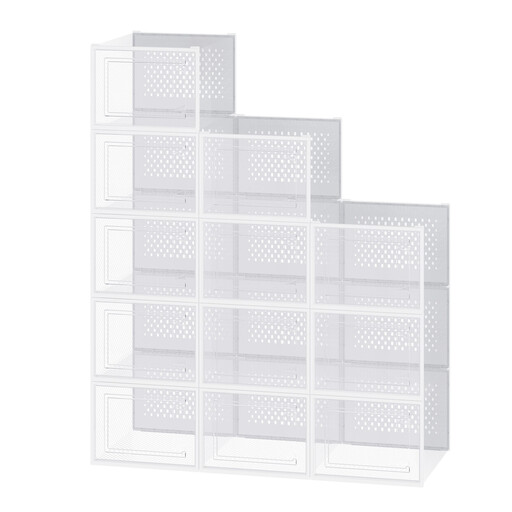
Why it's a match: With generous internal dimensions of 35 x 25 x 18.5 cm, these sneaker boxes offer ample space for high-tops and larger shoe sizes. The robust frame construction made of PS and PP allows for stable, taller stacking, ideal for showcasing a valuable collection.
The reinforced frame construction actively prevents the sagging and warping that occurs with cheaper models when stacked. The integrated ventilation holes provide the necessary air circulation to protect high-value trainers.
Large capacity for shoes up to approx. UK size 11. The transparent front door allows for quick access and excellent visibility.
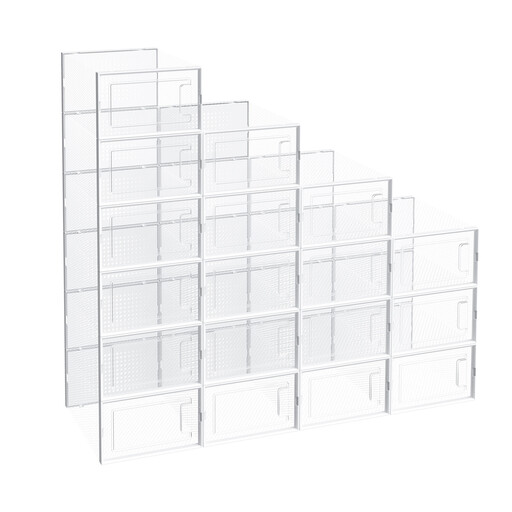
Why it's a match: This 18-piece shoe box set is a complete solution for the entire household. The uniform size (35 x 25.2 x 19 cm) creates a calm, tidy look in the hallway or dressing room and can handle a large quantity of shoes in various sizes.
The large quantity allows all shoes to be stored uniformly and securely, preventing the typical "shoe pile" in the entryway. The robust, stackable design provides a durable and space-saving solution for the whole family.
Large set for a comprehensive organisational solution. Foldable design for easy storage when not in use.
We have compiled a complete, up-to-date list of products that fully meet these strict selection criteria and applicable regulations.
1. How high can you stack plastic shoe boxes? The maximum stacking height depends heavily on the frame construction and the weight of the shoes. Models with a reinforced frame made of ABS or PS plastic can typically be safely stacked 8 to 10 boxes high. For simpler, frameless models made of thin PP material, a height of 5 to 6 boxes should not be exceeded to ensure stability. Always follow the manufacturer's instructions.
2. Do transparent shoe boxes protect against fading from sunlight? Standard transparent shoe boxes generally do not offer special UV protection. While the plastic may filter a small amount of UV radiation, the colours of delicate shoes can still fade with prolonged, direct exposure to sunlight. It is recommended to place the boxes in a location without direct, intense sunlight.
3. What should I pay attention to when assembling the boxes to achieve maximum stability? The most critical step is ensuring all components click into place correctly. Make sure the side panels audibly "click" into the front and rear frames. A common source of error is a connection that isn't fully engaged, which leads to instability. Take a moment to check that all parts are firmly and flushly connected before filling and stacking the boxes.