
Lieferung heute & morgen

Qualitätsgarantie

Willkommens-Angebote freischalten: KOSTENLOSE Lieferung | Bis zu 80 % RABATT | Kostenlose 30-Tage-JoyPlus-Testphase
App herunterladen
Shoes in the hallway, wardrobe or under the bed can take up more space than you might expect. Stackable shoe boxes can help keep your collection organised, as long as their dimensions, sturdiness and ventilation suit your needs. If you focus only on getting a large set or a particularly low price, you can easily overlook important details.
A shoe box may look spacious from the outside, while its usable interior is smaller because of the frame, doors or side panels. This can be a problem, especially with trainers, high-top trainers and shoes with wide soles. So check the internal dimensions or the shoe size explicitly stated as suitable, rather than just the box’s external dimensions.
The amount of floor space the boxes take up matters too. Several shoe boxes placed side by side need enough depth on a shelf or in a wardrobe. In a narrow hallway, a box that’s too deep could restrict the walkway.
Transparent shoe boxes make it easier to see what’s inside. But a clear front on its own doesn’t tell you how easy the shoes are to take out. Front openings, flaps or doors should still be easy to use when several shoe boxes are stacked on top of one another.
If you’re building a tall stack, it’s also worth checking how the boxes connect. Interlocking parts or specially designed recesses can make for a neater, more practical stack than containers simply placed on top of one another.
Ventilated shoe boxes often have openings or a partially open design. This can help air circulate, but it doesn’t replace letting your shoes dry completely before storing them. Don’t put damp shoes straight into closed shoe boxes.
Where you store them also makes a difference. Conditions in a damp cellar, next to a radiator or in a poorly ventilated cupboard are different from those in a dry dressing room.
Start by measuring the space available:
A shoe rack for your wardrobe needs to accommodate the boxes while leaving enough clearance for doors and drawers. A set of shoe boxes with several units can be a good choice for families. For a smaller collection, a compact option is often enough.
Plastic shoe boxes are often made with a polypropylene (PP) body and polystyrene (PS) transparent front panels. These details can help you understand the product, but they don’t replace checking the quality of its construction.
Look for:
Foldable shoe boxes save space when transporting or storing them. However, they need to be correctly aligned and fully clicked into place after assembly. With fabric models, check whether a frame or rigid panels help them keep their shape.
Shoe boxes with lids protect their contents from dust, while front openings make it easy to get to your shoes. For shoes you wear often, front doors are usually more convenient than lids that need to be removed completely.
When choosing shoe storage, also consider whether you want to be able to see every pair. Transparent fronts mean you won’t need to open several boxes when looking for a particular pair. A fabric model with a visible front panel can be a good alternative if you’d prefer a more understated look.
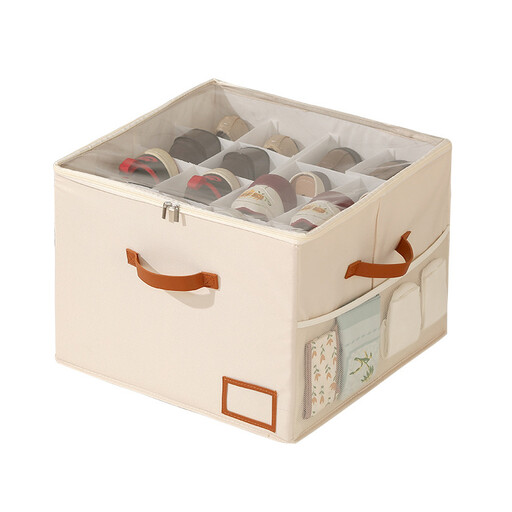
Why this product suits your needs: The foldable fabric design is a good fit if you want to expand your shoe storage as needed or stow it away to save space when it’s not in use. The lid helps keep shoes enclosed.
The foldable design takes up less space in storage and transit. Before buying, check the available internal dimensions and make sure they suit the shape of your shoes.
Foldable fabric design with a lid and a stackable shape; the grey colour offers a subtle look.
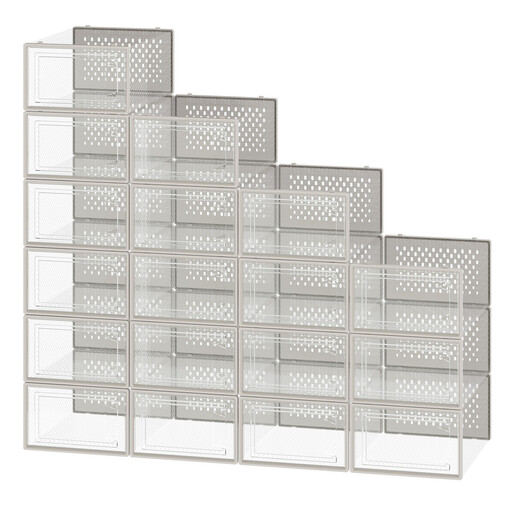
Why this product suits your needs: This set includes 18 boxes, making it a well-organised option for larger shoe collections. The stated internal dimensions are 31.2 × 22.5 × 13.5 cm, with transparent front doors and ventilation openings.
The stated dimensions make it easier to check whether the boxes will fit your shoes. The front doors let you see what’s inside, while the ventilation openings add airflow.
18 boxes, PP body, PS front door, transparent and beige finish, and stackable interlocking parts.
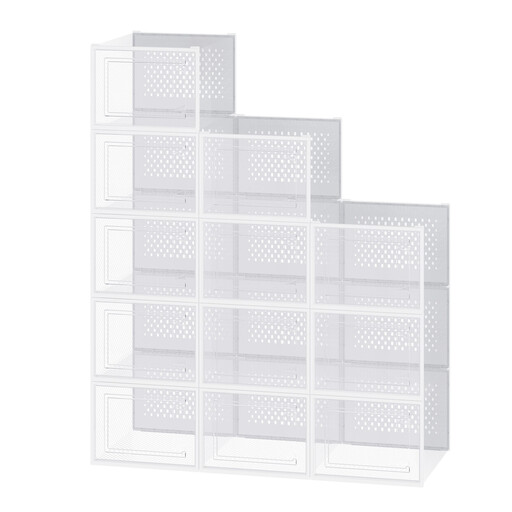
Why this product suits your needs: This set of 12 is designed to keep shoes neatly organised in a wardrobe, hallway or dressing room. Each box measures 35 × 25 × 18.5 cm and has a transparent front and ventilation.
Check the individual dimensions against your shoe size before buying. The front opening means you won’t need to rearrange the whole stack every time you take out a pair.
12 boxes made from PP and PS, a white finish, transparent front doors and built-in ventilation openings.
We’ve put together a complete, regularly updated list of products that meet these strict selection criteria and fully comply with the safety regulations in force in the EU.
Start by assembling the boxes on a flat surface. With interlocking systems, make sure all the parts are fully connected before putting anything inside or stacking the boxes. Place heavier shoes at the bottom and lighter pairs on top, to distribute the weight more evenly.
To help your boxes last longer:
It depends on the internal dimensions of the box. Always compare details such as “fits up to UK size 11” or specific measurements in centimetres with the length, width and height of your shoes. High-top trainers and shoes with particularly thick soles need extra room.
There’s no single answer that applies to every model. It depends on the construction, connecting parts, the weight of the shoes and how level the surface is. Follow the product guidance and make sure tall stacks can’t topple over or make it difficult to reach your shoes.
Transparent boxes make it easier to see what’s inside and are useful for shoes you wear often. Foldable shoe boxes take up less storage space when they’re not in use, making them a good fit for changing storage needs. The right choice depends on the space you have, how often you need to access your shoes, their size and the look you prefer.