
Lieferung heute & morgen

Qualitätsgarantie

Willkommens-Angebote freischalten: KOSTENLOSE Lieferung | Bis zu 80 % RABATT | Kostenlose 30-Tage-JoyPlus-Testphase
App herunterladen
Shoes in the hallway, wardrobe or under the bed can quickly take up a lot of space. Stackable shoe boxes can help keep your storage organised, provided their dimensions, ventilation and design suit the space you have. However, not every clear box is suitable for every type of shoe.
Before you buy, it’s worth checking the actual product specifications rather than relying on claims such as ‘one size fits all’ or ‘space-saving’.
A shoe box may look large enough from the outside, while its frame, door and base significantly reduce the space inside. This is especially important for sneaker storage boxes, boots and shoes with thicker soles.
Check the following:
If you’re storing several pairs, it’s best to measure more than just one. Different styles can take up different amounts of space, even if they’re the same shoe size.
Clear shoe boxes make it easier to choose a pair because you can see what’s inside. However, if a box is fully enclosed and has no front opening, you may need to remove it from the stack to get to your shoes.
Shoe boxes with lids or front doors are more practical if you wear the shoes regularly. For taller stacks, also check whether the front opening can be used fully and whether you can still reach the boxes inside your wardrobe.
Built-in vents can help air circulate, but they won’t automatically dry shoes that are damp or stored in unsuitable conditions. Make sure shoes are completely dry and free from loose dirt before putting them away.
For delicate materials, also follow the manufacturer’s care instructions. A plastic box protects shoes from dust, but it isn’t necessarily the right environment for every upper material.
Many plastic shoe boxes are made from PP, or polypropylene. This is the material used for the box body in the products listed here. Front doors, however, may be made from PS, or polystyrene, or another type of plastic in some models.
Plastic boxes hold their shape and can usually be cleaned with a damp cloth. Foldable fabric shoe boxes take up less space when they’re not in use. However, you should pay particular attention to the frame’s stability and how well the boxes can bear weight when stacked.
The Ochama set lists external dimensions of 35 × 25 × 18.5 cm per box. This size may suit many everyday shoes and trainers, but you should compare it with the actual internal dimensions and the shape of your shoes.
Depending on the model, JOYFURNOS lists dimensions of 33.3 × 23.2 × 14.3 cm or 35 × 25.2 × 19 cm. The product descriptions also state that the boxes are suitable for shoes up to UK size 11. This doesn’t replace measuring your own shoes, as their shape and overall volume matter too.
A wardrobe shoe organiser should not only be stackable but also fit the space available. Check:
If you’re buying a shoe box set of 12 or 18, work out the total width before you order. This helps you avoid buying more boxes than your wardrobe can hold.
The models below vary mainly in size, pack quantity, design and material. The details are based on the respective product descriptions.
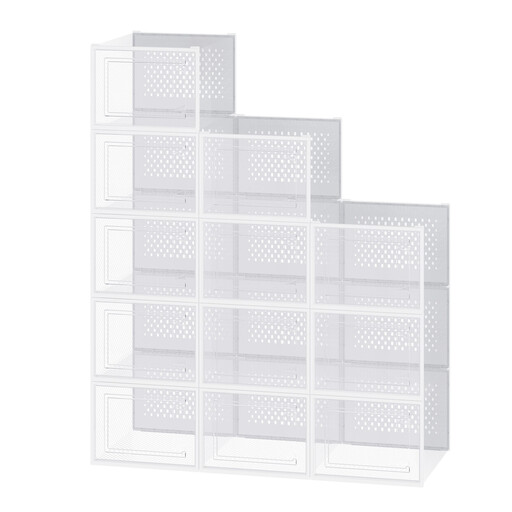
Why this product suits this need: This set of 12 is ideal for households looking to keep several pairs neatly organised. The clear front door makes it easy to choose a pair without opening every box.
The stated dimensions of 35 × 25 × 18.5 cm per box, along with the advice to check sizing, can help you avoid ordering a box that won’t fit.
12 PP plastic boxes with front doors, a stackable design and built-in ventilation.
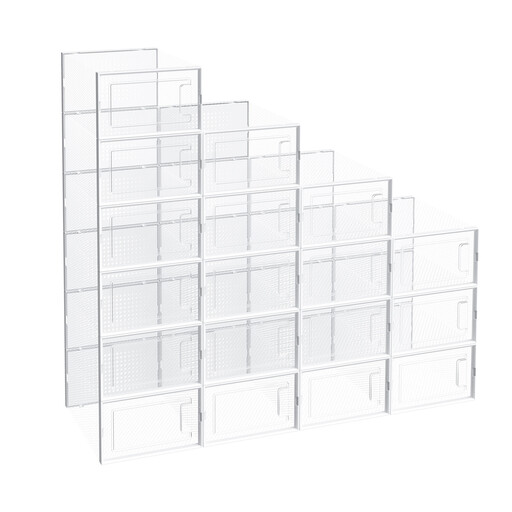
Why this product suits this need: This set of 18 offers a larger, coordinated storage solution for a collection or a bigger household. The front opening makes it easy to reach your shoes, even when the boxes are stacked.
The product description gives precise external dimensions of 35 × 25.2 × 19 cm and highlights the need to check your shoe size against the box dimensions.
18 foldable boxes with clear panels, front doors and ventilation holes; the product description states they’re suitable for trainers up to UK size 11.
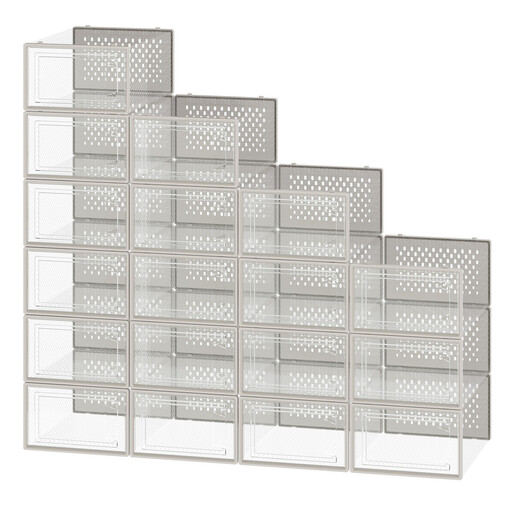
Why this product suits this need: This set is a good choice if you regularly use shoe boxes and want a large number of matching boxes in your wardrobe, hallway or entrance.
According to the description, each box consists of three parts and can be assembled by slotting them together. This makes assembly simpler than with more complex designs.
Internal dimensions of 31.2 × 22.5 × 13.5 cm according to the product description, with ventilation holes and interlocking points for stacking.
We’ve put together a complete, regularly updated list of products that meet these strict selection criteria and the safety regulations applicable in the EU.
Keep the shoes you wear most often at eye level or near the front of the stack. Seasonal footwear can go higher up or further back. For families, it can be helpful to organise shoes by person, size or purpose.
Store unused foldable shoe boxes flat and in a dry place. Before assembling them, check all the parts for damage and put the boxes together on a level surface. Don’t place heavy items on top of shoe boxes unless they have a stated load capacity.
It depends on the design, interlocking points, surface and manufacturer’s guidance. Without specific load-bearing information, it’s not possible to give a general maximum stack height. Make sure tall stacks are stable and regularly check that the boxes are still properly interlocked.
Many models are designed for trainers, but suitability depends on the internal dimensions, shoe shape and size. Measure the longest and widest points of your shoes, then compare them with the stated internal dimensions. If your shoes have high soles, check the internal height too.
Only store shoes when they’re clean and dry, and make use of any ventilation holes. Avoid direct heat sources and rooms that are consistently damp. A shoe box protects footwear from dust and helps keep it organised, but it doesn’t replace regular shoe care.