
Lieferung heute & morgen

Qualitätsgarantie

Willkommens-Angebote freischalten: KOSTENLOSE Lieferung | Bis zu 80 % RABATT | Kostenlose 30-Tage-JoyPlus-Testphase
App herunterladen
Keeping shoes tidy in the hallway, wardrobe or on shelves sounds simple. In practice, unsuitable dimensions, unstable designs or a lack of ventilation can quickly make shoe storage impractical. Stackable shoe boxes can save space and keep their contents visible – provided they suit your shoes and the place where you plan to put them.
Product pages often list the external dimensions. However, the internal dimensions are what matter when choosing a box. Seams, frames, doors and reinforced bases reduce the usable space inside. A box can be too small even if its external dimensions seem suitable, particularly for trainers, high-top shoes or larger sizes.
Not every shoe box can be safely stacked to any height. Check the connectors, contact surfaces and any guidance on maximum load. A tall stack should stand on a level surface and not be placed in front of doors or in walkways. If you have children at home, it’s also worth choosing a spot where the boxes are less likely to tip over.
Transparent shoe boxes make it easier to find what you’re looking for, but they don’t replace air circulation. Closed plastic boxes without ventilation holes may not be suitable for long-term storage if shoes are still damp or warm when you put them away. Let worn shoes dry first, and check whether the box has ventilation holes.
Measure the longest part of the shoe and allow a little extra room. For a pair of trainers, check the width and height as well as the length. Product descriptions such as ‘up to UK size 11’ are a useful guide, but they can’t guarantee a fit for every shoe shape. High-top trainers, walking boots and shoes with thick soles may need more room.
Common materials include PP polypropylene, PS polystyrene and textile fabrics. PP is lightweight and can usually be cleaned with a damp cloth. PS is often used for transparent doors or viewing panels. For foldable fabric boxes, check that the base holds its shape and that the surface can be wiped clean.
Shoe boxes with front doors let you reach your shoes without taking the stack apart. Side-opening doors can be useful when the boxes are placed on a shelf. Foldable shoe boxes take up less room before assembly, while rigid plastic boxes usually have a fixed shape. Also check whether they can be assembled without tools and whether the connectors fasten securely.
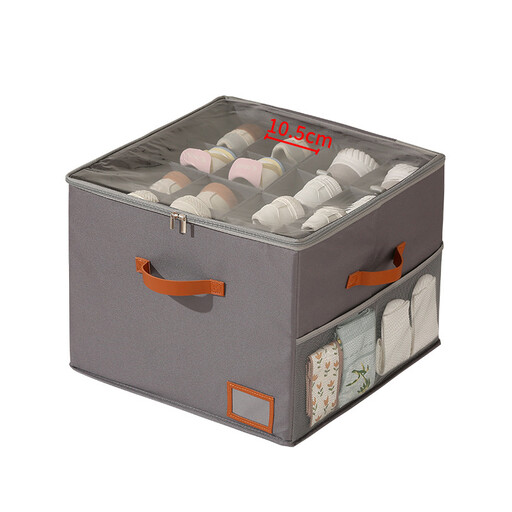
Why this product suits this profile: Its foldable design is ideal if you’re looking for flexible shoe storage in a wardrobe or on a shelf.
The foldable design takes up less space when not in use. Before buying, check your shoe size against the available internal space.
Textile, foldable construction and visible storage, as stated in the product name.
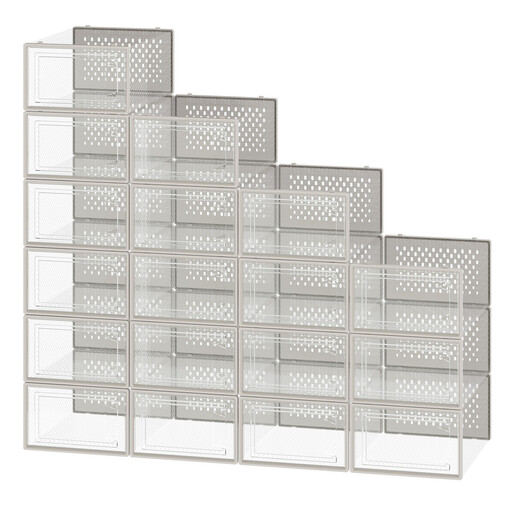
Why this product suits this profile: This set is designed for households or collectors who want to organise lots of pairs neatly and visibly in one shoe storage system.
Transparent front doors save you from having to open each box to find your shoes. Ventilation holes help avoid the common problem of fully enclosed storage.
18 boxes, transparent doors, ventilation holes and stated internal dimensions of 31,2 × 22,5 × 13,5 cm.
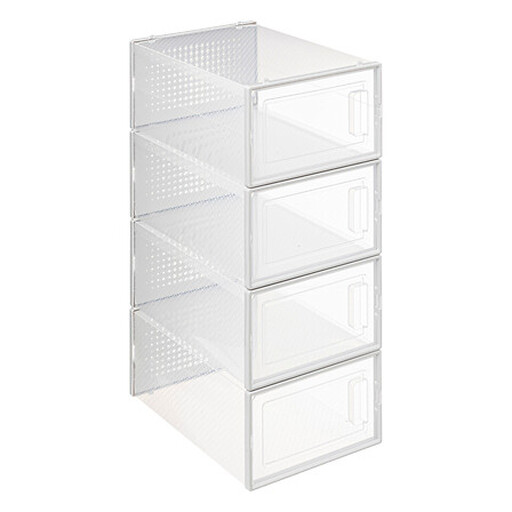
Why this product suits this profile: Four individual boxes are ideal for a modest shoe collection, a shelf or an entrance with limited floor space.
The side door makes it easier to access your shoes when space is tight. Before stacking, follow the guidance on safe assembly and avoid overloading the boxes.
Four transparent boxes, side doors, a ventilation system and stated suitability for shoe sizes up to 44.
We’ve put together a complete, regularly updated list of products that meet these strict selection criteria and all applicable EU safety regulations.
It depends on the design, connectors and location. Only stack them as high as the product description recommends. The surface must be level; an additional anti-tip measure is a good idea for a tall stack. Don’t place boxes directly in front of radiators or on escape routes.
Many models are designed for trainers, but the internal dimensions and shoe shape are what matter. Compare the length, width and height of your shoes with the product details. Allow extra room for high-top or particularly bulky trainers.
There’s no set lifespan. It depends on the material, assembly, load, cleaning and how often you open the boxes. Don’t overload them, keep them out of strong sunlight and clean plastic surfaces with a suitable non-abrasive cloth. When not in use, store foldable shoe boxes somewhere dry and without anything weighing them down.