
Lieferung heute & morgen

Qualitätsgarantie

Willkommens-Angebote freischalten: KOSTENLOSE Lieferung | Bis zu 80 % RABATT | Kostenlose 30-Tage-JoyPlus-Testphase
App herunterladen
Shoes in the hallway, wardrobe or under the bed can soon take up more space than you expected. Stackable shoe boxes can help you store pairs neatly, keep them dust-free and make better use of space. However, shoe storage boxes vary considerably in size, ventilation, stability and assembly.
If you focus only on a clear front or a large pack size, you could miss some important details. Three common problems are:
With plastic and folding shoe boxes, the most important thing is the usable space inside. The external dimensions include the walls, doors and connectors, so compare your shoes’ size, including any extra width and height, with the stated internal measurements.
Compact boxes are often fine for low-profile trainers. Shoes with thick soles, high-top trainers and larger men’s shoes need more height and depth. If you’re buying a set of several shoe boxes, check whether all your pairs need the same amount of space or whether any are unusually large.
A clear front door is handy: you can see the pair inside without having to open every box. Clear shoe boxes are therefore especially useful in wardrobes and open shelving.
A stackable shoe box shouldn’t simply rest on top of another box. Look for guides, connectors or sturdy tops and bases. These features help prevent the boxes from sliding around when you open the front door.
For tall stacks, choose a flat, sturdy surface. Depending on how the boxes are designed, a narrow hallway or wardrobe floor may be less suitable than a solid shelf. The number of boxes in a set doesn’t, on its own, tell you how high you can stack them. Check the assembly instructions and product dimensions before buying.
Plastic shoe boxes are easy to clean and, if they’re transparent, make it quick to see what’s inside. Polypropylene, or PP for short, is often used for the body. The front doors may be made from a different plastic, such as PS. Checking the material details can help you compare products more objectively.
Shoe boxes with lids and front openings each have their advantages:
Before storing your shoes, make sure they’re completely dry and free from heavy dirt. This helps keep your wardrobe shoe storage more hygienic and reduces wear on the box.
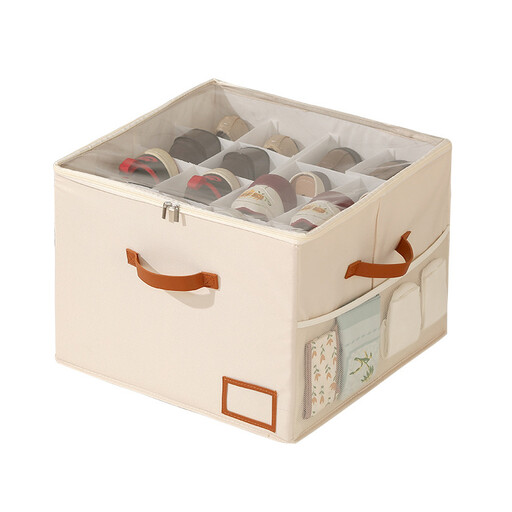
Why this product suits this profile: The folding design and lid make this a flexible, space-saving option for your wardrobe or for storing shoes you only wear in certain seasons.
The product description specifies a folding design, a lid and a stackable construction. Before buying, compare the stated measurements with the size of your shoes.
Folding design and lid; ideal for flexible, dust-free storage.
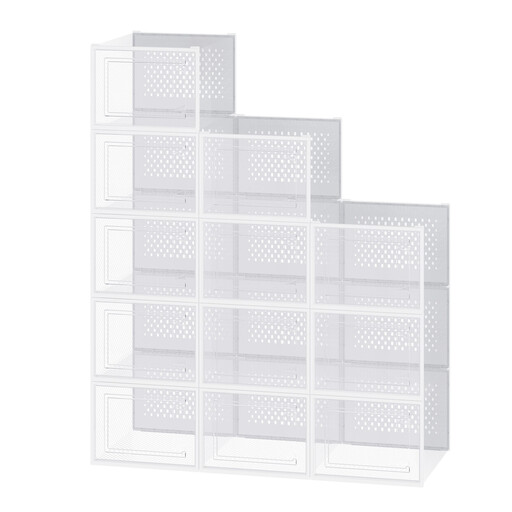
Why this product suits this profile: This set of 12 is aimed at trainer collectors and households looking for a matching set with front access and visible storage.
The clear doors make it easier to choose a pair, while the built-in ventilation holes help air circulate. Each box measures 35 × 25 × 18,5 cm.
12 boxes made from PP plastic with PS front doors; front access and a stackable design.
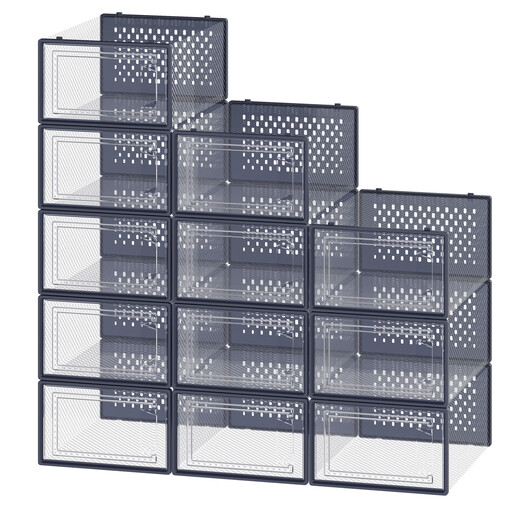
Why this product suits this profile: This set has 12 individual compartments for households with a range of different pairs. It works well on shelves, in wardrobes or in a dedicated shoe storage area.
The product details specify a snap-together assembly, transparent panels and ventilation holes. This makes it easier to find the right pair and gives you a clearer idea of the construction before you buy.
Each box measures 33,3 × 23,2 × 14,3 cm; front opening and ventilation make it easy to keep shoes organised and accessible.
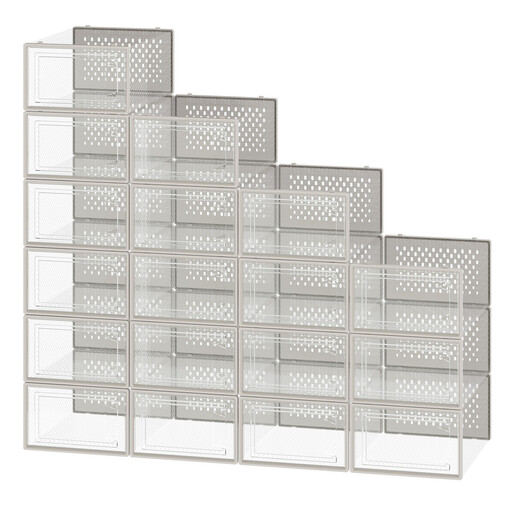
Why this product suits this profile: This set of 18 is designed for frequent use and larger shoe collections that need plenty of matching compartments with front access.
The stated internal dimensions of 31,2 × 22,5 × 13,5 cm and suitability for shoes up to UK size 11 make it easier to check the fit. Ventilation and connectors are also clearly specified.
18 folding boxes with clear doors, snap-together assembly and ventilation holes.
We’ve put together a complete, regularly updated list of products that meet these strict selection criteria and fully comply with the safety regulations in force in the EU.
For a tidy storage solution that lasts, follow these steps:
Allow wet shoes plenty of time to dry first. A ventilated box isn’t a drying device.
It depends on the design, the surface they’re on and the weight of the shoes. You can’t work out a safe stacking height from the number of boxes in a set alone. Follow the assembly instructions and, where possible, place the boxes on a sturdy, level shelf.
Clear shoe boxes are generally suitable for many trainers, provided the internal length, width and height are right. Measure particularly high styles and shoes with thick soles before buying. The internal dimensions are what matter, not just the product’s external size.
Lifespan depends on the material, load, assembly and day-to-day use. Frequent opening, heavy stacks and direct heat can put more strain on plastic or connecting parts. You can reduce typical wear by loading the boxes appropriately and not stacking them higher than the recommended limit.