
Lieferung heute & morgen

Qualitätsgarantie

Willkommens-Angebote freischalten: KOSTENLOSE Lieferung | Bis zu 80 % RABATT | Kostenlose 30-Tage-JoyPlus-Testphase
App herunterladen
Storing shoes in the hallway, wardrobe or under the bed may seem straightforward at first. In practice, though, piles can quickly become disorganised, pairs get dusty and cardboard boxes become damaged. Stackable shoe boxes can provide a more organised solution – as long as their size, material and accessibility suit your home.
Transparent shoe boxes make it easier to see what’s inside, but the external dimensions tell you little about the usable space within. The length and height of your shoes, as well as their shape, all need to fit the box. Trainers with thicker soles, walking boots and ankle-high styles need more internal height than flat everyday shoes.
Before buying, measure the longest and highest points of your shoes. If you have larger pairs, it’s worth allowing a little extra room so they don’t get squashed.
A stackable shoe box should have clearly interlocking parts, a sufficiently sturdy base and secure connections. If boxes are simply placed on top of one another, they can slip or become misshapen under the weight. Also consider the surface they’ll be placed on: shoe storage boxes are better suited to a level shelf than an uneven floor.
For tall stacks, place heavier boxes at the bottom. Families with children should also check that the stack won’t tip over easily and is securely assembled.
Ventilation holes can help air circulate inside shoe storage boxes. However, they don’t make damp or dirty shoes ready to store. Shoes should be clean and dry before you put them away. If you’re storing them for a longer period, it’s also a good idea to open the box occasionally and check the shoes.
Don’t just compare the stated external dimensions – check the internal dimensions too, if possible. A set may suit many everyday shoes, while high-top trainers, boots or shoes with a wide toe box may need more space. Some models also state a maximum shoe size; make sure you interpret international sizing correctly.
Plastic boxes are often made with a PP (polypropylene) body and PS (polystyrene) front doors or frames. These details can help you assess a product, but they don’t replace checking its stability and build quality. A transparent panel is handy if you want to identify your shoes without opening the box.
Fabric or foldable shoe boxes are a good option if you want flexible shoe storage for your wardrobe. They can be put away compactly when not in use. Look for a base that holds its shape and a fastening that can be opened and closed regularly.
Boxes with a front door let you access individual pairs without dismantling the whole stack. Side-opening doors may work better on shelves. Make sure the opening direction suits the available space and where you plan to put the box.
Ventilation holes are a useful feature, especially when several boxes are placed close together. Even so, don’t seal shoes in an airtight box straight after wearing them.
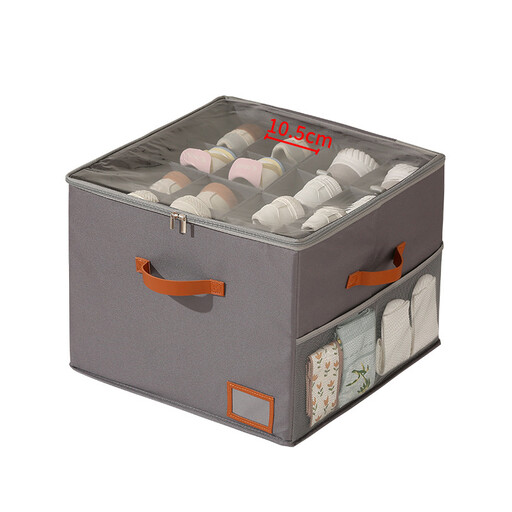
Why this product suits this shopper: Its foldable design is ideal for households looking for flexible shoe storage in a wardrobe or on a shelf.
The box folds flat when not in use, helping you avoid taking up storage space unnecessarily.
Fabric construction, foldable design and visible front panel, according to the product name.
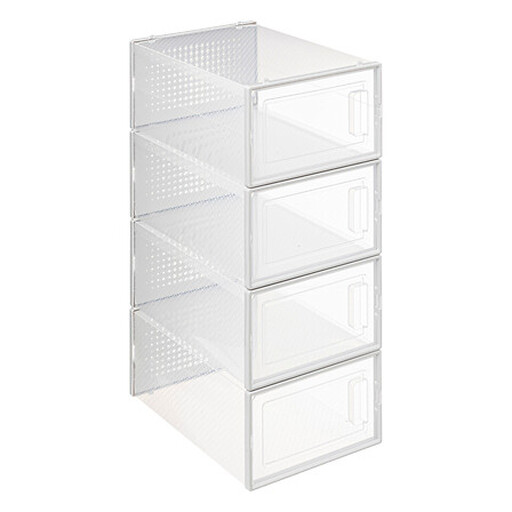
Why this product suits this shopper: This set of four is designed for a modest shoe collection in the hallway, on a shelf or in a wardrobe.
The stated dimensions of 23.2 × 33.5 × 14 cm and maximum shoe size of up to 44 make it easier to plan your storage space in advance.
PP/PS materials, transparent panels, stackable design and ventilation at the back.
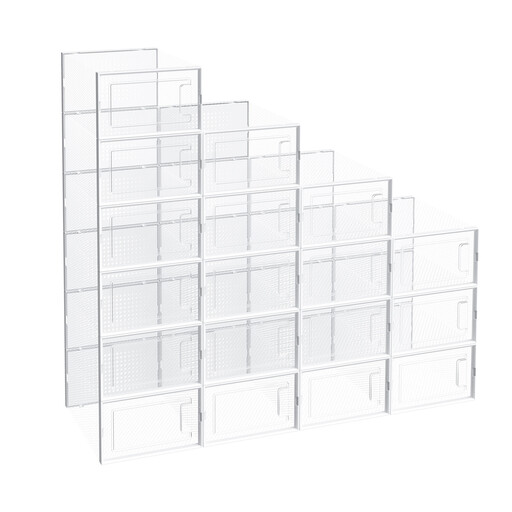
Why this product suits this shopper: This set of 18 boxes is designed for larger shoe collections or households looking to organise several pairs in one place.
The set features front doors, ventilation openings and separate boxes, so your shoes won’t end up in one disorganised pile.
18 foldable boxes, transparent fronts, stackable design and stated dimensions of 35 × 25.2 × 19 cm per box.
We’ve put together a complete, regularly updated list of products that meet these strict selection criteria and fully comply with the safety regulations in force in the EU.
It depends on the design, material, surface and the manufacturer’s guidance. There’s no reliable one-size-fits-all number. If you stack boxes high, check their stability regularly and consider using a shelving unit or additional support.
Many models are designed for trainers, but the internal length, width and height are what matter. Compare these measurements with the pair you want to store, especially if they have thick soles or come in a larger size.
Their lifespan depends on the material, load, assembly and how often they’re opened. Foldable models have the advantage of taking up less space when not in use. For longer-lasting use, don’t overload them and place them on a level surface.