
Lieferung heute & morgen

Qualitätsgarantie

Willkommens-Angebote freischalten: KOSTENLOSE Lieferung | Bis zu 80 % RABATT | Kostenlose 30-Tage-JoyPlus-Testphase
App herunterladen
Stackable shoe boxes keep hallways, wardrobes and dressing rooms tidy. However, not every transparent box is suitable for every shoe, and an inexpensive shoe box set can prove impractical if its dimensions, access or stability are not right for the intended use. This buying guide explains what households, sneaker collectors and anyone with limited storage space should check before buying.
Product specifications often state the external dimensions. However, the usable internal dimensions are what determine whether your shoes will fit. A box measuring 33.5 × 23.2 × 14.3 cm externally may offer less space inside due to the wall thickness, door frame or connecting elements. Before buying, measure the shoe at its longest point, including any protruding soles or heels.
Stackability initially describes only the design. Whether several shoe boxes can be safely stacked on top of one another depends on their shape, connecting joints, the surface they stand on and the weight of each box. An uneven floor or an overloaded box can affect stability. Wherever possible, build tall stacks against a wall and follow the manufacturer’s assembly instructions.
Transparent shoe boxes make it easier to see what is inside, but they do not replace suitable storage conditions. Ventilation holes can support air circulation, but they do not automatically prevent moisture or odours. Shoes should be dry and clean before being stored. For delicate materials, you should also follow the care and storage instructions provided by the relevant shoe manufacturer.
Before buying, check:
According to the product specifications, the JOYFURNOS models listed are designed for different types of footwear. Nevertheless, you should always compare the length of your own shoes with the internal dimensions. This is particularly important if you want to store larger trainers or styles with a high shaft.
With plastic boxes, the type of material, door mechanism and connection points are all relevant. According to the product description, both JOYFURNOS sets consist of a PP plastic body and a PS plastic frame on the front door. PP stands for polypropylene, while PS stands for polystyrene. These details describe the plastics used, but on their own they say nothing about the maximum load or unlimited service life.
Also check whether the box is supplied as a push-fit, foldable or pre-assembled model. With push-fit systems, all components should be connected fully. Forcing parts during assembly or dismantling can damage the plastic components.
Shoe boxes with front doors are practical in everyday use when several boxes are stacked on top of one another. They allow you to access a single pair without taking down the entire stack. A transparent front also makes it easier to identify what is inside. For a closed wardrobe, however, storage boxes with lids or foldable storage boxes may be more suitable, particularly if the boxes are frequently rearranged.
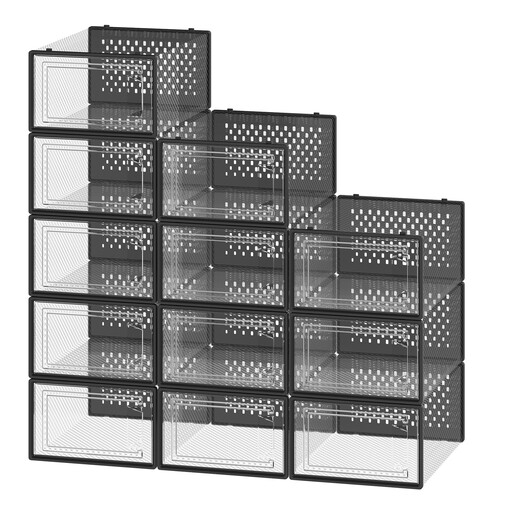
Why this product suits this profile: The set of 12 boxes is ideal for households that want to store several pairs neatly in a wardrobe or entrance hall without immediately needing storage for a larger collection.
The transparent front sections make it easier to see what is inside. With the stated individual dimensions of 33.5 × 23.2 × 14.3 cm, you can plan the available space more precisely in advance.
12 individual boxes, push-fit assembly without additional tools according to the product description, plus a PP body and PS front-door frame.
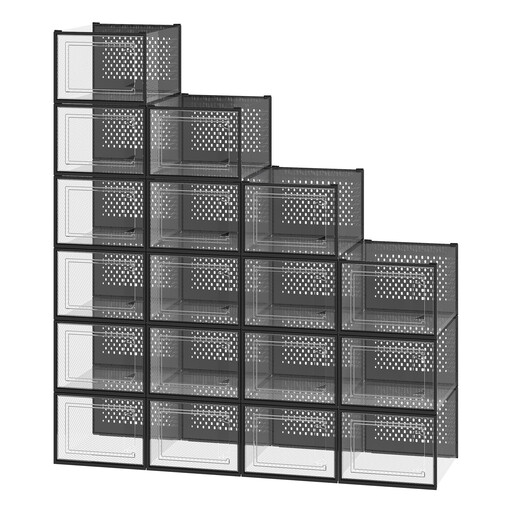
Why this product suits this profile: The larger set is designed for a more extensive shoe collection. Its consistent black and transparent look can help create an organised arrangement on an open shoe rack.
The front door gives you access to individual pairs. Before buying, compare the product dimensions of 25.2 × 35 × 19 cm per box with your shoe size and the available floor space.
18 shoe organiser boxes, transparent front doors and ventilation openings to support air circulation, according to the product description.
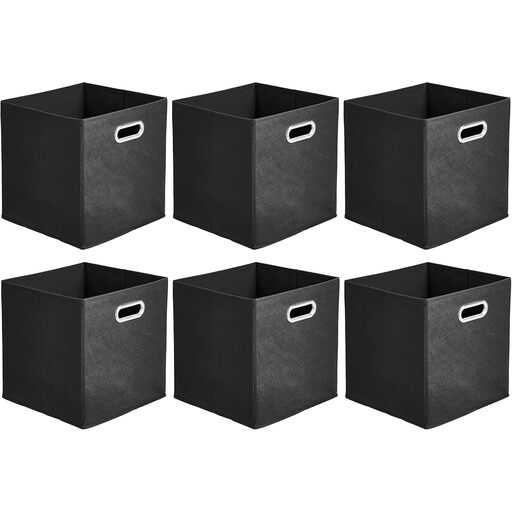
Why this product suits this profile: These black storage boxes are not primarily designed as front-opening shoe boxes. They are suitable for toys, craft supplies, provisions or small household items on shelves and in cupboards.
Clearly separating its intended use prevents false expectations: it does not have a transparent front for shoes, but the cube can be folded flat when not in use.
Six-piece set, dimensions of 26.7 × 26.7 × 27.9 cm per container and, according to the product description, a stackable design with a black finish.
First, measure the available width, depth and height inside your wardrobe. If you are building a tall stack, make sure the top box remains within reach. Assemble push-fit models according to the instructions, and do not force the connections apart. Place the boxes on a level surface and avoid overloading them.
For storing shoes in a wardrobe, it is best to keep the front doors facing the same way. This keeps pairs visible and accessible. If the boxes are also used for clothing, toys or household items, label the contents. Foldable storage boxes save space when they are not needed for a while, but depending on their design they may offer different stability from rigid plastic boxes.
We have put together a complete, regularly updated list of products that fully meet these strict selection criteria and the safety regulations applicable in the EU.
It is not possible to give a reliable general number without information about the design, load capacity and supporting surface. The manufacturer’s instructions, the stability of the stack and its overall height are all important. When stacking several levels, the arrangement should not wobble and should be protected against accidental movement.
No. Low boxes are often suitable for flat trainers or everyday shoes, while boots, high-top trainers and styles with bulky soles need more height. Always measure the specific pair and compare it with the stated internal dimensions.
Their service life depends on the material, assembly, load, temperature and frequency of use. Proper handling, a level storage area and avoiding overloading can help protect the construction. A specific lifespan cannot be determined from the product dimensions or material details alone.