
Lieferung heute & morgen

Qualitätsgarantie

Willkommens-Angebote freischalten: KOSTENLOSE Lieferung | Bis zu 80 % RABATT | Kostenlose 30-Tage-JoyPlus-Testphase
App herunterladen
Shoes in the hallway, under the bed or in the wardrobe can take up more space than you might expect. Stackable shoe storage boxes help keep things organised, provided their size, material and ease of access suit your home. But not every clear box is right for every pair of shoes or for building tall stacks.
Product specifications often give the external dimensions. Wall thickness, frames and front doors all reduce the usable space inside. So a box may not be suitable for trainers, walking boots or shoes with a high shaft, even if its external dimensions look right.
Before buying, measure the actual shoes for length, width and height. If they have thick soles or prominent laces, allow a little extra room.
A box may be stackable without being designed to support a tall stack. Look for:
In homes with children, tall pieces of furniture should be secured to the wall in line with the manufacturer’s instructions. Plastic shoe cabinets should never be used for climbing.
Clear shoe boxes make it easier to find the pair you want, but they won’t automatically prevent damp or odours. Ventilation holes can help air circulate. Make sure worn shoes are completely dry before storing them. For delicate materials, also follow the shoe manufacturer’s care instructions.
Many shoe organisers for wardrobes are designed for everyday shoes and trainers. One example in the range measures around 33,3 × 23,2 × 14,3 cm per box. This may be enough for many flat shoes, but check the dimensions against your own footwear.
Another model is listed as 35 × 25,2 × 19 cm and, according to the product description, is suitable for shoes up to UK size 11. However, you can’t reliably convert this directly to EU sizes, as the shape of the last and the shoe style affect how much space is needed.
PP plastic, or polypropylene, is lightweight, wipe-clean and commonly used for plastic shoe boxes. Front doors may be made from other plastics, such as PS or ABS. Check that the connectors lock securely and whether the surfaces can be cleaned with a slightly damp cloth.
For a multi-section plastic shoe cabinet, it’s also worth checking the load capacity per level. Distribute the weight evenly and don’t exceed the manufacturer’s limit.
Shoe boxes with front openings are handy in the hallway, as you won’t need to remove the boxes above them. For under-bed storage, overall height and the space available to grip the box matter most. A closed shoe rack with space for lots of pairs is a better fit for households that prefer a coordinated furniture look.
Before assembling, check:
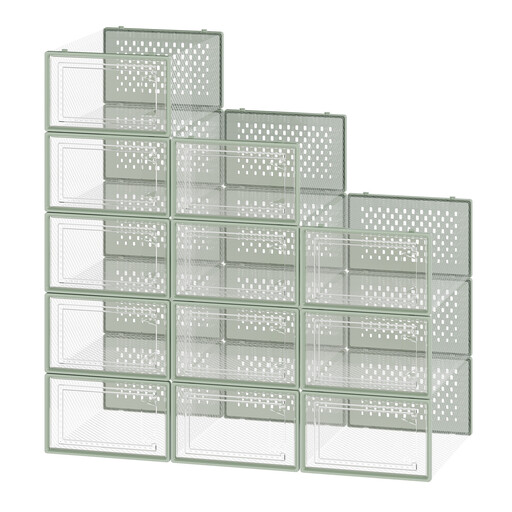
Why it suits this need: This set of 12 is a manageable starting point for a wardrobe, bedroom or small shoe collection. Each box measures 33,3 × 23,2 × 14,3 cm.
The product details list the dimensions and material, and advise checking your shoe size before buying. Snap-fit connectors and ventilation holes address common issues with assembly and air circulation.
Clear fronts, front access, a PP body and tool-free assembly. The set can be split into separate stacks.
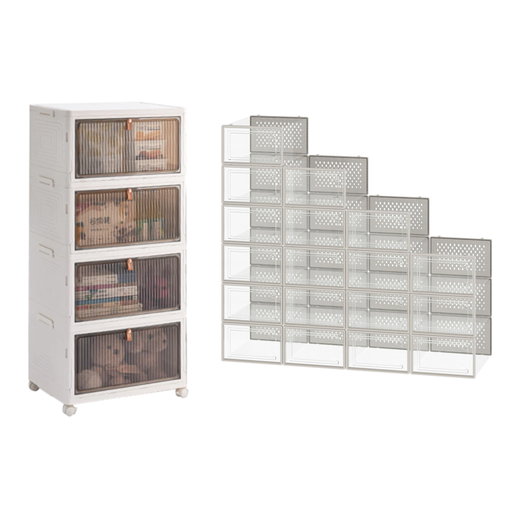
Why it suits this need: This bundle pairs a foldable storage cabinet with 18 stackable boxes. It’s a good choice if you want to organise shoes and other household items in one modular system.
According to the product description, the shoe boxes are stackable and can be assembled without screws or nails. Before buying, check that the stated shoe dimensions will fit your footwear.
18 boxes, a four-tier cabinet and a top compartment for smaller items. The clear design makes it easier to identify each pair.
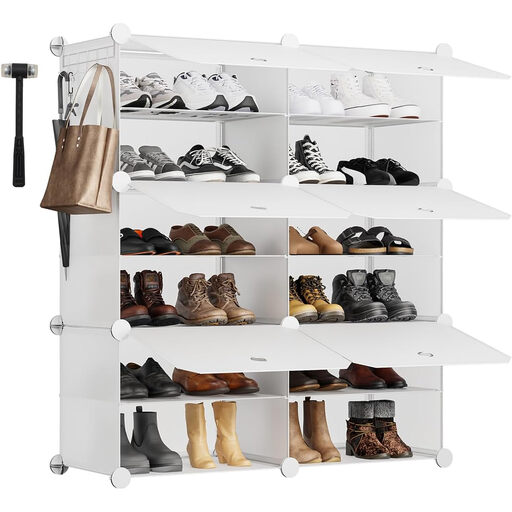
Why it suits this need: According to the supplier, this cabinet holds up to 24 pairs of shoes, making it a good fit for families, hallways or separate dressing rooms.
The product description lists a load capacity of 5 kg per level, ventilation and several anti-tip features. The cabinet must stand on a level surface and, as instructed, be secured to the wall.
PP panels, a stated moisture-resistant material, six compartments and assembly with an illustrated guide and the included assembly hammer.
We’ve put together a complete, regularly updated list of products that meet these strict selection criteria and fully comply with the safety regulations in force in the EU.
Where possible, put heavier shoes on the lower levels and lighter trainers higher up. If your shoe boxes have front openings, make sure the structure is locked together before loading them fully. Once assembled, check that the doors open freely and the stacks are straight.
You can usually remove dust with a soft, slightly damp cloth. Make sure shoes are clean and dry before putting them in the boxes. If the boxes are left in place for a long time, check the connections and stability from time to time.
It depends on more than the EU shoe size. Measure your longest shoe and compare its length, width and height with the internal dimensions of the box. Allow extra room for high-top trainers or shoes with thick soles.
There’s no one-size-fits-all answer. Check the manufacturer’s guidance on connectors and load limits, and make sure the floor is level and the stack is stable. Tall units should also be secured to prevent them tipping over.
Yes, as long as the boxes are protected from direct moisture and the front doors are easy to open. For hallway shoe storage, sturdy, wipe-clean materials and a stable construction are especially important.